

78
3.3 Mangrove Species and Distribution Patterns
3.3.1 Mangrove Plant Species
From time to time I meet someone who thinks that “mangrove” refers to a certain
plant species that “looks like an octopus.” In actuality, there are about a hundred
species of mangroves worldwide, although because there is not general agreement
on what is and what is not a mangrove, reports of the number of mangrove species
do not agree. For example, in their Atlas, Spalding et al. (2010) listed a total of 74
mangrove species and hybrids, whereas according to Tomlinson (1986) there are 54
species, according to Saenger (2002) there are 84 species, and Duke et al. (1998)
mention 70 species. Because mangrove ecosystems lie in the ecotone between sea
and land ecosystems, many mangroves have a broad habitat range, which makes it
difficult to distinguish between mangrove and upland species. Furthermore, there
are taxonomic uncertainties about some mangrove taxa. For example, in the genus
Rhizophora, R. mucronata in East Africa is morphologically similar to R. stylosa in
the Asia-Pacific region. The application of recently developed molecular genetic
techniques to mangroves will lead to advances in mangrove taxonomy.
120,000
140,000
160,000
180,000
200,000
1975 1980 1985 1990 1995 2000 2005 2010
Area (km 2
)
Year
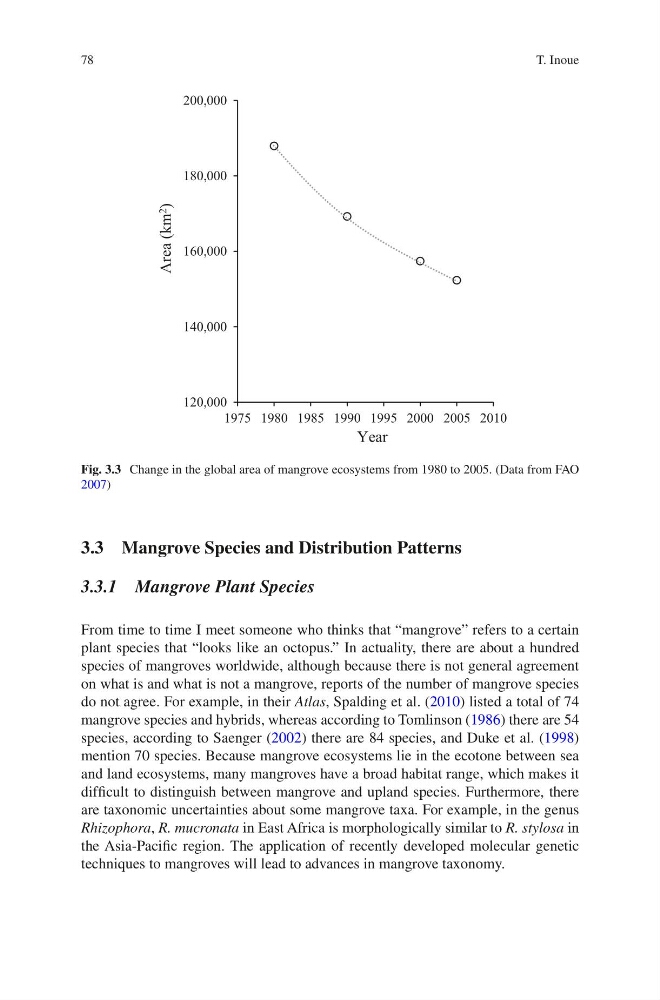
Fig. 3.3 Change in the global area of mangrove ecosystems from 1980 to 2005. (Data from FAO
2007)
T. Inoue
3.3 Mangrove Species and Distribution Patterns
3.3.1 Mangrove Plant Species
From time to time I meet someone who thinks that “mangrove” refers to a certain
plant species that “looks like an octopus.” In actuality, there are about a hundred
species of mangroves worldwide, although because there is not general agreement
on what is and what is not a mangrove, reports of the number of mangrove species
do not agree. For example, in their Atlas, Spalding et al. (2010) listed a total of 74
mangrove species and hybrids, whereas according to Tomlinson (1986) there are 54
species, according to Saenger (2002) there are 84 species, and Duke et al. (1998)
mention 70 species. Because mangrove ecosystems lie in the ecotone between sea
and land ecosystems, many mangroves have a broad habitat range, which makes it
difficult to distinguish between mangrove and upland species. Furthermore, there
are taxonomic uncertainties about some mangrove taxa. For example, in the genus
Rhizophora, R. mucronata in East Africa is morphologically similar to R. stylosa in
the Asia-Pacific region. The application of recently developed molecular genetic
techniques to mangroves will lead to advances in mangrove taxonomy.
120,000
140,000
160,000
180,000
200,000
1975 1980 1985 1990 1995 2000 2005 2010
Area (km 2
)
Year
Fig. 3.3 Change in the global area of mangrove ecosystems from 1980 to 2005. (Data from FAO
2007)
T. Inoue