

77
deltaic coasts, where they may extend inland for several tens of kilometers and
include large, massive forest trees over 20 m tall. The Sundarbans of India and
Bangladesh, the best-known mangrove forests, have a total area of 6500 km
2
and
extend up to 85 km inland (Akhand et al. 2018). Large mangrove tracts are also
found in northern Brazil (6500 km
2
) and the Gulf of Papua (5400 km
2
). The mangrove distribution is comparatively sparse in East Africa, the Middle East, South
Asia, and Australia. Accurate global distribution maps are essential for assessing
carbon sequestration and other ecosystem functions at global scale.
Although there are no accurate data on the past distribution of mangroves, in
almost all countries where they are found, there has been a considerable decline in
the area occupied, especially during the past 40 years, as a result of human activities. According to the Food and Agriculture Organization of the United Nations
(FAO 2007), in the 25 years from 1980 to 2005, the area declined at an average rate
of 0.7% per year, from 187,940 km
2
in 1980 to 169,250 km
2
in 1990, 157,400 km
2
in 2000, and 152,310 km
2
in 2005 (Fig. 3.3). By combining data from three datasets—the global forest cover dataset (Hansen et al. 2013), the global mangrove forest
dataset (Giri et al. 2011), and the global terrestrial ecoregions dataset (Olson et al.
2001)—Hamilton and Casey (2016) estimated that the global mangrove forest area
decreased by 4.73% from 2000 to 2012 by deforestation, an annual rate of loss of
0.39%. In Southeast Asia, where most mangrove forests are found, the area declined
by 8.08% on average from 2000 to 2012. When mangrove ecosystems disappear, all
of the living things that depend on them disappear as well. What would be the consequences of a world without mangroves? Now is the time to seriously think about
the future of this unique and rare ecosystem.
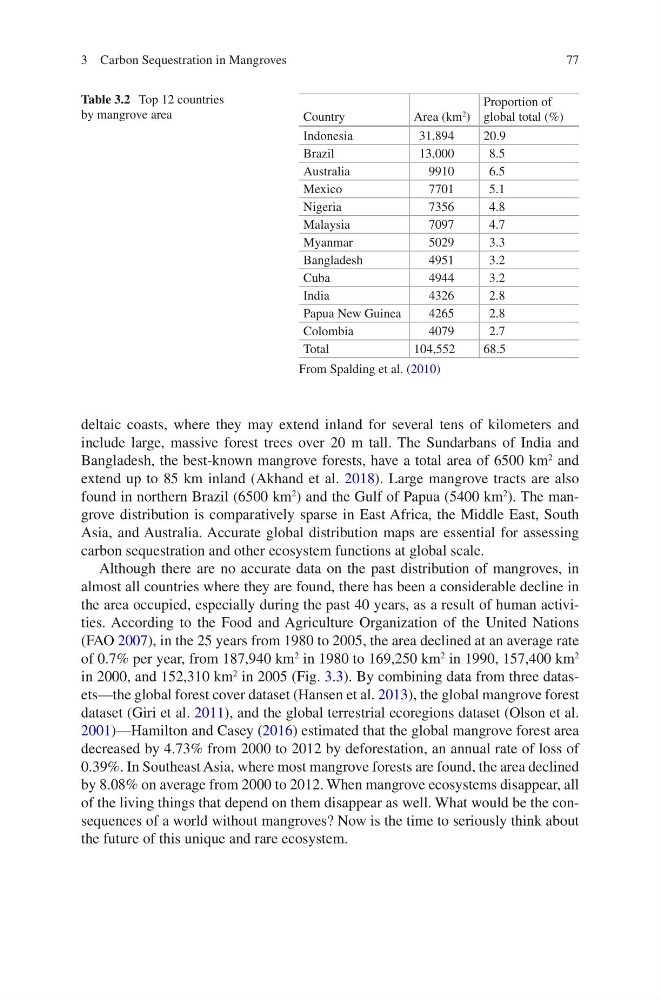
Table 3.2 Top 12 countries
by mangrove area
Country
Area (km
2
)
Proportion of
global total (%)
Indonesia
31,894
20.9
Brazil
13,000
8.5
Australia
9910
6.5
Mexico
7701
5.1
Nigeria
7356
4.8
Malaysia
7097
4.7
Myanmar
5029
3.3
Bangladesh
4951
3.2
Cuba
4944
3.2
India
4326
2.8
Papua New Guinea
4265
2.8
Colombia
4079
2.7
Total
104,552
68.5
From Spalding et al. (2010)
3 Carbon Sequestration in Mangroves
deltaic coasts, where they may extend inland for several tens of kilometers and
include large, massive forest trees over 20 m tall. The Sundarbans of India and
Bangladesh, the best-known mangrove forests, have a total area of 6500 km
2
and
extend up to 85 km inland (Akhand et al. 2018). Large mangrove tracts are also
found in northern Brazil (6500 km
2
) and the Gulf of Papua (5400 km
2
). The mangrove distribution is comparatively sparse in East Africa, the Middle East, South
Asia, and Australia. Accurate global distribution maps are essential for assessing
carbon sequestration and other ecosystem functions at global scale.
Although there are no accurate data on the past distribution of mangroves, in
almost all countries where they are found, there has been a considerable decline in
the area occupied, especially during the past 40 years, as a result of human activities. According to the Food and Agriculture Organization of the United Nations
(FAO 2007), in the 25 years from 1980 to 2005, the area declined at an average rate
of 0.7% per year, from 187,940 km
2
in 1980 to 169,250 km
2
in 1990, 157,400 km
2
in 2000, and 152,310 km
2
in 2005 (Fig. 3.3). By combining data from three datasets—the global forest cover dataset (Hansen et al. 2013), the global mangrove forest
dataset (Giri et al. 2011), and the global terrestrial ecoregions dataset (Olson et al.
2001)—Hamilton and Casey (2016) estimated that the global mangrove forest area
decreased by 4.73% from 2000 to 2012 by deforestation, an annual rate of loss of
0.39%. In Southeast Asia, where most mangrove forests are found, the area declined
by 8.08% on average from 2000 to 2012. When mangrove ecosystems disappear, all
of the living things that depend on them disappear as well. What would be the consequences of a world without mangroves? Now is the time to seriously think about
the future of this unique and rare ecosystem.
Table 3.2 Top 12 countries
by mangrove area
Country
Area (km
2
)
Proportion of
global total (%)
Indonesia
31,894
20.9
Brazil
13,000
8.5
Australia
9910
6.5
Mexico
7701
5.1
Nigeria
7356
4.8
Malaysia
7097
4.7
Myanmar
5029
3.3
Bangladesh
4951
3.2
Cuba
4944
3.2
India
4326
2.8
Papua New Guinea
4265
2.8
Colombia
4079
2.7
Total
104,552
68.5
From Spalding et al. (2010)
3 Carbon Sequestration in Mangroves