

363
13.2 Integrate climate change measures into national policies, strategies, and
planning;
13.3 Improve education, awareness raising, and human and institutional capacity on
climate change mitigation, adaptation, impact reduction, and early warning.
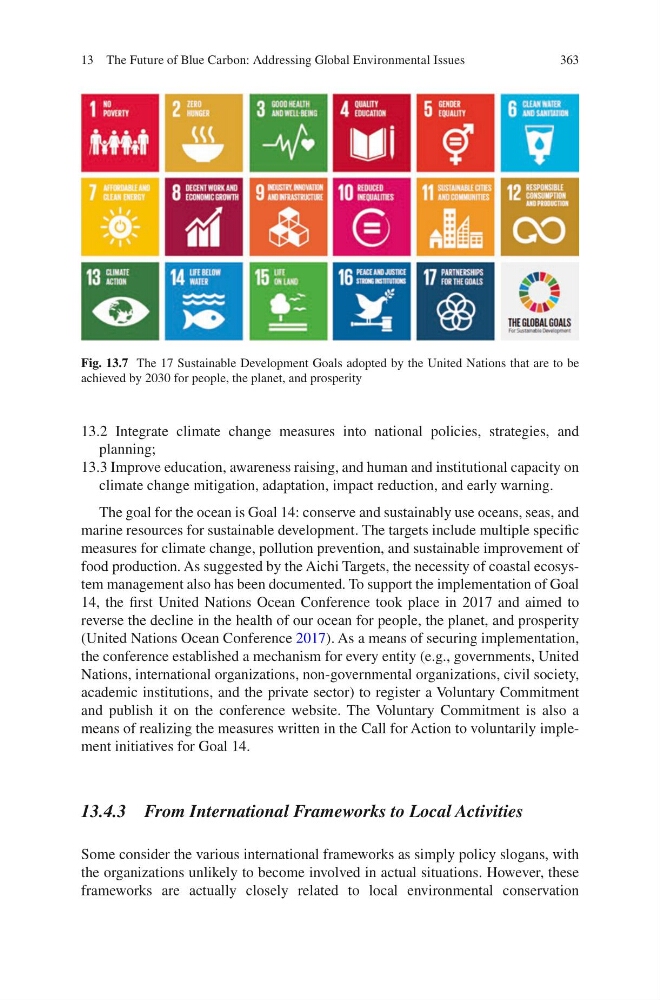
The goal for the ocean is Goal 14: conserve and sustainably use oceans, seas, and
marine resources for sustainable development. The targets include multiple specific
measures for climate change, pollution prevention, and sustainable improvement of
food production. As suggested by the Aichi Targets, the necessity of coastal ecosystem management also has been documented. To support the implementation of Goal
14, the first United Nations Ocean Conference took place in 2017 and aimed to
reverse the decline in the health of our ocean for people, the planet, and prosperity
(United Nations Ocean Conference 2017). As a means of securing implementation,
the conference established a mechanism for every entity (e.g., governments, United
Nations, international organizations, non-governmental organizations, civil society,
academic institutions, and the private sector) to register a Voluntary Commitment
and publish it on the conference website. The Voluntary Commitment is also a
means of realizing the measures written in the Call for Action to voluntarily implement initiatives for Goal 14.
13.4.3 From International Frameworks to Local Activities
Some consider the various international frameworks as simply policy slogans, with
the organizations unlikely to become involved in actual situations. However, these
frameworks are actually closely related to local environmental conservation
Fig. 13.7 The 17 Sustainable Development Goals adopted by the United Nations that are to be
achieved by 2030 for people, the planet, and prosperity
13 The Future of Blue Carbon: Addressing Global Environmental Issues
13.2 Integrate climate change measures into national policies, strategies, and
planning;
13.3 Improve education, awareness raising, and human and institutional capacity on
climate change mitigation, adaptation, impact reduction, and early warning.
The goal for the ocean is Goal 14: conserve and sustainably use oceans, seas, and
marine resources for sustainable development. The targets include multiple specific
measures for climate change, pollution prevention, and sustainable improvement of
food production. As suggested by the Aichi Targets, the necessity of coastal ecosystem management also has been documented. To support the implementation of Goal
14, the first United Nations Ocean Conference took place in 2017 and aimed to
reverse the decline in the health of our ocean for people, the planet, and prosperity
(United Nations Ocean Conference 2017). As a means of securing implementation,
the conference established a mechanism for every entity (e.g., governments, United
Nations, international organizations, non-governmental organizations, civil society,
academic institutions, and the private sector) to register a Voluntary Commitment
and publish it on the conference website. The Voluntary Commitment is also a
means of realizing the measures written in the Call for Action to voluntarily implement initiatives for Goal 14.
13.4.3 From International Frameworks to Local Activities
Some consider the various international frameworks as simply policy slogans, with
the organizations unlikely to become involved in actual situations. However, these
frameworks are actually closely related to local environmental conservation
Fig. 13.7 The 17 Sustainable Development Goals adopted by the United Nations that are to be
achieved by 2030 for people, the planet, and prosperity
13 The Future of Blue Carbon: Addressing Global Environmental Issues