

342
where
B: seagrass biomass (kg wet/m
2
)
WC: water content of seagrass body (%)
CC: carbon content of seagrass body (kg C/kg dry)
SR: carbon storage rate/biomass ratio (/year)
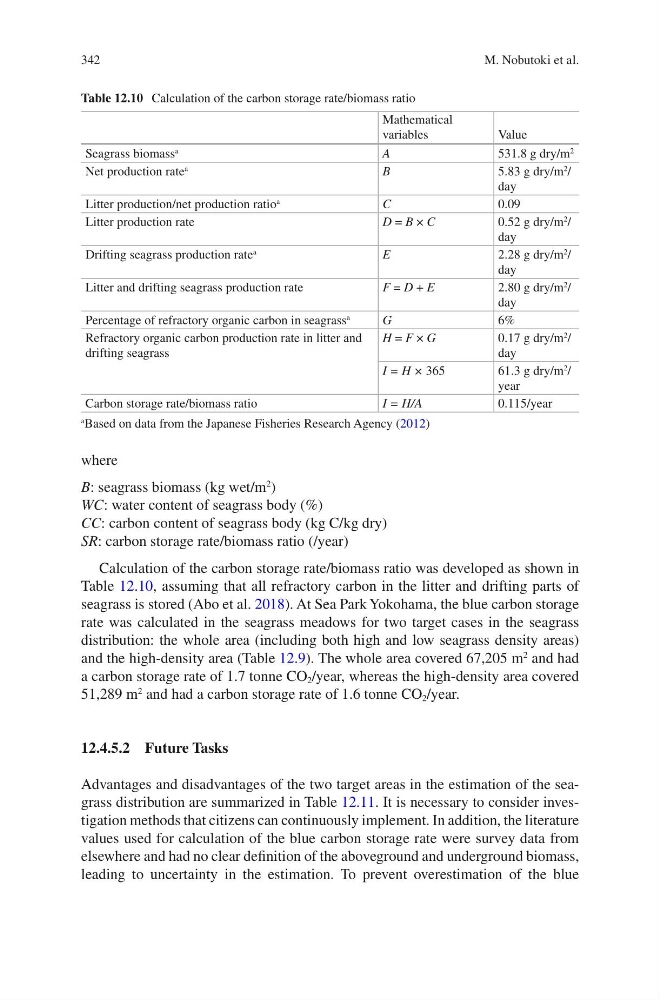
Calculation of the carbon storage rate/biomass ratio was developed as shown in
Table 12.10, assuming that all refractory carbon in the litter and drifting parts of
seagrass is stored (Abo et al. 2018). At Sea Park Yokohama, the blue carbon storage
rate was calculated in the seagrass meadows for two target cases in the seagrass
distribution: the whole area (including both high and low seagrass density areas)
and the high-density area (Table 12.9). The whole area covered 67,205 m
2
and had
a carbon storage rate of 1.7 tonne CO 2 /year, whereas the high-density area covered
51,289 m
2
and had a carbon storage rate of 1.6 tonne CO 2 /year.
12.4.5.2 Future Tasks
Advantages and disadvantages of the two target areas in the estimation of the seagrass distribution are summarized in Table 12.11. It is necessary to consider investigation methods that citizens can continuously implement. In addition, the literature
values used for calculation of the blue carbon storage rate were survey data from
elsewhere and had no clear definition of the aboveground and underground biomass,
leading to uncertainty in the estimation. To prevent overestimation of the blue
Table 12.10 Calculation of the carbon storage rate/biomass ratio
Mathematical
variables
Value
Seagrass biomass
a
A
531.8 g dry/m
2
Net production rate
a
B
5.83 g dry/m
2
/
day
Litter production/net production ratio
a
C
0.09
Litter production rate
D = B × C
0.52 g dry/m
2
/
day
Drifting seagrass production rate
a
E
2.28 g dry/m
2
/
day
Litter and drifting seagrass production rate
F = D + E
2.80 g dry/m
2
/
day
Percentage of refractory organic carbon in seagrass
a
G
6%
Refractory organic carbon production rate in litter and
drifting seagrass
H = F × G
0.17 g dry/m
2
/
day
I = H × 365
61.3 g dry/m
2
/
year
Carbon storage rate/biomass ratio
I = H/A
0.115/year
a
Based on data from the Japanese Fisheries Research Agency (2012)
M. Nobutoki et al.
where
B: seagrass biomass (kg wet/m
2
)
WC: water content of seagrass body (%)
CC: carbon content of seagrass body (kg C/kg dry)
SR: carbon storage rate/biomass ratio (/year)
Calculation of the carbon storage rate/biomass ratio was developed as shown in
Table 12.10, assuming that all refractory carbon in the litter and drifting parts of
seagrass is stored (Abo et al. 2018). At Sea Park Yokohama, the blue carbon storage
rate was calculated in the seagrass meadows for two target cases in the seagrass
distribution: the whole area (including both high and low seagrass density areas)
and the high-density area (Table 12.9). The whole area covered 67,205 m
2
and had
a carbon storage rate of 1.7 tonne CO 2 /year, whereas the high-density area covered
51,289 m
2
and had a carbon storage rate of 1.6 tonne CO 2 /year.
12.4.5.2 Future Tasks
Advantages and disadvantages of the two target areas in the estimation of the seagrass distribution are summarized in Table 12.11. It is necessary to consider investigation methods that citizens can continuously implement. In addition, the literature
values used for calculation of the blue carbon storage rate were survey data from
elsewhere and had no clear definition of the aboveground and underground biomass,
leading to uncertainty in the estimation. To prevent overestimation of the blue
Table 12.10 Calculation of the carbon storage rate/biomass ratio
Mathematical
variables
Value
Seagrass biomass
a
A
531.8 g dry/m
2
Net production rate
a
B
5.83 g dry/m
2
/
day
Litter production/net production ratio
a
C
0.09
Litter production rate
D = B × C
0.52 g dry/m
2
/
day
Drifting seagrass production rate
a
E
2.28 g dry/m
2
/
day
Litter and drifting seagrass production rate
F = D + E
2.80 g dry/m
2
/
day
Percentage of refractory organic carbon in seagrass
a
G
6%
Refractory organic carbon production rate in litter and
drifting seagrass
H = F × G
0.17 g dry/m
2
/
day
I = H × 365
61.3 g dry/m
2
/
year
Carbon storage rate/biomass ratio
I = H/A
0.115/year
a
Based on data from the Japanese Fisheries Research Agency (2012)
M. Nobutoki et al.