

341
12.4.5.1 Calculation Method for Blue Carbon Storage Rate
Part of the organic carbon originates from seagrass deposits on the seabed, but it is
difficult to monitor the amount of the deposits within and outside the meadows.
Therefore, based on biomass (wet mass basis) measured in the project area and
values reported in the literature (Kawabata et al., 1993; Terawaki et al., 2002), the
following formula for calculating the blue carbon storage rate was developed (see
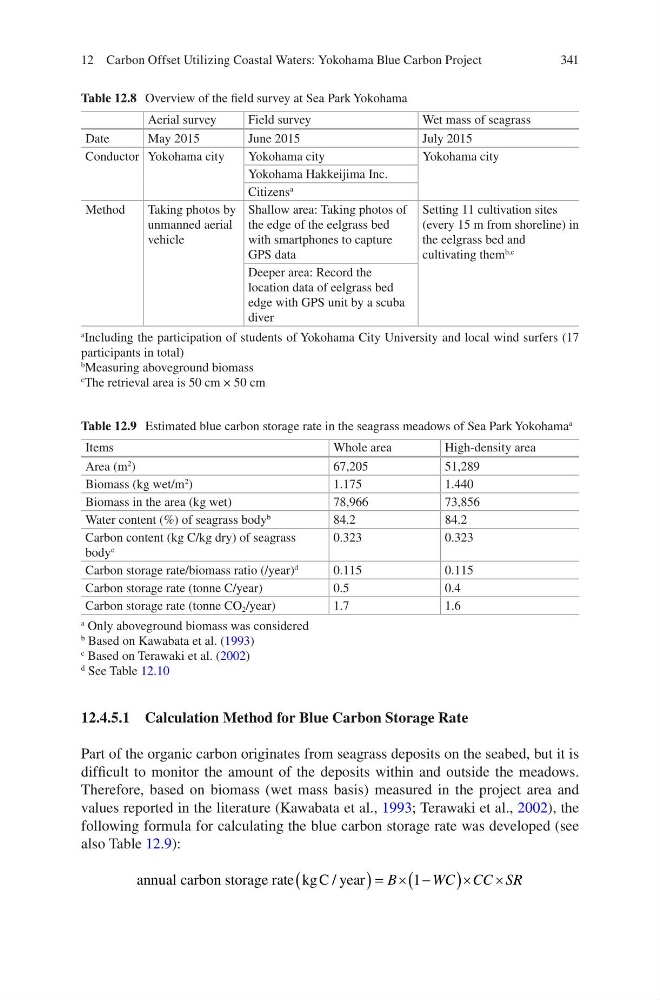
also Table 12.9):
annual carbon storage rate kg C year
/
(
)= ´ -
(
)´ ´
B
WC CC SR
1
Table 12.8 Overview of the field survey at Sea Park Yokohama
Aerial survey
Field survey
Wet mass of seagrass
Date
May 2015
June 2015
July 2015
Conductor Yokohama city
Yokohama city
Yokohama city
Yokohama Hakkeijima Inc.
Citizens
a
Method
Taking photos by
unmanned aerial
vehicle
Shallow area: Taking photos of
the edge of the eelgrass bed
with smartphones to capture
GPS data
Setting 11 cultivation sites
(every 15 m from shoreline) in
the eelgrass bed and
cultivating them
b,c
Deeper area: Record the
location data of eelgrass bed
edge with GPS unit by a scuba
diver
a
Including the participation of students of Yokohama City University and local wind surfers (17
participants in total)
b
Measuring aboveground biomass
c
The retrieval area is 50 cm × 50 cm
Table 12.9 Estimated blue carbon storage rate in the seagrass meadows of Sea Park Yokohama
a
Items
Whole area
High-density area
Area (m
2 )
67,205
51,289
Biomass (kg wet/m
2 )
1.175
1.440
Biomass in the area (kg wet)
78,966
73,856
Water content (%) of seagrass body
b
84.2
84.2
Carbon content (kg C/kg dry) of seagrass
body
c
0.323
0.323
Carbon storage rate/biomass ratio (/year)
d
0.115
0.115
Carbon storage rate (tonne C/year)
0.5
0.4
Carbon storage rate (tonne CO 2 /year)
1.7
1.6
a Only aboveground biomass was considered
b Based on Kawabata et al. (1993)
c Based on Terawaki et al. (2002)
d See Table 12.10
12 Carbon Offset Utilizing Coastal Waters: Yokohama Blue Carbon Project
12.4.5.1 Calculation Method for Blue Carbon Storage Rate
Part of the organic carbon originates from seagrass deposits on the seabed, but it is
difficult to monitor the amount of the deposits within and outside the meadows.
Therefore, based on biomass (wet mass basis) measured in the project area and
values reported in the literature (Kawabata et al., 1993; Terawaki et al., 2002), the
following formula for calculating the blue carbon storage rate was developed (see
also Table 12.9):
annual carbon storage rate kg C year
/
(
)= ´ -
(
)´ ´
B
WC CC SR
1
Table 12.8 Overview of the field survey at Sea Park Yokohama
Aerial survey
Field survey
Wet mass of seagrass
Date
May 2015
June 2015
July 2015
Conductor Yokohama city
Yokohama city
Yokohama city
Yokohama Hakkeijima Inc.
Citizens
a
Method
Taking photos by
unmanned aerial
vehicle
Shallow area: Taking photos of
the edge of the eelgrass bed
with smartphones to capture
GPS data
Setting 11 cultivation sites
(every 15 m from shoreline) in
the eelgrass bed and
cultivating them
b,c
Deeper area: Record the
location data of eelgrass bed
edge with GPS unit by a scuba
diver
a
Including the participation of students of Yokohama City University and local wind surfers (17
participants in total)
b
Measuring aboveground biomass
c
The retrieval area is 50 cm × 50 cm
Table 12.9 Estimated blue carbon storage rate in the seagrass meadows of Sea Park Yokohama
a
Items
Whole area
High-density area
Area (m
2 )
67,205
51,289
Biomass (kg wet/m
2 )
1.175
1.440
Biomass in the area (kg wet)
78,966
73,856
Water content (%) of seagrass body
b
84.2
84.2
Carbon content (kg C/kg dry) of seagrass
body
c
0.323
0.323
Carbon storage rate/biomass ratio (/year)
d
0.115
0.115
Carbon storage rate (tonne C/year)
0.5
0.4
Carbon storage rate (tonne CO 2 /year)
1.7
1.6
a Only aboveground biomass was considered
b Based on Kawabata et al. (1993)
c Based on Terawaki et al. (2002)
d See Table 12.10
12 Carbon Offset Utilizing Coastal Waters: Yokohama Blue Carbon Project