

330
imported from China and South Korea, with the rest produced domestically outside
of Yokohama City. Thus, implementation of local seaweed production in Yokohama
City will shorten the food transportation distance and reduce CO 2 emissions associated with fuel consumption of ships and autos.
Second, we expected a reduction of CO 2 emissions in aquaculture and manufacturing processes. Seaweed cultivation is being carried out by the Yokohama City
Fishery Cooperative Association and Yokohama Hakkeijima. Because it is assumed
that production involves a lot of manual work on a small scale compared to the
cultivation method elsewhere, the amount of CO 2 emissions associated with it will
be reduced.
Calculation Periods and Scope In the conventional calculation method, the
amount of CO 2 reduction is calculated based on the difference in emission before
and after the project implementation. We defined the before and after periods as that
without local seaweed production (all seaweed is imported as usual) and that with
local seaweed production (less seaweed is imported and some is obtained from local
production), respectively.
The amount of CO 2 reduction accompanying local production of seaweed was
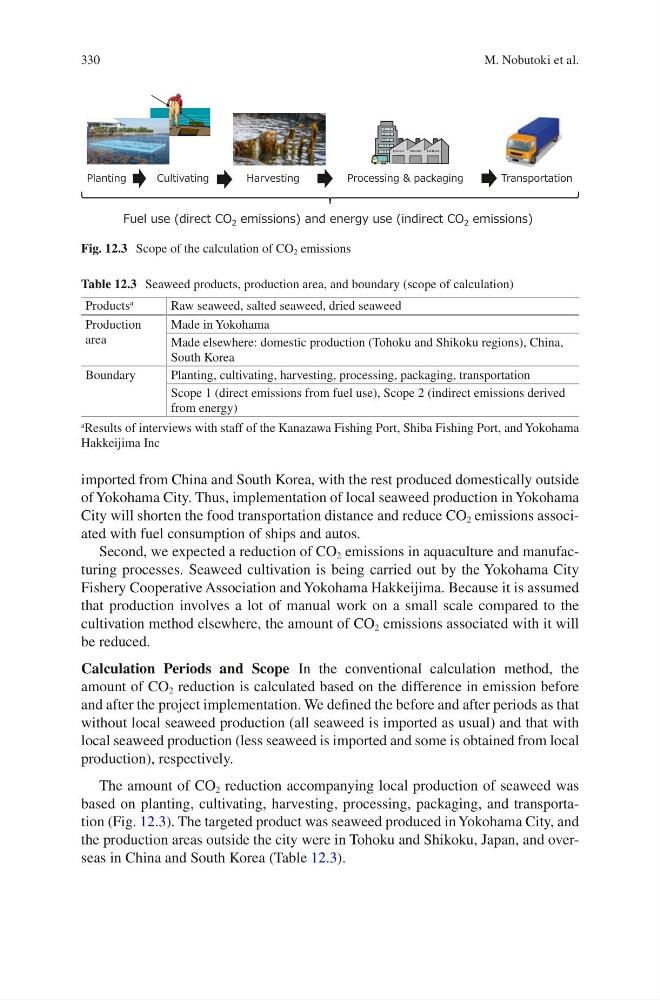
based on planting, cultivating, harvesting, processing, packaging, and transportation (Fig. 12.3). The targeted product was seaweed produced in Yokohama City, and
the production areas outside the city were in Tohoku and Shikoku, Japan, and overseas in China and South Korea (Table 12.3).
Fig. 12.3 Scope of the calculation of CO 2 emissions
Table 12.3 Seaweed products, production area, and boundary (scope of calculation)
Products
a
Raw seaweed, salted seaweed, dried seaweed
Production
area
Made in Yokohama
Made elsewhere: domestic production (Tohoku and Shikoku regions), China,
South Korea
Boundary
Planting, cultivating, harvesting, processing, packaging, transportation
Scope 1 (direct emissions from fuel use), Scope 2 (indirect emissions derived
from energy)
a
Results of interviews with staff of the Kanazawa Fishing Port, Shiba Fishing Port, and Yokohama
Hakkeijima Inc
M. Nobutoki et al.
imported from China and South Korea, with the rest produced domestically outside
of Yokohama City. Thus, implementation of local seaweed production in Yokohama
City will shorten the food transportation distance and reduce CO 2 emissions associated with fuel consumption of ships and autos.
Second, we expected a reduction of CO 2 emissions in aquaculture and manufacturing processes. Seaweed cultivation is being carried out by the Yokohama City
Fishery Cooperative Association and Yokohama Hakkeijima. Because it is assumed
that production involves a lot of manual work on a small scale compared to the
cultivation method elsewhere, the amount of CO 2 emissions associated with it will
be reduced.
Calculation Periods and Scope In the conventional calculation method, the
amount of CO 2 reduction is calculated based on the difference in emission before
and after the project implementation. We defined the before and after periods as that
without local seaweed production (all seaweed is imported as usual) and that with
local seaweed production (less seaweed is imported and some is obtained from local
production), respectively.
The amount of CO 2 reduction accompanying local production of seaweed was
based on planting, cultivating, harvesting, processing, packaging, and transportation (Fig. 12.3). The targeted product was seaweed produced in Yokohama City, and
the production areas outside the city were in Tohoku and Shikoku, Japan, and overseas in China and South Korea (Table 12.3).
Fig. 12.3 Scope of the calculation of CO 2 emissions
Table 12.3 Seaweed products, production area, and boundary (scope of calculation)
Products
a
Raw seaweed, salted seaweed, dried seaweed
Production
area
Made in Yokohama
Made elsewhere: domestic production (Tohoku and Shikoku regions), China,
South Korea
Boundary
Planting, cultivating, harvesting, processing, packaging, transportation
Scope 1 (direct emissions from fuel use), Scope 2 (indirect emissions derived
from energy)
a
Results of interviews with staff of the Kanazawa Fishing Port, Shiba Fishing Port, and Yokohama
Hakkeijima Inc
M. Nobutoki et al.