

287
incorporating these feedback interactions so that, for example, the modeled coral
could respond to ocean acidification (OA). They also incorporated the effects of
seawater flow over the reef on mass transfer in the model. Higher bottom velocity
and hence higher bottom shear stress induces higher mass transfer velocity, which
in turn enhances diffusive material exchange between corals and ambient seawater.
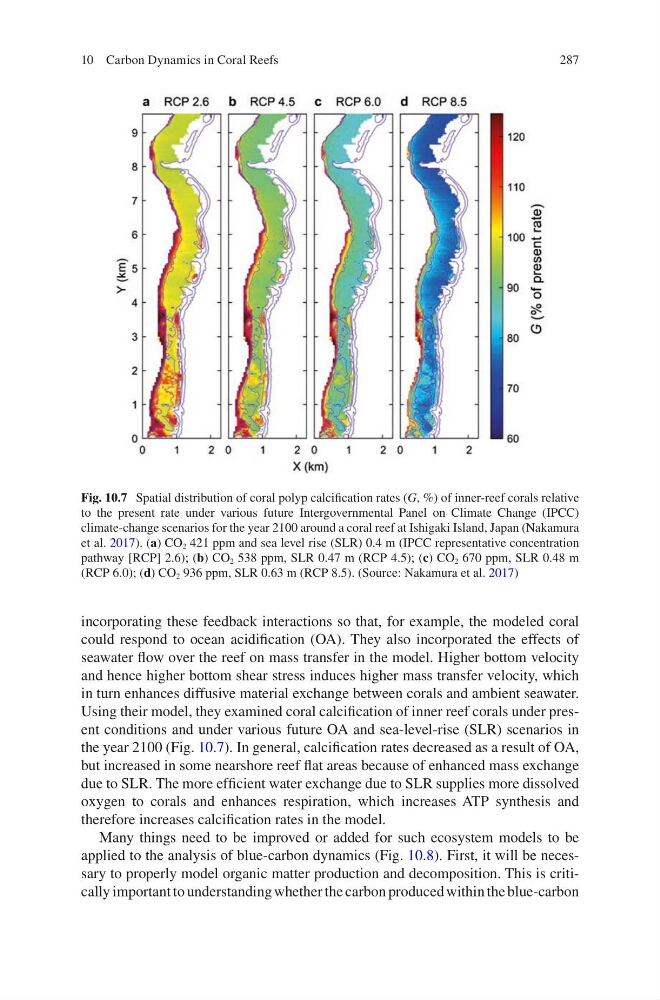
Using their model, they examined coral calcification of inner reef corals under present conditions and under various future OA and sea-level-rise (SLR) scenarios in
the year 2100 (Fig. 10.7). In general, calcification rates decreased as a result of OA,
but increased in some nearshore reef flat areas because of enhanced mass exchange
due to SLR. The more efficient water exchange due to SLR supplies more dissolved
oxygen to corals and enhances respiration, which increases ATP synthesis and
therefore increases calcification rates in the model.
Many things need to be improved or added for such ecosystem models to be
applied to the analysis of blue-carbon dynamics (Fig. 10.8). First, it will be necessary to properly model organic matter production and decomposition. This is critically important to understanding whether the carbon produced within the blue-carbon
Fig. 10.7 Spatial distribution of coral polyp calcification rates (G, %) of inner-reef corals relative
to the present rate under various future Intergovernmental Panel on Climate Change (IPCC)
climate- change scenarios for the year 2100 around a coral reef at Ishigaki Island, Japan (Nakamura
et al. 2017). (a) CO 2 421 ppm and sea level rise (SLR) 0.4 m (IPCC representative concentration
pathway [RCP] 2.6); (b) CO 2 538 ppm, SLR 0.47 m (RCP 4.5); (c) CO 2 670 ppm, SLR 0.48 m
(RCP 6.0); (d) CO 2 936 ppm, SLR 0.63 m (RCP 8.5). (Source: Nakamura et al. 2017)
10 Carbon Dynamics in Coral Reefs
incorporating these feedback interactions so that, for example, the modeled coral
could respond to ocean acidification (OA). They also incorporated the effects of
seawater flow over the reef on mass transfer in the model. Higher bottom velocity
and hence higher bottom shear stress induces higher mass transfer velocity, which
in turn enhances diffusive material exchange between corals and ambient seawater.
Using their model, they examined coral calcification of inner reef corals under present conditions and under various future OA and sea-level-rise (SLR) scenarios in
the year 2100 (Fig. 10.7). In general, calcification rates decreased as a result of OA,
but increased in some nearshore reef flat areas because of enhanced mass exchange
due to SLR. The more efficient water exchange due to SLR supplies more dissolved
oxygen to corals and enhances respiration, which increases ATP synthesis and
therefore increases calcification rates in the model.
Many things need to be improved or added for such ecosystem models to be
applied to the analysis of blue-carbon dynamics (Fig. 10.8). First, it will be necessary to properly model organic matter production and decomposition. This is critically important to understanding whether the carbon produced within the blue-carbon
Fig. 10.7 Spatial distribution of coral polyp calcification rates (G, %) of inner-reef corals relative
to the present rate under various future Intergovernmental Panel on Climate Change (IPCC)
climate- change scenarios for the year 2100 around a coral reef at Ishigaki Island, Japan (Nakamura
et al. 2017). (a) CO 2 421 ppm and sea level rise (SLR) 0.4 m (IPCC representative concentration
pathway [RCP] 2.6); (b) CO 2 538 ppm, SLR 0.47 m (RCP 4.5); (c) CO 2 670 ppm, SLR 0.48 m
(RCP 6.0); (d) CO 2 936 ppm, SLR 0.63 m (RCP 8.5). (Source: Nakamura et al. 2017)
10 Carbon Dynamics in Coral Reefs