

286
10.4 Directions for Future Study of Blue–Carbon Dynamics
in Coral Reefs and Connected Ecosystems
Modeling can be a strong approach to understanding blue-carbon dynamics in coral
reefs under both current and future conditions. Considering the large spatiotemporal
variability of carbon dynamics caused by the heterogeneous distribution of benthic
organisms and the resultant biogeochemical cycles in coral reefs, it is difficult to
accurately represent blue-carbon dynamics solely from field data. Recently biogeochemical models have been coupled with hydrodynamic models for coral reefs
(Zhang et al. 2011; Falter et al. 2013; Watanabe et al. 2013; Nakamura et al. 2017).
For example, Watanabe et al. (2013) developed a carbonate-system dynamics model
driven by coral and seagrass photosynthesis and calcification, and described the
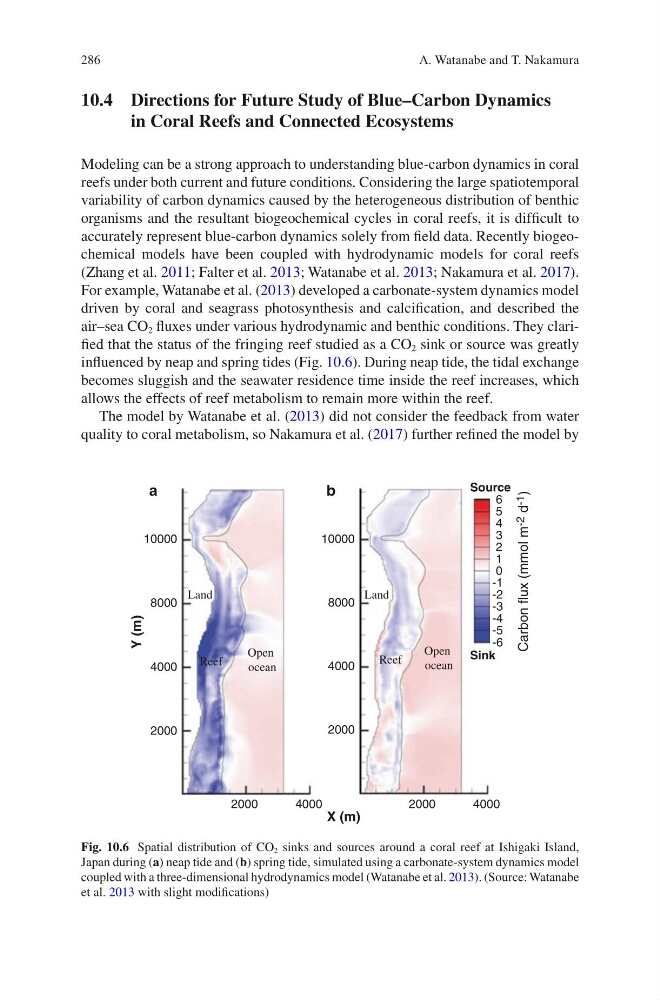
air–sea CO 2 fluxes under various hydrodynamic and benthic conditions. They clarified that the status of the fringing reef studied as a CO 2 sink or source was greatly
influenced by neap and spring tides (Fig. 10.6). During neap tide, the tidal exchange
becomes sluggish and the seawater residence time inside the reef increases, which
allows the effects of reef metabolism to remain more within the reef.
The model by Watanabe et al. (2013) did not consider the feedback from water
quality to coral metabolism, so Nakamura et al. (2017) further refined the model by
10000
8000
4000
2000
10000
8000
Carbon flux (mmol m -2
d -1
)
6
5
4
3
2
1
0
-1
-2
-3
-4
-5
-6
Sink
b
a
Source
X (m)
Y (m)
4000
Open
ocean
Open
ocean
Reef
Reef
Land
Land
2000
2000
4000
2000
4000
Fig. 10.6 Spatial distribution of CO 2 sinks and sources around a coral reef at Ishigaki Island,
Japan during (a) neap tide and (b) spring tide, simulated using a carbonate-system dynamics model
coupled with a three-dimensional hydrodynamics model (Watanabe et al. 2013). (Source: Watanabe
et al. 2013 with slight modifications)
A. Watanabe and T. Nakamura
10.4 Directions for Future Study of Blue–Carbon Dynamics
in Coral Reefs and Connected Ecosystems
Modeling can be a strong approach to understanding blue-carbon dynamics in coral
reefs under both current and future conditions. Considering the large spatiotemporal
variability of carbon dynamics caused by the heterogeneous distribution of benthic
organisms and the resultant biogeochemical cycles in coral reefs, it is difficult to
accurately represent blue-carbon dynamics solely from field data. Recently biogeochemical models have been coupled with hydrodynamic models for coral reefs
(Zhang et al. 2011; Falter et al. 2013; Watanabe et al. 2013; Nakamura et al. 2017).
For example, Watanabe et al. (2013) developed a carbonate-system dynamics model
driven by coral and seagrass photosynthesis and calcification, and described the
air–sea CO 2 fluxes under various hydrodynamic and benthic conditions. They clarified that the status of the fringing reef studied as a CO 2 sink or source was greatly
influenced by neap and spring tides (Fig. 10.6). During neap tide, the tidal exchange
becomes sluggish and the seawater residence time inside the reef increases, which
allows the effects of reef metabolism to remain more within the reef.
The model by Watanabe et al. (2013) did not consider the feedback from water
quality to coral metabolism, so Nakamura et al. (2017) further refined the model by
10000
8000
4000
2000
10000
8000
Carbon flux (mmol m -2
d -1
)
6
5
4
3
2
1
0
-1
-2
-3
-4
-5
-6
Sink
b
a
Source
X (m)
Y (m)
4000
Open
ocean
Open
ocean
Reef
Reef
Land
Land
2000
2000
4000
2000
4000
Fig. 10.6 Spatial distribution of CO 2 sinks and sources around a coral reef at Ishigaki Island,
Japan during (a) neap tide and (b) spring tide, simulated using a carbonate-system dynamics model
coupled with a three-dimensional hydrodynamics model (Watanabe et al. 2013). (Source: Watanabe
et al. 2013 with slight modifications)
A. Watanabe and T. Nakamura