

254
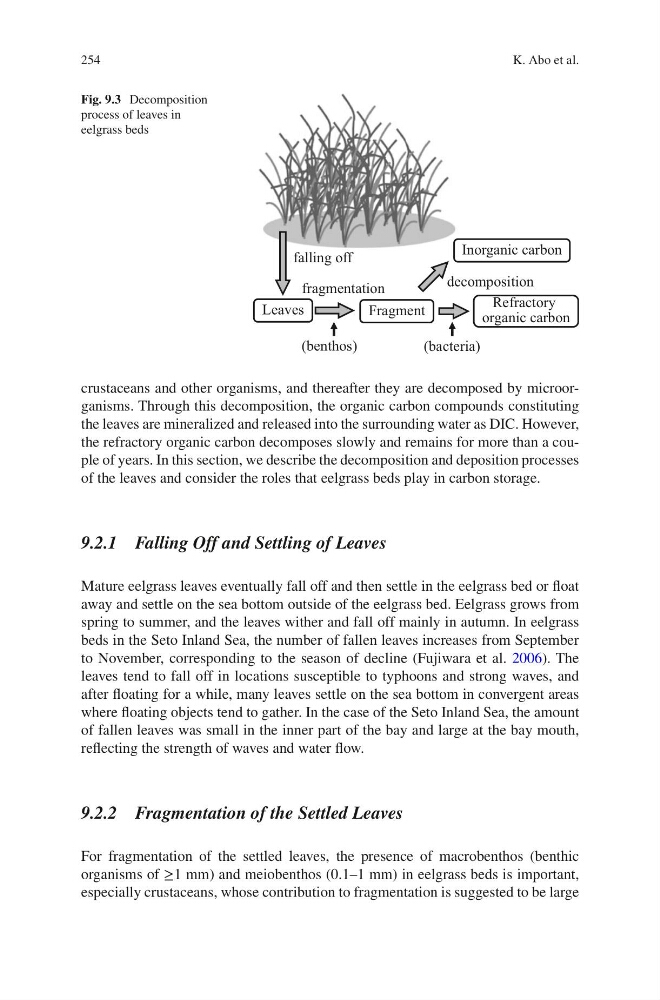
crustaceans and other organisms, and thereafter they are decomposed by microorganisms. Through this decomposition, the organic carbon compounds constituting
the leaves are mineralized and released into the surrounding water as DIC. However,
the refractory organic carbon decomposes slowly and remains for more than a couple of years. In this section, we describe the decomposition and deposition processes
of the leaves and consider the roles that eelgrass beds play in carbon storage.
9.2.1 Falling Off and Settling of Leaves
Mature eelgrass leaves eventually fall off and then settle in the eelgrass bed or float
away and settle on the sea bottom outside of the eelgrass bed. Eelgrass grows from
spring to summer, and the leaves wither and fall off mainly in autumn. In eelgrass
beds in the Seto Inland Sea, the number of fallen leaves increases from September
to November, corresponding to the season of decline (Fujiwara et al. 2006). The
leaves tend to fall off in locations susceptible to typhoons and strong waves, and
after floating for a while, many leaves settle on the sea bottom in convergent areas
where floating objects tend to gather. In the case of the Seto Inland Sea, the amount
of fallen leaves was small in the inner part of the bay and large at the bay mouth,
reflecting the strength of waves and water flow.
9.2.2 Fragmentation of the Settled Leaves
For fragmentation of the settled leaves, the presence of macrobenthos (benthic
organisms of ≥1 mm) and meiobenthos (0.1–1 mm) in eelgrass beds is important,
especially crustaceans, whose contribution to fragmentation is suggested to be large
falling off
fragmentation
decomposition
Leaves
Fragment
Inorganic carbon
Refractory
organic carbon
(benthos)
(bacteria)
Fig. 9.3 Decomposition
process of leaves in
eelgrass beds
K. Abo et al.
crustaceans and other organisms, and thereafter they are decomposed by microorganisms. Through this decomposition, the organic carbon compounds constituting
the leaves are mineralized and released into the surrounding water as DIC. However,
the refractory organic carbon decomposes slowly and remains for more than a couple of years. In this section, we describe the decomposition and deposition processes
of the leaves and consider the roles that eelgrass beds play in carbon storage.
9.2.1 Falling Off and Settling of Leaves
Mature eelgrass leaves eventually fall off and then settle in the eelgrass bed or float
away and settle on the sea bottom outside of the eelgrass bed. Eelgrass grows from
spring to summer, and the leaves wither and fall off mainly in autumn. In eelgrass
beds in the Seto Inland Sea, the number of fallen leaves increases from September
to November, corresponding to the season of decline (Fujiwara et al. 2006). The
leaves tend to fall off in locations susceptible to typhoons and strong waves, and
after floating for a while, many leaves settle on the sea bottom in convergent areas
where floating objects tend to gather. In the case of the Seto Inland Sea, the amount
of fallen leaves was small in the inner part of the bay and large at the bay mouth,
reflecting the strength of waves and water flow.
9.2.2 Fragmentation of the Settled Leaves
For fragmentation of the settled leaves, the presence of macrobenthos (benthic
organisms of ≥1 mm) and meiobenthos (0.1–1 mm) in eelgrass beds is important,
especially crustaceans, whose contribution to fragmentation is suggested to be large
falling off
fragmentation
decomposition
Leaves
Fragment
Inorganic carbon
Refractory
organic carbon
(benthos)
(bacteria)
Fig. 9.3 Decomposition
process of leaves in
eelgrass beds
K. Abo et al.