

253
up dissolved inorganic carbon (DIC) in the water column and directly absorbs atmospheric carbon dioxide by photosynthesis (Watanabe and Kuwae 2015) and accumulates carbon as organic compounds in the leaves. After that, some of the fallen
leaves settle in the eelgrass bed, while a portion of them flow out as drifting seagrass. The settled leaves are first fragmented by grazers such as small crustaceans,
and then they are decomposed and mineralized by microorganisms. After that, the
carbon compounds in the leaves are remineralized to DIC and released into the
environment. In addition, the remaining eelgrass-derived organic carbon that settles
on the bottom can flow out of the eelgrass bed due to tidal effects or meteorological
disturbances such as typhoons. The leaves that flow out of the eelgrass beds drift for
a while and settle in other locations. Some of the carbon compounds deposited on
the sea bed are resuspended into the water column due to strong flow or disturbance
and are transported even greater distances.
In this chapter, using the Seto Inland Sea as an example, we describe the transport
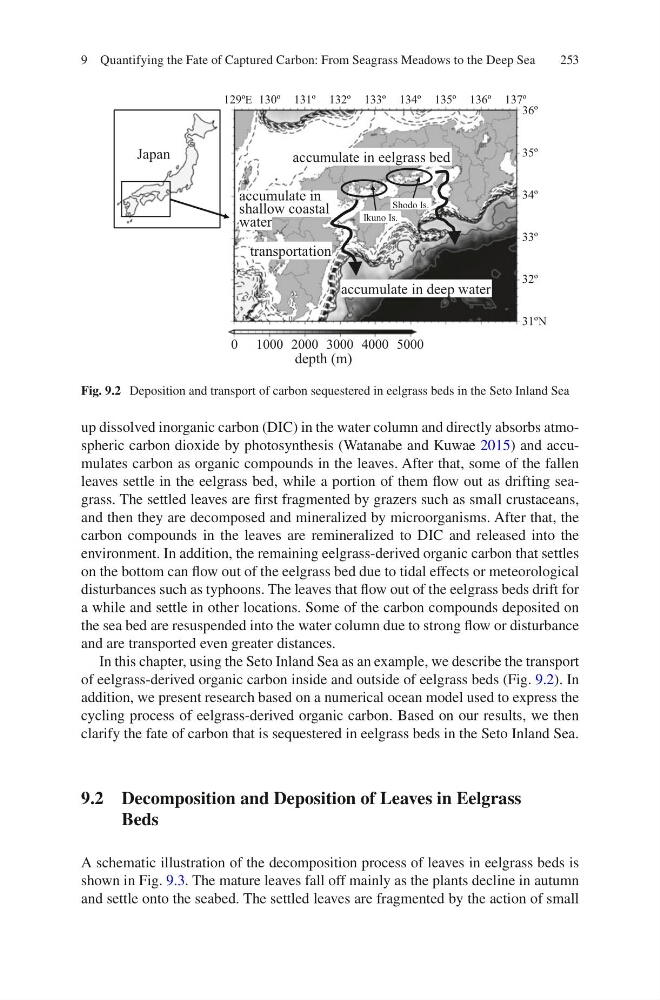
of eelgrass-derived organic carbon inside and outside of eelgrass beds (Fig. 9.2). In
addition, we present research based on a numerical ocean model used to express the
cycling process of eelgrass-derived organic carbon. Based on our results, we then
clarify the fate of carbon that is sequestered in eelgrass beds in the Seto Inland Sea.
9.2 Decomposition and Deposition of Leaves in Eelgrass
Beds
A schematic illustration of the decomposition process of leaves in eelgrass beds is
shown in Fig. 9.3. The mature leaves fall off mainly as the plants decline in autumn
and settle onto the seabed. The settled leaves are fragmented by the action of small
transportation
accumulate in eelgrass bed
accumulate in deep water
accumulate in
shallow coastal
water
Shodo Is.
Ikuno Is.
Japan
E
N
depth (m)
0 1000 2000 3000 4000 5000
129º 130º 131º 132º 133º 134º 135º 136º 137º
36º
35º
34º
33º
32º
31º
Fig. 9.2 Deposition and transport of carbon sequestered in eelgrass beds in the Seto Inland Sea
9 Quantifying the Fate of Captured Carbon: From Seagrass Meadows to the Deep Sea
up dissolved inorganic carbon (DIC) in the water column and directly absorbs atmospheric carbon dioxide by photosynthesis (Watanabe and Kuwae 2015) and accumulates carbon as organic compounds in the leaves. After that, some of the fallen
leaves settle in the eelgrass bed, while a portion of them flow out as drifting seagrass. The settled leaves are first fragmented by grazers such as small crustaceans,
and then they are decomposed and mineralized by microorganisms. After that, the
carbon compounds in the leaves are remineralized to DIC and released into the
environment. In addition, the remaining eelgrass-derived organic carbon that settles
on the bottom can flow out of the eelgrass bed due to tidal effects or meteorological
disturbances such as typhoons. The leaves that flow out of the eelgrass beds drift for
a while and settle in other locations. Some of the carbon compounds deposited on
the sea bed are resuspended into the water column due to strong flow or disturbance
and are transported even greater distances.
In this chapter, using the Seto Inland Sea as an example, we describe the transport
of eelgrass-derived organic carbon inside and outside of eelgrass beds (Fig. 9.2). In
addition, we present research based on a numerical ocean model used to express the
cycling process of eelgrass-derived organic carbon. Based on our results, we then
clarify the fate of carbon that is sequestered in eelgrass beds in the Seto Inland Sea.
9.2 Decomposition and Deposition of Leaves in Eelgrass
Beds
A schematic illustration of the decomposition process of leaves in eelgrass beds is
shown in Fig. 9.3. The mature leaves fall off mainly as the plants decline in autumn
and settle onto the seabed. The settled leaves are fragmented by the action of small
transportation
accumulate in eelgrass bed
accumulate in deep water
accumulate in
shallow coastal
water
Shodo Is.
Ikuno Is.
Japan
E
N
depth (m)
0 1000 2000 3000 4000 5000
129º 130º 131º 132º 133º 134º 135º 136º 137º
36º
35º
34º
33º
32º
31º
Fig. 9.2 Deposition and transport of carbon sequestered in eelgrass beds in the Seto Inland Sea
9 Quantifying the Fate of Captured Carbon: From Seagrass Meadows to the Deep Sea