

255
(Zupo et al. 2001; Bostrom and Mattila 2005). Field experiments using litter bags
(i.e., mesh bags that store fallen blades and leaves) are often performed to investigate the fragmentation and decomposition process of leaves. The litter bags are
placed on the sediment of an eelgrass bed for a certain period, and then the leaves
and remnants in the bag are observed periodically to investigate the fragmentation
process.
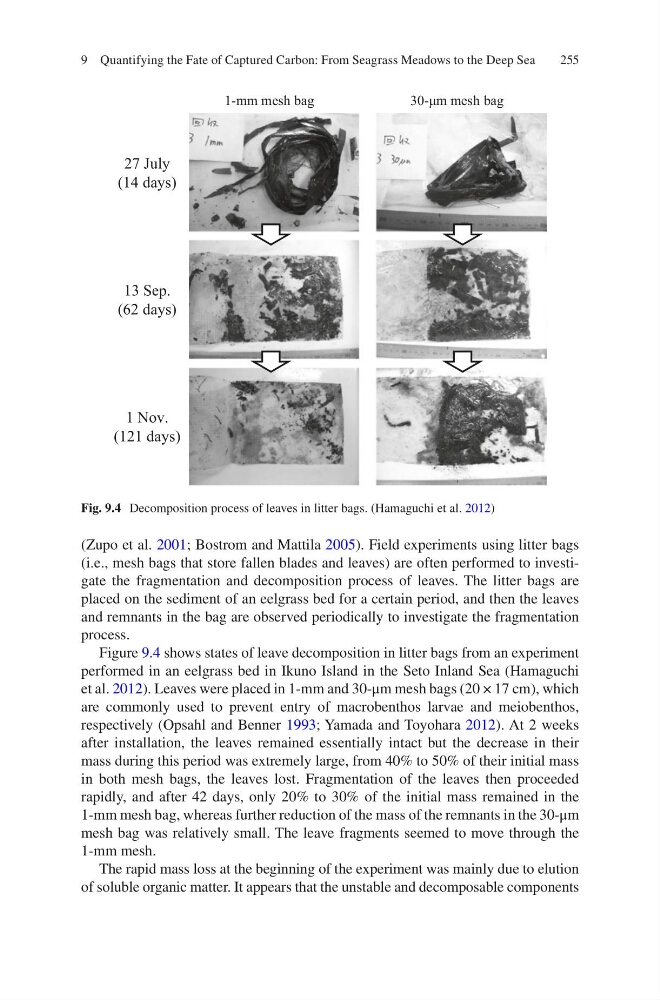
Figure 9.4 shows states of leave decomposition in litter bags from an experiment
performed in an eelgrass bed in Ikuno Island in the Seto Inland Sea (Hamaguchi
et al. 2012). Leaves were placed in 1-mm and 30-μm mesh bags (20 × 17 cm), which
are commonly used to prevent entry of macrobenthos larvae and meiobenthos,
respectively (Opsahl and Benner 1993; Yamada and Toyohara 2012). At 2 weeks
after installation, the leaves remained essentially intact but the decrease in their
mass during this period was extremely large, from 40% to 50% of their initial mass
in both mesh bags, the leaves lost. Fragmentation of the leaves then proceeded
rapidly, and after 42 days, only 20% to 30% of the initial mass remained in the
1-mm mesh bag, whereas further reduction of the mass of the remnants in the 30-μm
mesh bag was relatively small. The leave fragments seemed to move through the
1-mm mesh.
The rapid mass loss at the beginning of the experiment was mainly due to elution
of soluble organic matter. It appears that the unstable and decomposable components
1-mm mesh bag
3 0-μm mesh bag
27 July
(14 days)
13 Sep.
(62 days)
1 Nov.
(121 days)
Fig. 9.4 Decomposition process of leaves in litter bags. (Hamaguchi et al. 2012)
9 Quantifying the Fate of Captured Carbon: From Seagrass Meadows to the Deep Sea
(Zupo et al. 2001; Bostrom and Mattila 2005). Field experiments using litter bags
(i.e., mesh bags that store fallen blades and leaves) are often performed to investigate the fragmentation and decomposition process of leaves. The litter bags are
placed on the sediment of an eelgrass bed for a certain period, and then the leaves
and remnants in the bag are observed periodically to investigate the fragmentation
process.
Figure 9.4 shows states of leave decomposition in litter bags from an experiment
performed in an eelgrass bed in Ikuno Island in the Seto Inland Sea (Hamaguchi
et al. 2012). Leaves were placed in 1-mm and 30-μm mesh bags (20 × 17 cm), which
are commonly used to prevent entry of macrobenthos larvae and meiobenthos,
respectively (Opsahl and Benner 1993; Yamada and Toyohara 2012). At 2 weeks
after installation, the leaves remained essentially intact but the decrease in their
mass during this period was extremely large, from 40% to 50% of their initial mass
in both mesh bags, the leaves lost. Fragmentation of the leaves then proceeded
rapidly, and after 42 days, only 20% to 30% of the initial mass remained in the
1-mm mesh bag, whereas further reduction of the mass of the remnants in the 30-μm
mesh bag was relatively small. The leave fragments seemed to move through the
1-mm mesh.
The rapid mass loss at the beginning of the experiment was mainly due to elution
of soluble organic matter. It appears that the unstable and decomposable components
1-mm mesh bag
3 0-μm mesh bag
27 July
(14 days)
13 Sep.
(62 days)
1 Nov.
(121 days)
Fig. 9.4 Decomposition process of leaves in litter bags. (Hamaguchi et al. 2012)
9 Quantifying the Fate of Captured Carbon: From Seagrass Meadows to the Deep Sea