

178
this technique has become commercially available at a cost similar to that of δ
13
C
analysis.
The following two points concern the merits of using Δ
14
C to estimate the origin
and fate of carbon. First, Δ
14
C values provide information about time scales. We can
distinguish carbon sources using Δ
14
C that could not be separated on the basis of
δ
13
C values. For example, both modern-day plants and plants that inhabited Earth
-20
-15
-10
-5
0
5
10
0
1 0
2 0
3 0
δ 13
C (‰)
Salinity
Atmospheric CO 2
DIC
E elgrass
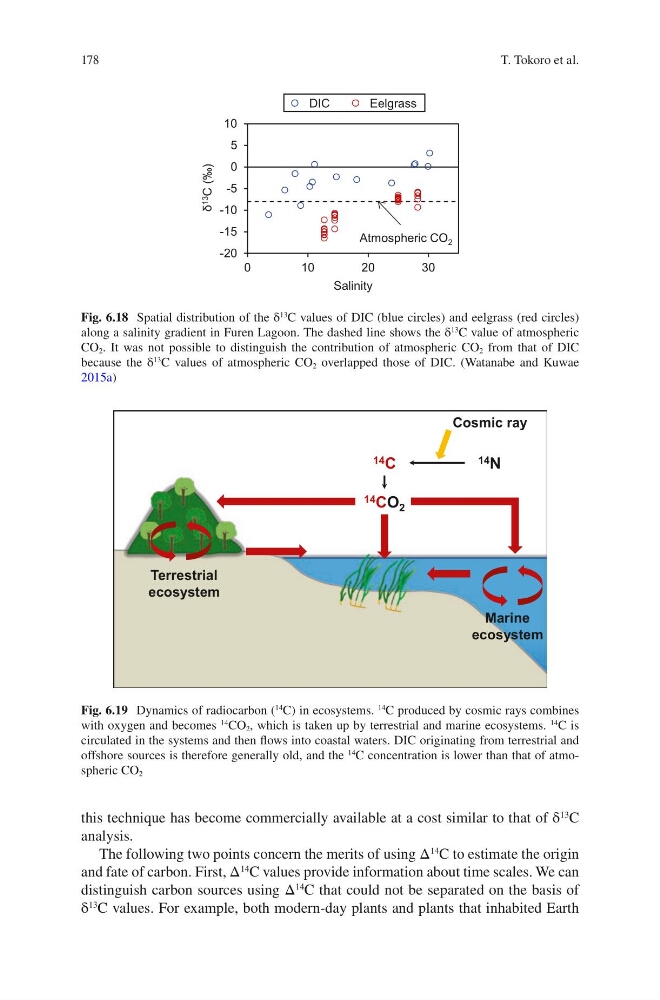
Fig. 6.18 Spatial distribution of the δ
13 C values of DIC (blue circles) and eelgrass (red circles)
along a salinity gradient in Furen Lagoon. The dashed line shows the δ
13
C value of atmospheric
CO 2 . It was not possible to distinguish the contribution of atmospheric CO 2 from that of DIC
because the δ
13
C values of atmospheric CO 2 overlapped those of DIC. (Watanabe and Kuwae
2015a)
14 N
14 C
14 CO 2
Cosmic ray
Terrestrial
ecosystem
Marine
ecosystem
Fig. 6.19 Dynamics of radiocarbon (
14 C) in ecosystems.
14 C produced by cosmic rays combines
with oxygen and becomes
14 CO 2 , which is taken up by terrestrial and marine ecosystems.
14 C is
circulated in the systems and then flows into coastal waters. DIC originating from terrestrial and
offshore sources is therefore generally old, and the
14
C concentration is lower than that of atmospheric CO 2
T. Tokoro et al.
this technique has become commercially available at a cost similar to that of δ
13
C
analysis.
The following two points concern the merits of using Δ
14
C to estimate the origin
and fate of carbon. First, Δ
14
C values provide information about time scales. We can
distinguish carbon sources using Δ
14
C that could not be separated on the basis of
δ
13
C values. For example, both modern-day plants and plants that inhabited Earth
-20
-15
-10
-5
0
5
10
0
1 0
2 0
3 0
δ 13
C (‰)
Salinity
Atmospheric CO 2
DIC
E elgrass
Fig. 6.18 Spatial distribution of the δ
13 C values of DIC (blue circles) and eelgrass (red circles)
along a salinity gradient in Furen Lagoon. The dashed line shows the δ
13
C value of atmospheric
CO 2 . It was not possible to distinguish the contribution of atmospheric CO 2 from that of DIC
because the δ
13
C values of atmospheric CO 2 overlapped those of DIC. (Watanabe and Kuwae
2015a)
14 N
14 C
14 CO 2
Cosmic ray
Terrestrial
ecosystem
Marine
ecosystem
Fig. 6.19 Dynamics of radiocarbon (
14 C) in ecosystems.
14 C produced by cosmic rays combines
with oxygen and becomes
14 CO 2 , which is taken up by terrestrial and marine ecosystems.
14 C is
circulated in the systems and then flows into coastal waters. DIC originating from terrestrial and
offshore sources is therefore generally old, and the
14
C concentration is lower than that of atmospheric CO 2
T. Tokoro et al.