

175
the spatial and temporal coverage of pCO 2water data, and the methods are hard for
non-specialists and organizations to use. Statistical models aimed at predicting
pCO 2water may overcome these limitations. The global efflux of CO 2 from river networks has been estimated with a statistical model (Lauerwald et al. 2015), but there
have been few similar estimates in shallow coastal waters. Here, we discuss studies
based on statistical analyses of air–water CO 2 exchanges in shallow coastal waters
in Japan.
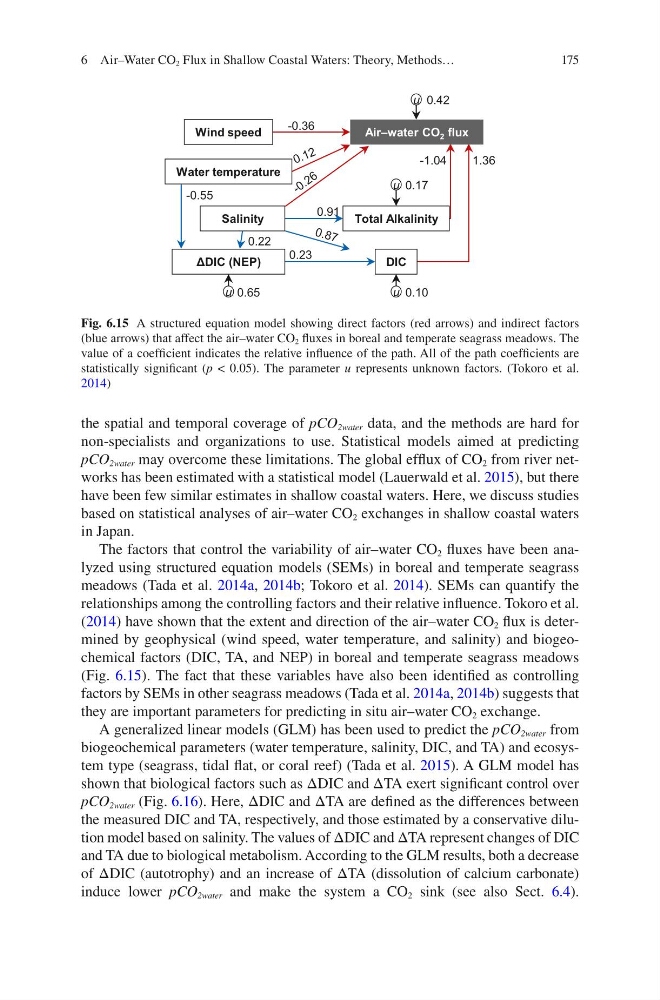
The factors that control the variability of air–water CO 2 fluxes have been analyzed using structured equation models (SEMs) in boreal and temperate seagrass
meadows (Tada et al. 2014a, 2014b; Tokoro et al. 2014). SEMs can quantify the
relationships among the controlling factors and their relative influence. Tokoro et al.
(2014) have shown that the extent and direction of the air–water CO 2 flux is determined by geophysical (wind speed, water temperature, and salinity) and biogeochemical factors (DIC, TA, and NEP) in boreal and temperate seagrass meadows
(Fig. 6.15). The fact that these variables have also been identified as controlling
factors by SEMs in other seagrass meadows (Tada et al. 2014a, 2014b) suggests that
they are important parameters for predicting in situ air–water CO 2 exchange.
A generalized linear models (GLM) has been used to predict the pCO 2water from
biogeochemical parameters (water temperature, salinity, DIC, and TA) and ecosystem type (seagrass, tidal flat, or coral reef) (Tada et al. 2015). A GLM model has
shown that biological factors such as ΔDIC and ΔTA exert significant control over
pCO 2water (Fig. 6.16). Here, ΔDIC and ΔTA are defined as the differences between
the measured DIC and TA, respectively, and those estimated by a conservative dilution model based on salinity. The values of ΔDIC and ΔTA represent changes of DIC
and TA due to biological metabolism. According to the GLM results, both a decrease
of ΔDIC (autotrophy) and an increase of ΔTA (dissolution of calcium carbonate)
induce lower pCO 2water and make the system a CO 2 sink (see also Sect. 6.4).
Wind speed
Air–water CO 2 flux
Total Alkalinity
DIC
ΔDIC (NEP)
-0.36
-0.55
0.91
-1.04
1.36
0.17
0.10
0.65
0.23
0.42
0.22
u
Salinity
Water temperature
u
u
u
Fig. 6.15 A structured equation model showing direct factors (red arrows) and indirect factors
(blue arrows) that affect the air–water CO 2 fluxes in boreal and temperate seagrass meadows. The
value of a coefficient indicates the relative influence of the path. All of the path coefficients are
statistically significant (p < 0.05). The parameter u represents unknown factors. (Tokoro et al.
2014)
6 Air–Water CO 2 Flux in Shallow Coastal Waters: Theory, Methods…
the spatial and temporal coverage of pCO 2water data, and the methods are hard for
non-specialists and organizations to use. Statistical models aimed at predicting
pCO 2water may overcome these limitations. The global efflux of CO 2 from river networks has been estimated with a statistical model (Lauerwald et al. 2015), but there
have been few similar estimates in shallow coastal waters. Here, we discuss studies
based on statistical analyses of air–water CO 2 exchanges in shallow coastal waters
in Japan.
The factors that control the variability of air–water CO 2 fluxes have been analyzed using structured equation models (SEMs) in boreal and temperate seagrass
meadows (Tada et al. 2014a, 2014b; Tokoro et al. 2014). SEMs can quantify the
relationships among the controlling factors and their relative influence. Tokoro et al.
(2014) have shown that the extent and direction of the air–water CO 2 flux is determined by geophysical (wind speed, water temperature, and salinity) and biogeochemical factors (DIC, TA, and NEP) in boreal and temperate seagrass meadows
(Fig. 6.15). The fact that these variables have also been identified as controlling
factors by SEMs in other seagrass meadows (Tada et al. 2014a, 2014b) suggests that
they are important parameters for predicting in situ air–water CO 2 exchange.
A generalized linear models (GLM) has been used to predict the pCO 2water from
biogeochemical parameters (water temperature, salinity, DIC, and TA) and ecosystem type (seagrass, tidal flat, or coral reef) (Tada et al. 2015). A GLM model has
shown that biological factors such as ΔDIC and ΔTA exert significant control over
pCO 2water (Fig. 6.16). Here, ΔDIC and ΔTA are defined as the differences between
the measured DIC and TA, respectively, and those estimated by a conservative dilution model based on salinity. The values of ΔDIC and ΔTA represent changes of DIC
and TA due to biological metabolism. According to the GLM results, both a decrease
of ΔDIC (autotrophy) and an increase of ΔTA (dissolution of calcium carbonate)
induce lower pCO 2water and make the system a CO 2 sink (see also Sect. 6.4).
Wind speed
Air–water CO 2 flux
Total Alkalinity
DIC
ΔDIC (NEP)
-0.36
-0.55
0.91
-1.04
1.36
0.17
0.10
0.65
0.23
0.42
0.22
u
Salinity
Water temperature
u
u
u
Fig. 6.15 A structured equation model showing direct factors (red arrows) and indirect factors
(blue arrows) that affect the air–water CO 2 fluxes in boreal and temperate seagrass meadows. The
value of a coefficient indicates the relative influence of the path. All of the path coefficients are
statistically significant (p < 0.05). The parameter u represents unknown factors. (Tokoro et al.
2014)
6 Air–Water CO 2 Flux in Shallow Coastal Waters: Theory, Methods…