

174
pCO 2water (Frankignoulle et al. 1994; Suzuki and Kawahata 2004; Ware et al. 1992).
The exact value of the ratio is a function of water temperature, salinity, and other
carbonate parameters (Watanabe and Nakamura, 2018).
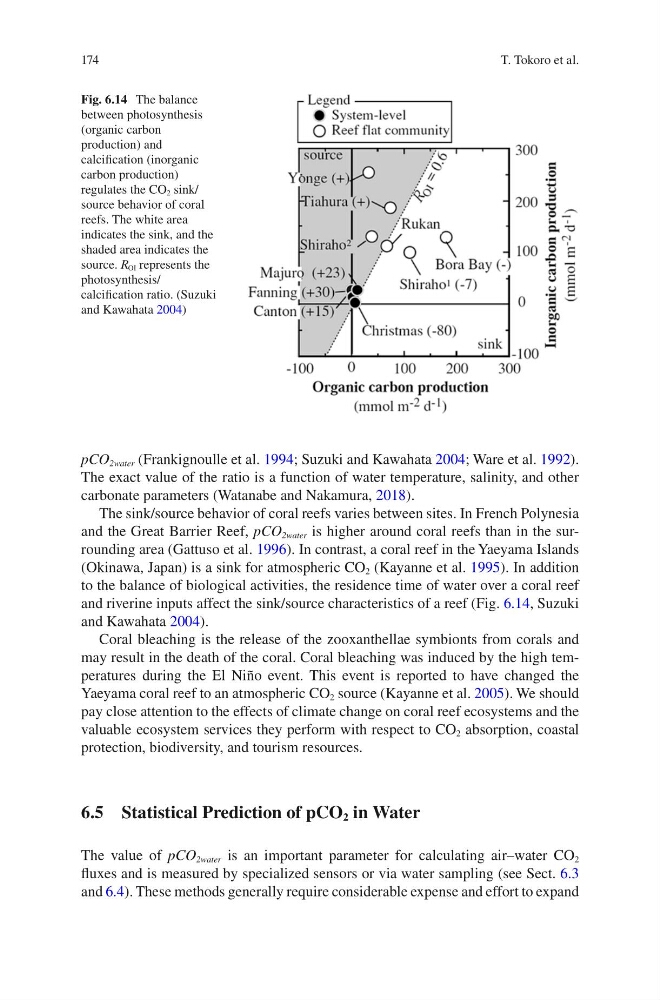
The sink/source behavior of coral reefs varies between sites. In French Polynesia
and the Great Barrier Reef, pCO 2water is higher around coral reefs than in the surrounding area (Gattuso et al. 1996). In contrast, a coral reef in the Yaeyama Islands
(Okinawa, Japan) is a sink for atmospheric CO 2 (Kayanne et al. 1995). In addition
to the balance of biological activities, the residence time of water over a coral reef
and riverine inputs affect the sink/source characteristics of a reef (Fig. 6.14, Suzuki
and Kawahata 2004).
Coral bleaching is the release of the zooxanthellae symbionts from corals and
may result in the death of the coral. Coral bleaching was induced by the high temperatures during the El Niño event. This event is reported to have changed the
Yaeyama coral reef to an atmospheric CO 2 source (Kayanne et al. 2005). We should
pay close attention to the effects of climate change on coral reef ecosystems and the
valuable ecosystem services they perform with respect to CO 2 absorption, coastal
protection, biodiversity, and tourism resources.
6.5 Statistical Prediction of pCO 2 in Water
The value of pCO 2water is an important parameter for calculating air–water CO 2
fluxes and is measured by specialized sensors or via water sampling (see Sect. 6.3
and 6.4). These methods generally require considerable expense and effort to expand
Fig. 6.14 The balance
between photosynthesis
(organic carbon
production) and
calcification (inorganic
carbon production)
regulates the CO 2 sink/
source behavior of coral
reefs. The white area
indicates the sink, and the
shaded area indicates the
source. R OI represents the
photosynthesis/
calcification ratio. (Suzuki
and Kawahata 2004)
T. Tokoro et al.
pCO 2water (Frankignoulle et al. 1994; Suzuki and Kawahata 2004; Ware et al. 1992).
The exact value of the ratio is a function of water temperature, salinity, and other
carbonate parameters (Watanabe and Nakamura, 2018).
The sink/source behavior of coral reefs varies between sites. In French Polynesia
and the Great Barrier Reef, pCO 2water is higher around coral reefs than in the surrounding area (Gattuso et al. 1996). In contrast, a coral reef in the Yaeyama Islands
(Okinawa, Japan) is a sink for atmospheric CO 2 (Kayanne et al. 1995). In addition
to the balance of biological activities, the residence time of water over a coral reef
and riverine inputs affect the sink/source characteristics of a reef (Fig. 6.14, Suzuki
and Kawahata 2004).
Coral bleaching is the release of the zooxanthellae symbionts from corals and
may result in the death of the coral. Coral bleaching was induced by the high temperatures during the El Niño event. This event is reported to have changed the
Yaeyama coral reef to an atmospheric CO 2 source (Kayanne et al. 2005). We should
pay close attention to the effects of climate change on coral reef ecosystems and the
valuable ecosystem services they perform with respect to CO 2 absorption, coastal
protection, biodiversity, and tourism resources.
6.5 Statistical Prediction of pCO 2 in Water
The value of pCO 2water is an important parameter for calculating air–water CO 2
fluxes and is measured by specialized sensors or via water sampling (see Sect. 6.3
and 6.4). These methods generally require considerable expense and effort to expand
Fig. 6.14 The balance
between photosynthesis
(organic carbon
production) and
calcification (inorganic
carbon production)
regulates the CO 2 sink/
source behavior of coral
reefs. The white area
indicates the sink, and the
shaded area indicates the
source. R OI represents the
photosynthesis/
calcification ratio. (Suzuki
and Kawahata 2004)
T. Tokoro et al.