

173
effect on pCO 2water is greater than the effect of the DIC decrease due to
calcification.
In contrast, primary producers (zooxanthellae, seagrasses, and algae) consume
DIC via photosynthesis and thus reduce pCO 2water . The balance between calcification/dissolution and photosynthesis/remineralization determines whether the ecosystem is a CO 2 sink or source. Previous studies have suggested that a photosynthesis/
calcification ratio of about 0.6 is the boundary between an increase or decrease of
1900
1950
2000
2050
70
80
90
200
250
300
350
400
pCO
2 (µatm)
DIC (µmol kg −1
-water)
DOC (µmol L −1
)
Sargassum
bed
Adjacent
barren water
Offshore
water
Sargassum
bed
Adjacent
barren water
Offshore
water
Sargassum
bed
Adjacent
barren water
Offshore
water
(a)
( b)
(c)
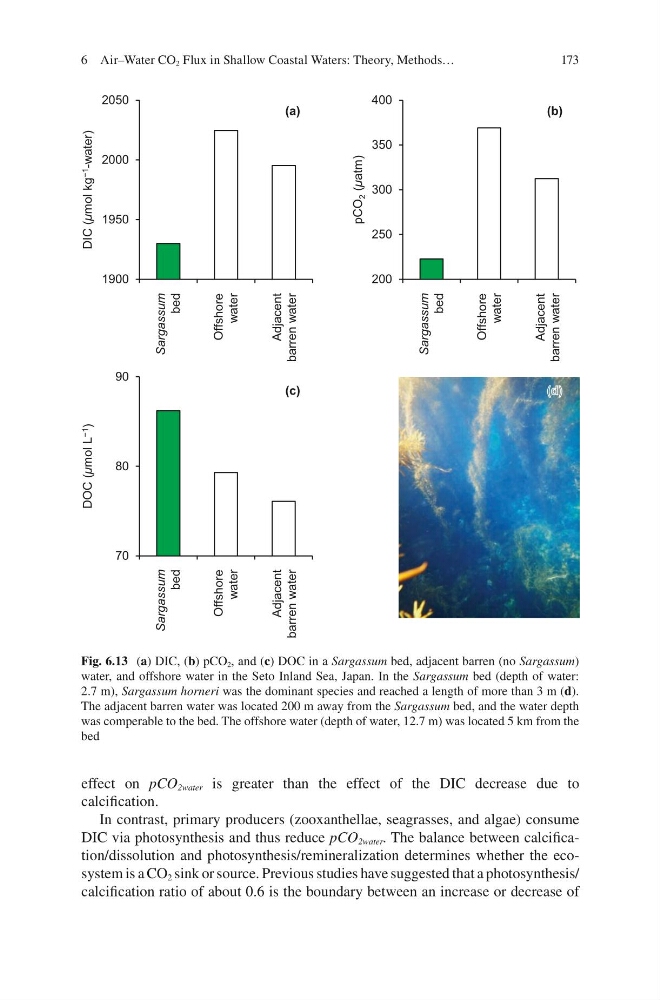
Fig. 6.13 (a) DIC, (b) pCO 2 , and (c) DOC in a Sargassum bed, adjacent barren (no Sargassum)
water, and offshore water in the Seto Inland Sea, Japan. In the Sargassum bed (depth of water:
2.7 m), Sargassum horneri was the dominant species and reached a length of more than 3 m (d).
The adjacent barren water was located 200 m away from the Sargassum bed, and the water depth
was comperable to the bed. The offshore water (depth of water, 12.7 m) was located 5 km from the
bed
6 Air–Water CO 2 Flux in Shallow Coastal Waters: Theory, Methods…
effect on pCO 2water is greater than the effect of the DIC decrease due to
calcification.
In contrast, primary producers (zooxanthellae, seagrasses, and algae) consume
DIC via photosynthesis and thus reduce pCO 2water . The balance between calcification/dissolution and photosynthesis/remineralization determines whether the ecosystem is a CO 2 sink or source. Previous studies have suggested that a photosynthesis/
calcification ratio of about 0.6 is the boundary between an increase or decrease of
1900
1950
2000
2050
70
80
90
200
250
300
350
400
pCO
2 (µatm)
DIC (µmol kg −1
-water)
DOC (µmol L −1
)
Sargassum
bed
Adjacent
barren water
Offshore
water
Sargassum
bed
Adjacent
barren water
Offshore
water
Sargassum
bed
Adjacent
barren water
Offshore
water
(a)
( b)
(c)
Fig. 6.13 (a) DIC, (b) pCO 2 , and (c) DOC in a Sargassum bed, adjacent barren (no Sargassum)
water, and offshore water in the Seto Inland Sea, Japan. In the Sargassum bed (depth of water:
2.7 m), Sargassum horneri was the dominant species and reached a length of more than 3 m (d).
The adjacent barren water was located 200 m away from the Sargassum bed, and the water depth
was comperable to the bed. The offshore water (depth of water, 12.7 m) was located 5 km from the
bed
6 Air–Water CO 2 Flux in Shallow Coastal Waters: Theory, Methods…