

172
6.4.3 Air–Water CO 2 Fluxes over Coral Reefs: Effects
of Calcification and Dissolution Processes
The calcification and dissolution of calcium carbonate (e.g., coral skeletons, foraminiferal tests, pteropod shells, coccolithophores) exert a substantial control on
pCO 2water in addition to photosynthesis, respiration, and remineralization, especially
on coral reefs. Recent studies have proposed that calcium carbonate cycling should
be accounted for in evaluating the carbon sequestration potential of blue carbon
ecosystems (Howard et al. 2017; Macreadie et al. 2017). In this section, basic concepts concerned with air–water CO 2 fluxes and pCO 2water over coral reefs are briefly
explained. For a comprehensive review, see Chap. 10 (Watanabe and Nakamura,
2018).
The calcification process increases pCO 2water according to the following
equation.
Ca
HCO
CaCO CO H O
2
3
3
2
2
2
+
-
+
®
+
+
(6.5)
The calcification process consumes calcium ions in water and decreases TA. As
already noted (Sect. 6.2.2), TA is a parameter that reflects the potential of dissolved
CO 2 to convert into bicarbonate and carbonate ions. A decrease of TA thus reflects
a conversion of these ions into dissolved CO 2 and an increase of pCO 2water . This
Air–water CO
2 flux
(µmol-C m −2
s −1
)
y = 0.001x − 0.014
R² = 0.278
-1.2
-0.6
0.0
0.6
1.2
-500
-250
0
2 50
∆DIC (µmol/kg −1 -water)
Efflux
Influx
n = 177
Heterotrophy
Autotrophy
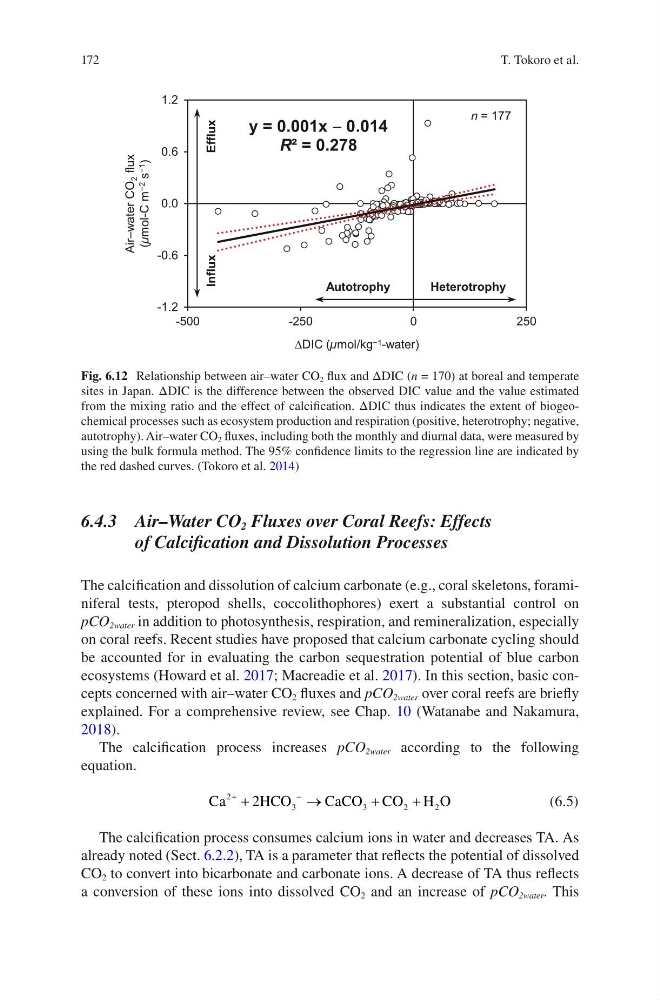
Fig. 6.12 Relationship between air–water CO 2 flux and ΔDIC (n = 170) at boreal and temperate
sites in Japan. ΔDIC is the difference between the observed DIC value and the value estimated
from the mixing ratio and the effect of calcification. ΔDIC thus indicates the extent of biogeochemical processes such as ecosystem production and respiration (positive, heterotrophy; negative,
autotrophy). Air–water CO 2 fluxes, including both the monthly and diurnal data, were measured by
using the bulk formula method. The 95% confidence limits to the regression line are indicated by
the red dashed curves. (Tokoro et al. 2014)
T. Tokoro et al.
6.4.3 Air–Water CO 2 Fluxes over Coral Reefs: Effects
of Calcification and Dissolution Processes
The calcification and dissolution of calcium carbonate (e.g., coral skeletons, foraminiferal tests, pteropod shells, coccolithophores) exert a substantial control on
pCO 2water in addition to photosynthesis, respiration, and remineralization, especially
on coral reefs. Recent studies have proposed that calcium carbonate cycling should
be accounted for in evaluating the carbon sequestration potential of blue carbon
ecosystems (Howard et al. 2017; Macreadie et al. 2017). In this section, basic concepts concerned with air–water CO 2 fluxes and pCO 2water over coral reefs are briefly
explained. For a comprehensive review, see Chap. 10 (Watanabe and Nakamura,
2018).
The calcification process increases pCO 2water according to the following
equation.
Ca
HCO
CaCO CO H O
2
3
3
2
2
2
+
-
+
®
+
+
(6.5)
The calcification process consumes calcium ions in water and decreases TA. As
already noted (Sect. 6.2.2), TA is a parameter that reflects the potential of dissolved
CO 2 to convert into bicarbonate and carbonate ions. A decrease of TA thus reflects
a conversion of these ions into dissolved CO 2 and an increase of pCO 2water . This
Air–water CO
2 flux
(µmol-C m −2
s −1
)
y = 0.001x − 0.014
R² = 0.278
-1.2
-0.6
0.0
0.6
1.2
-500
-250
0
2 50
∆DIC (µmol/kg −1 -water)
Efflux
Influx
n = 177
Heterotrophy
Autotrophy
Fig. 6.12 Relationship between air–water CO 2 flux and ΔDIC (n = 170) at boreal and temperate
sites in Japan. ΔDIC is the difference between the observed DIC value and the value estimated
from the mixing ratio and the effect of calcification. ΔDIC thus indicates the extent of biogeochemical processes such as ecosystem production and respiration (positive, heterotrophy; negative,
autotrophy). Air–water CO 2 fluxes, including both the monthly and diurnal data, were measured by
using the bulk formula method. The 95% confidence limits to the regression line are indicated by
the red dashed curves. (Tokoro et al. 2014)
T. Tokoro et al.