

170
6.4.2 Air–Water CO 2 Fluxes in Macroalgal Beds
Beds of macroalgae such as Sargassum and kelp have limited capacity to store
organic carbon in their substrata because they do not develop their own organic-rich
sediment. However, recent studies have suggested that they act as “carbon donors”
to receiver sites, where the organic carbon accumulates (Duarte et al. 2017; Hill
et al. 2015; Krause-Jensen and Duarte 2016). The fact that macroalgal beds are
among the most productive of shallow coastal ecosystems (Yoshida et al., 2018)
indicates that macroalgal beds have the potential to serve as a direct sink of atmospheric CO 2 (Krause-Jensen and Duarte 2016). However, few empirical measurements have been made of the sink/source behavior of macroalgal beds (Ikawa and
Oechel, 2014). Here, we demonstrate that macroalgal beds can contribute to the
absorption of atmospheric CO 2 based on in situ measurement in the Seto Inland Sea
in western Japan.
To examine the sink/source behavior of the macroalgal bed, pCO 2water , DIC, and
dissolved organic carbon (DOC) were measured in the Sargassum bed and in adjacent waters without vegetation. The DIC concentration was lower in the Sargassum
bed than in the adjacent waters (Fig. 6.13). Conversely, the DOC concentration was
higher in the Sargassum bed. These results indicate that the Sargassum bed was
autotrophic and that DOC was released by the Sargassum bed. The pCO 2water was
15
5
10
2
Jul
A ug
Sep
O ct
Jun
N ov
Distance from
the river mouth (km)
Month
10
−3
10
−2
10
−1
0.3
−10
−3
−10
−2
−10
−1
−0.3
0
Air–water CO 2 flux (µmol-C m
−2
s
−1
)
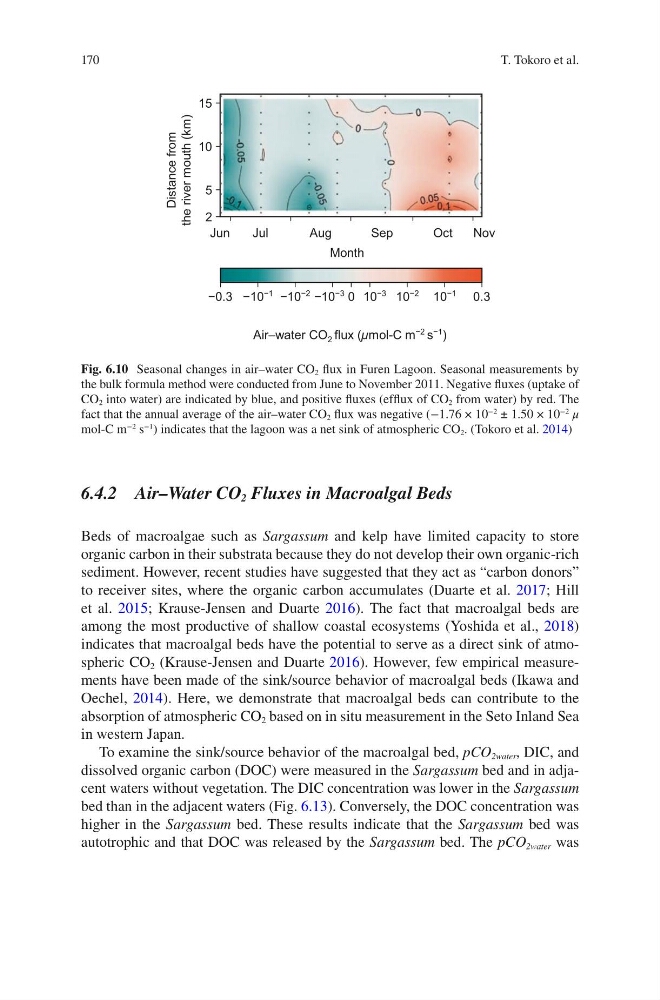
Fig. 6.10 Seasonal changes in air–water CO 2 flux in Furen Lagoon. Seasonal measurements by
the bulk formula method were conducted from June to November 2011. Negative fluxes (uptake of
CO 2 into water) are indicated by blue, and positive fluxes (efflux of CO 2 from water) by red. The
fact that the annual average of the air–water CO 2 flux was negative (−1.76 × 10
−2 ± 1.50 × 10
−2
μ
mol- C m
−2 s
−1 ) indicates that the lagoon was a net sink of atmospheric CO 2 . (Tokoro et al. 2014)
T. Tokoro et al.
6.4.2 Air–Water CO 2 Fluxes in Macroalgal Beds
Beds of macroalgae such as Sargassum and kelp have limited capacity to store
organic carbon in their substrata because they do not develop their own organic-rich
sediment. However, recent studies have suggested that they act as “carbon donors”
to receiver sites, where the organic carbon accumulates (Duarte et al. 2017; Hill
et al. 2015; Krause-Jensen and Duarte 2016). The fact that macroalgal beds are
among the most productive of shallow coastal ecosystems (Yoshida et al., 2018)
indicates that macroalgal beds have the potential to serve as a direct sink of atmospheric CO 2 (Krause-Jensen and Duarte 2016). However, few empirical measurements have been made of the sink/source behavior of macroalgal beds (Ikawa and
Oechel, 2014). Here, we demonstrate that macroalgal beds can contribute to the
absorption of atmospheric CO 2 based on in situ measurement in the Seto Inland Sea
in western Japan.
To examine the sink/source behavior of the macroalgal bed, pCO 2water , DIC, and
dissolved organic carbon (DOC) were measured in the Sargassum bed and in adjacent waters without vegetation. The DIC concentration was lower in the Sargassum
bed than in the adjacent waters (Fig. 6.13). Conversely, the DOC concentration was
higher in the Sargassum bed. These results indicate that the Sargassum bed was
autotrophic and that DOC was released by the Sargassum bed. The pCO 2water was
15
5
10
2
Jul
A ug
Sep
O ct
Jun
N ov
Distance from
the river mouth (km)
Month
10
−3
10
−2
10
−1
0.3
−10
−3
−10
−2
−10
−1
−0.3
0
Air–water CO 2 flux (µmol-C m
−2
s
−1
)
Fig. 6.10 Seasonal changes in air–water CO 2 flux in Furen Lagoon. Seasonal measurements by
the bulk formula method were conducted from June to November 2011. Negative fluxes (uptake of
CO 2 into water) are indicated by blue, and positive fluxes (efflux of CO 2 from water) by red. The
fact that the annual average of the air–water CO 2 flux was negative (−1.76 × 10
−2 ± 1.50 × 10
−2
μ
mol- C m
−2 s
−1 ) indicates that the lagoon was a net sink of atmospheric CO 2 . (Tokoro et al. 2014)
T. Tokoro et al.