

169
(ΔDIC) due to biogeochemical processes such as ecosystem production and respiration (positive ΔDIC, heterotrophy; negative ΔDIC, autotrophy) also supports the
importance of NEP as a key regulating factor (Fig. 6.12).
These results imply that conservation and restoration of strongly autotrophic
coastal vegetated habitats have the potential to serve as an effective way to mitigate
the adverse effects of anthropogenic CO 2 emissions.
1.2
0.6
0
-0.6
0
1 2
2 4
3 6
4 8
6 0
7 2
1.2
0.6
0
-0.6
Air–water CO
2 flux
(µmol-C m
−2
s
−1
)
Time (hour)
(a) Summer
(b) Winter
Bulk formula
Floating chamber
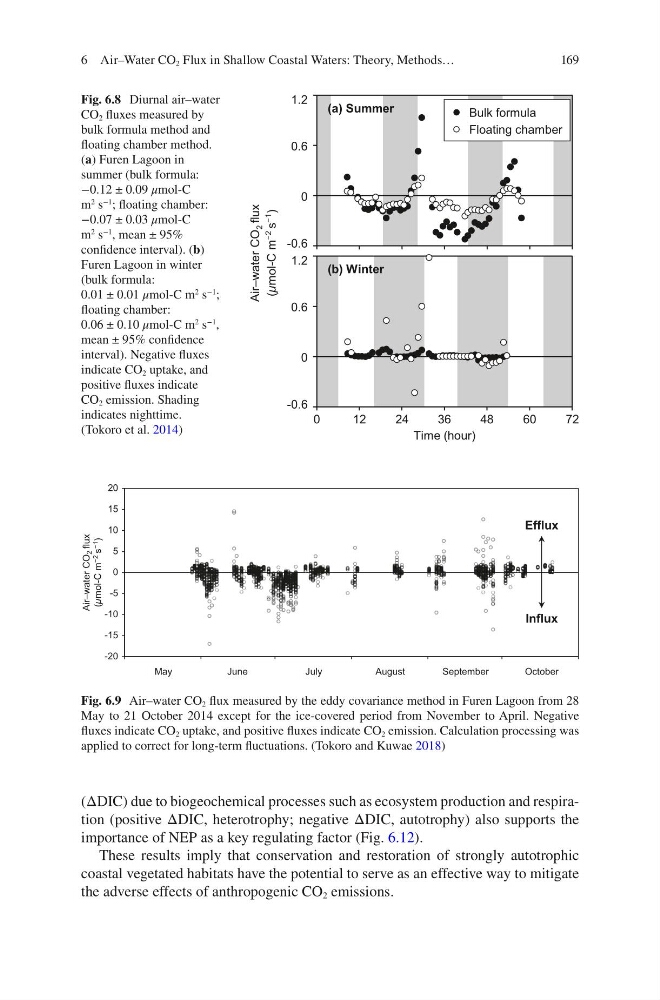
Fig. 6.8 Diurnal air–water
CO 2 fluxes measured by
bulk formula method and
floating chamber method.
(a) Furen Lagoon in
summer (bulk formula:
−0.12 ± 0.09 μmol-C
m
2 s
−1 ; floating chamber:
−0.07 ± 0.03 μmol-C
m
2 s
−1 , mean ± 95%
confidence interval). (b)
Furen Lagoon in winter
(bulk formula:
0.01 ± 0.01 μmol-C m
2 s
−1
;
floating chamber:
0.06 ± 0.10 μmol-C m
2 s
−1
,
mean ± 95% confidence
interval). Negative fluxes
indicate CO 2 uptake, and
positive fluxes indicate
CO 2 emission. Shading
indicates nighttime.
(Tokoro et al. 2014)
-20
-15
-10
-5
0
5
10
15
20
Efflux
Influx
Air–water CO
2 flux
(µmol-C m −2
s −1
)
May
J une
J uly
A ugust
September
October
Fig. 6.9 Air–water CO 2 flux measured by the eddy covariance method in Furen Lagoon from 28
May to 21 October 2014 except for the ice-covered period from November to April. Negative
fluxes indicate CO 2 uptake, and positive fluxes indicate CO 2 emission. Calculation processing was
applied to correct for long-term fluctuations. (Tokoro and Kuwae 2018)
6 Air–Water CO 2 Flux in Shallow Coastal Waters: Theory, Methods…
(ΔDIC) due to biogeochemical processes such as ecosystem production and respiration (positive ΔDIC, heterotrophy; negative ΔDIC, autotrophy) also supports the
importance of NEP as a key regulating factor (Fig. 6.12).
These results imply that conservation and restoration of strongly autotrophic
coastal vegetated habitats have the potential to serve as an effective way to mitigate
the adverse effects of anthropogenic CO 2 emissions.
1.2
0.6
0
-0.6
0
1 2
2 4
3 6
4 8
6 0
7 2
1.2
0.6
0
-0.6
Air–water CO
2 flux
(µmol-C m
−2
s
−1
)
Time (hour)
(a) Summer
(b) Winter
Bulk formula
Floating chamber
Fig. 6.8 Diurnal air–water
CO 2 fluxes measured by
bulk formula method and
floating chamber method.
(a) Furen Lagoon in
summer (bulk formula:
−0.12 ± 0.09 μmol-C
m
2 s
−1 ; floating chamber:
−0.07 ± 0.03 μmol-C
m
2 s
−1 , mean ± 95%
confidence interval). (b)
Furen Lagoon in winter
(bulk formula:
0.01 ± 0.01 μmol-C m
2 s
−1
;
floating chamber:
0.06 ± 0.10 μmol-C m
2 s
−1
,
mean ± 95% confidence
interval). Negative fluxes
indicate CO 2 uptake, and
positive fluxes indicate
CO 2 emission. Shading
indicates nighttime.
(Tokoro et al. 2014)
-20
-15
-10
-5
0
5
10
15
20
Efflux
Influx
Air–water CO
2 flux
(µmol-C m −2
s −1
)
May
J une
J uly
A ugust
September
October
Fig. 6.9 Air–water CO 2 flux measured by the eddy covariance method in Furen Lagoon from 28
May to 21 October 2014 except for the ice-covered period from November to April. Negative
fluxes indicate CO 2 uptake, and positive fluxes indicate CO 2 emission. Calculation processing was
applied to correct for long-term fluctuations. (Tokoro and Kuwae 2018)
6 Air–Water CO 2 Flux in Shallow Coastal Waters: Theory, Methods…