

168
value of pCO 2water determines whether the system is a sink or source of atmospheric
CO 2 . Factors that control the pCO 2water therefore have a major effect on the sink/
source behavior.
In Furen Lagoon, net ecosystem production (NEP) is the key factor that controls
the air–water CO 2 flux (Fig. 6.11). Observed values of DIC, which is changed by the
NEP and regulates the pCO 2water , have been compared with the DIC estimated from
the conservative mixing line (determined from salinity) of both the riverine and
coastal endmembers. The estimated value can be assumed to be DIC when the NEP
is zero, and the pCO 2water without NEP can be calculated by the estimated DIC (the
TA can be assumed to be independent from any ecosystem activities in this site).
The pCO 2water without NEP was higher than both the observed pCO 2 and atmospheric pCO 2 . This result shows that the seagrass ecosystem changed the lagoon
from a source to a sink of CO 2 . The fact that the decrease of DIC with NEP continued at night indicates that the reduction of DIC by photosynthesis during the day
exceeded the increase of DIC due to respiration and decomposition at night. The
significant correlation between the air–water CO 2 flux and the change of DIC
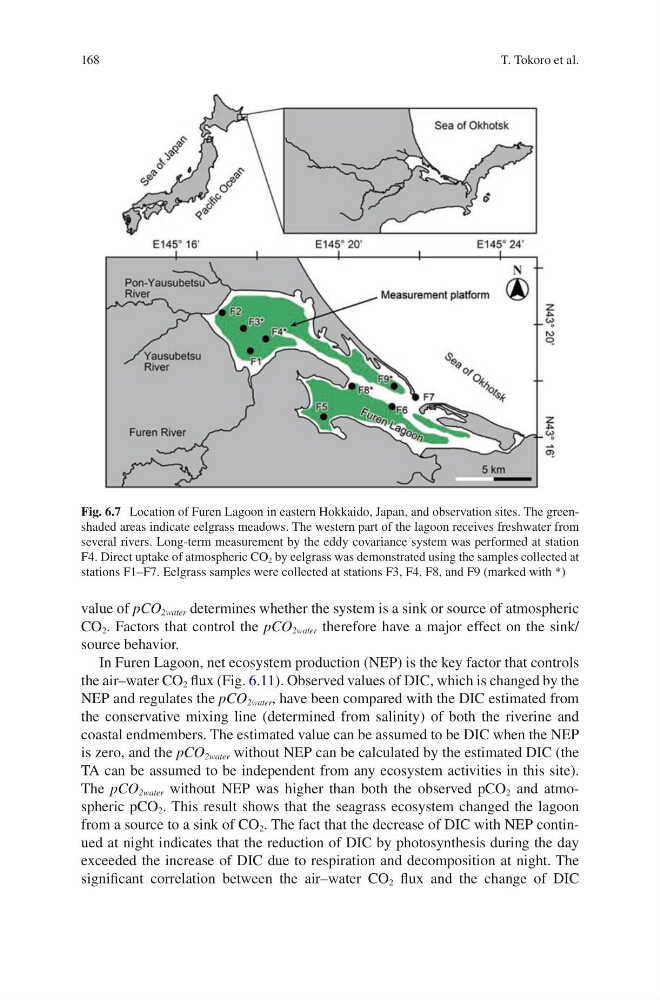
Fig. 6.7 Location of Furen Lagoon in eastern Hokkaido, Japan, and observation sites. The greenshaded areas indicate eelgrass meadows. The western part of the lagoon receives freshwater from
several rivers. Long-term measurement by the eddy covariance system was performed at station
F4. Direct uptake of atmospheric CO 2 by eelgrass was demonstrated using the samples collected at
stations F1–F7. Eelgrass samples were collected at stations F3, F4, F8, and F9 (marked with *)
T. Tokoro et al.
value of pCO 2water determines whether the system is a sink or source of atmospheric
CO 2 . Factors that control the pCO 2water therefore have a major effect on the sink/
source behavior.
In Furen Lagoon, net ecosystem production (NEP) is the key factor that controls
the air–water CO 2 flux (Fig. 6.11). Observed values of DIC, which is changed by the
NEP and regulates the pCO 2water , have been compared with the DIC estimated from
the conservative mixing line (determined from salinity) of both the riverine and
coastal endmembers. The estimated value can be assumed to be DIC when the NEP
is zero, and the pCO 2water without NEP can be calculated by the estimated DIC (the
TA can be assumed to be independent from any ecosystem activities in this site).
The pCO 2water without NEP was higher than both the observed pCO 2 and atmospheric pCO 2 . This result shows that the seagrass ecosystem changed the lagoon
from a source to a sink of CO 2 . The fact that the decrease of DIC with NEP continued at night indicates that the reduction of DIC by photosynthesis during the day
exceeded the increase of DIC due to respiration and decomposition at night. The
significant correlation between the air–water CO 2 flux and the change of DIC
Fig. 6.7 Location of Furen Lagoon in eastern Hokkaido, Japan, and observation sites. The greenshaded areas indicate eelgrass meadows. The western part of the lagoon receives freshwater from
several rivers. Long-term measurement by the eddy covariance system was performed at station
F4. Direct uptake of atmospheric CO 2 by eelgrass was demonstrated using the samples collected at
stations F1–F7. Eelgrass samples were collected at stations F3, F4, F8, and F9 (marked with *)
T. Tokoro et al.