

113
peak growing season ranged from 60 to 250 shoots/m
2
, and the biomass (aboveground and underground) ranged from 64 to 430 g dry weight/m
2
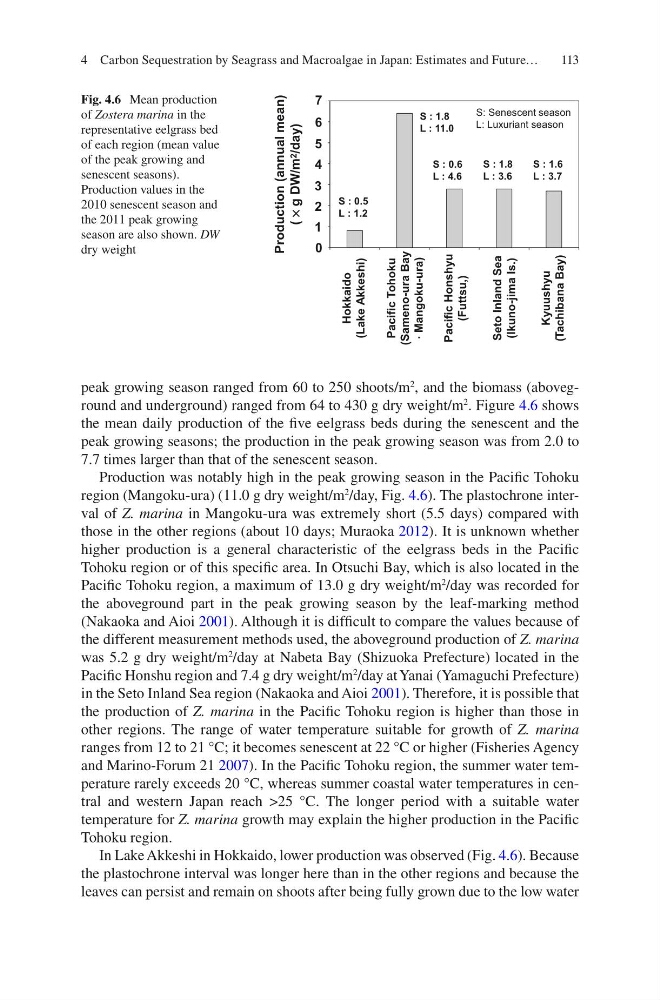
. Figure 4.6 shows
the mean daily production of the five eelgrass beds during the senescent and the
peak growing seasons; the production in the peak growing season was from 2.0 to
7.7 times larger than that of the senescent season.
Production was notably high in the peak growing season in the Pacific Tohoku
region (Mangoku-ura) (11.0 g dry weight/m
2
/day, Fig. 4.6). The plastochrone interval of Z. marina in Mangoku-ura was extremely short (5.5 days) compared with
those in the other regions (about 10 days; Muraoka 2012). It is unknown whether
higher production is a general characteristic of the eelgrass beds in the Pacific
Tohoku region or of this specific area. In Otsuchi Bay, which is also located in the
Pacific Tohoku region, a maximum of 13.0 g dry weight/m
2
/day was recorded for
the aboveground part in the peak growing season by the leaf-marking method
(Nakaoka and Aioi 2001). Although it is difficult to compare the values because of
the different measurement methods used, the aboveground production of Z. marina
was 5.2 g dry weight/m
2
/day at Nabeta Bay (Shizuoka Prefecture) located in the
Pacific Honshu region and 7.4 g dry weight/m
2
/day at Yanai (Yamaguchi Prefecture)
in the Seto Inland Sea region (Nakaoka and Aioi 2001). Therefore, it is possible that
the production of Z. marina in the Pacific Tohoku region is higher than those in
other regions. The range of water temperature suitable for growth of Z. marina
ranges from 12 to 21 °C; it becomes senescent at 22 °C or higher (Fisheries Agency
and Marino-Forum 21 2007). In the Pacific Tohoku region, the summer water temperature rarely exceeds 20 °C, whereas summer coastal water temperatures in central and western Japan reach >25 °C. The longer period with a suitable water
temperature for Z. marina growth may explain the higher production in the Pacific
Tohoku region.
In Lake Akkeshi in Hokkaido, lower production was observed (Fig. 4.6). Because
the plastochrone interval was longer here than in the other regions and because the
leaves can persist and remain on shoots after being fully grown due to the low water
0
1
2
3
4
5
6
7
Production (annual mean)
( ¥
g DW/m 2
/day)
Hokkaido
(Lake Akkeshi)
Pacific Tohoku
(Sameno-ura Bay
.
Mangoku-ura)
Pacific Honshyu
(Futtsu,)
Seto Inland Sea
(Ikuno-jima Is.)
Kyuushyu
(Tachibana Bay)
S : 0.5
L : 1.2
S : 1.8
L : 11.0
S : 0.6
L : 4.6
S : 1.6
L : 3.7
S : 1.8
L : 3.6
S: Senescent season
L: Luxuriant season
Fig. 4.6 Mean production
of Zostera marina in the
representative eelgrass bed
of each region (mean value
of the peak growing and
senescent seasons).
Production values in the
2010 senescent season and
the 2011 peak growing
season are also shown. DW
dry weight
4 Carbon Sequestration by Seagrass and Macroalgae in Japan: Estimates and Future…
peak growing season ranged from 60 to 250 shoots/m
2
, and the biomass (aboveground and underground) ranged from 64 to 430 g dry weight/m
2
. Figure 4.6 shows
the mean daily production of the five eelgrass beds during the senescent and the
peak growing seasons; the production in the peak growing season was from 2.0 to
7.7 times larger than that of the senescent season.
Production was notably high in the peak growing season in the Pacific Tohoku
region (Mangoku-ura) (11.0 g dry weight/m
2
/day, Fig. 4.6). The plastochrone interval of Z. marina in Mangoku-ura was extremely short (5.5 days) compared with
those in the other regions (about 10 days; Muraoka 2012). It is unknown whether
higher production is a general characteristic of the eelgrass beds in the Pacific
Tohoku region or of this specific area. In Otsuchi Bay, which is also located in the
Pacific Tohoku region, a maximum of 13.0 g dry weight/m
2
/day was recorded for
the aboveground part in the peak growing season by the leaf-marking method
(Nakaoka and Aioi 2001). Although it is difficult to compare the values because of
the different measurement methods used, the aboveground production of Z. marina
was 5.2 g dry weight/m
2
/day at Nabeta Bay (Shizuoka Prefecture) located in the
Pacific Honshu region and 7.4 g dry weight/m
2
/day at Yanai (Yamaguchi Prefecture)
in the Seto Inland Sea region (Nakaoka and Aioi 2001). Therefore, it is possible that
the production of Z. marina in the Pacific Tohoku region is higher than those in
other regions. The range of water temperature suitable for growth of Z. marina
ranges from 12 to 21 °C; it becomes senescent at 22 °C or higher (Fisheries Agency
and Marino-Forum 21 2007). In the Pacific Tohoku region, the summer water temperature rarely exceeds 20 °C, whereas summer coastal water temperatures in central and western Japan reach >25 °C. The longer period with a suitable water
temperature for Z. marina growth may explain the higher production in the Pacific
Tohoku region.
In Lake Akkeshi in Hokkaido, lower production was observed (Fig. 4.6). Because
the plastochrone interval was longer here than in the other regions and because the
leaves can persist and remain on shoots after being fully grown due to the low water
0
1
2
3
4
5
6
7
Production (annual mean)
( ¥
g DW/m 2
/day)
Hokkaido
(Lake Akkeshi)
Pacific Tohoku
(Sameno-ura Bay
.
Mangoku-ura)
Pacific Honshyu
(Futtsu,)
Seto Inland Sea
(Ikuno-jima Is.)
Kyuushyu
(Tachibana Bay)
S : 0.5
L : 1.2
S : 1.8
L : 11.0
S : 0.6
L : 4.6
S : 1.6
L : 3.7
S : 1.8
L : 3.6
S: Senescent season
L: Luxuriant season
Fig. 4.6 Mean production
of Zostera marina in the
representative eelgrass bed
of each region (mean value
of the peak growing and
senescent seasons).
Production values in the
2010 senescent season and
the 2011 peak growing
season are also shown. DW
dry weight
4 Carbon Sequestration by Seagrass and Macroalgae in Japan: Estimates and Future…