

112
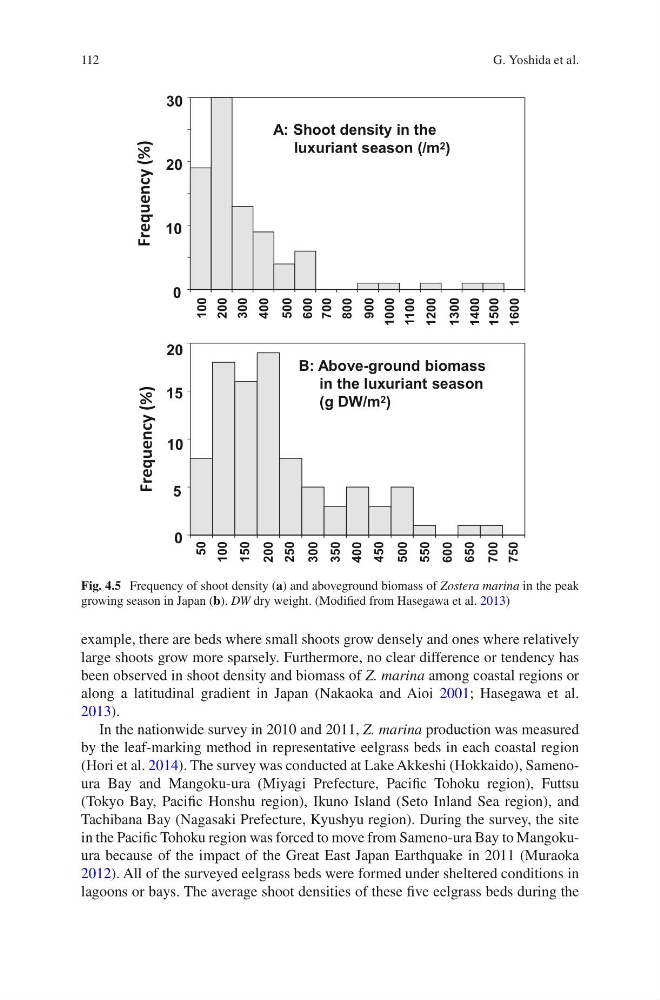
example, there are beds where small shoots grow densely and ones where relatively
large shoots grow more sparsely. Furthermore, no clear difference or tendency has
been observed in shoot density and biomass of Z. marina among coastal regions or
along a latitudinal gradient in Japan (Nakaoka and Aioi 2001; Hasegawa et al.
2013).
In the nationwide survey in 2010 and 2011, Z. marina production was measured
by the leaf-marking method in representative eelgrass beds in each coastal region
(Hori et al. 2014). The survey was conducted at Lake Akkeshi (Hokkaido), Samenoura Bay and Mangoku-ura (Miyagi Prefecture, Pacific Tohoku region), Futtsu
(Tokyo Bay, Pacific Honshu region), Ikuno Island (Seto Inland Sea region), and
Tachibana Bay (Nagasaki Prefecture, Kyushyu region). During the survey, the site
in the Pacific Tohoku region was forced to move from Sameno-ura Bay to Mangokuura because of the impact of the Great East Japan Earthquake in 2011 (Muraoka
2012). All of the surveyed eelgrass beds were formed under sheltered conditions in
lagoons or bays. The average shoot densities of these five eelgrass beds during the
100
200
300
400
500
600
700
800
900
1000
1100
1200
1300
1400
1500
1600
50
100
150
200
250
300
350
400
450
500
550
600
650
700
750
A: Shoot density in the
luxuriant season (/m 2 )
B: Above-ground biomass
in the luxuriant season
(g DW/m 2 )
0
10
20
30
0
10
15
20
5
Frequency (%)
Frequency (%)
Fig. 4.5 Frequency of shoot density (a) and aboveground biomass of Zostera marina in the peak
growing season in Japan (b). DW dry weight. (Modified from Hasegawa et al. 2013)
G. Yoshida et al.
example, there are beds where small shoots grow densely and ones where relatively
large shoots grow more sparsely. Furthermore, no clear difference or tendency has
been observed in shoot density and biomass of Z. marina among coastal regions or
along a latitudinal gradient in Japan (Nakaoka and Aioi 2001; Hasegawa et al.
2013).
In the nationwide survey in 2010 and 2011, Z. marina production was measured
by the leaf-marking method in representative eelgrass beds in each coastal region
(Hori et al. 2014). The survey was conducted at Lake Akkeshi (Hokkaido), Samenoura Bay and Mangoku-ura (Miyagi Prefecture, Pacific Tohoku region), Futtsu
(Tokyo Bay, Pacific Honshu region), Ikuno Island (Seto Inland Sea region), and
Tachibana Bay (Nagasaki Prefecture, Kyushyu region). During the survey, the site
in the Pacific Tohoku region was forced to move from Sameno-ura Bay to Mangokuura because of the impact of the Great East Japan Earthquake in 2011 (Muraoka
2012). All of the surveyed eelgrass beds were formed under sheltered conditions in
lagoons or bays. The average shoot densities of these five eelgrass beds during the
100
200
300
400
500
600
700
800
900
1000
1100
1200
1300
1400
1500
1600
50
100
150
200
250
300
350
400
450
500
550
600
650
700
750
A: Shoot density in the
luxuriant season (/m 2 )
B: Above-ground biomass
in the luxuriant season
(g DW/m 2 )
0
10
20
30
0
10
15
20
5
Frequency (%)
Frequency (%)
Fig. 4.5 Frequency of shoot density (a) and aboveground biomass of Zostera marina in the peak
growing season in Japan (b). DW dry weight. (Modified from Hasegawa et al. 2013)
G. Yoshida et al.