

114
temperature, the biomass can remain high (close to the maximum) longer, which in
turn inhibits growth. In addition, in Lake Akkeshi, abundant microalgae were found
to adhere to eelgrass leaves (Hasegawa et al. 2007), which could also inhibit Z.
marina growth, so multiple factors may interact to influence production in Lake
Akkeshi.
Duarte and Chiscano (1999) reviewed many studies that reported seagrass production including Z. marina in countries other than Japan. Production of seagrass in
various regions of the world has been reported to vary depending on species, but its
average is about 5 g dry weight/m
2
/day (3.8 g aboveground +1.2 g underground;
Duarte and Chiscano 1999) in the peak growing season. Although Z. marina production varies depending on beds and regions, its mean value (5.2 g aboveground
+1.7 g underground; Duarte and Chiscano 1999) is a somewhat larger than the mean
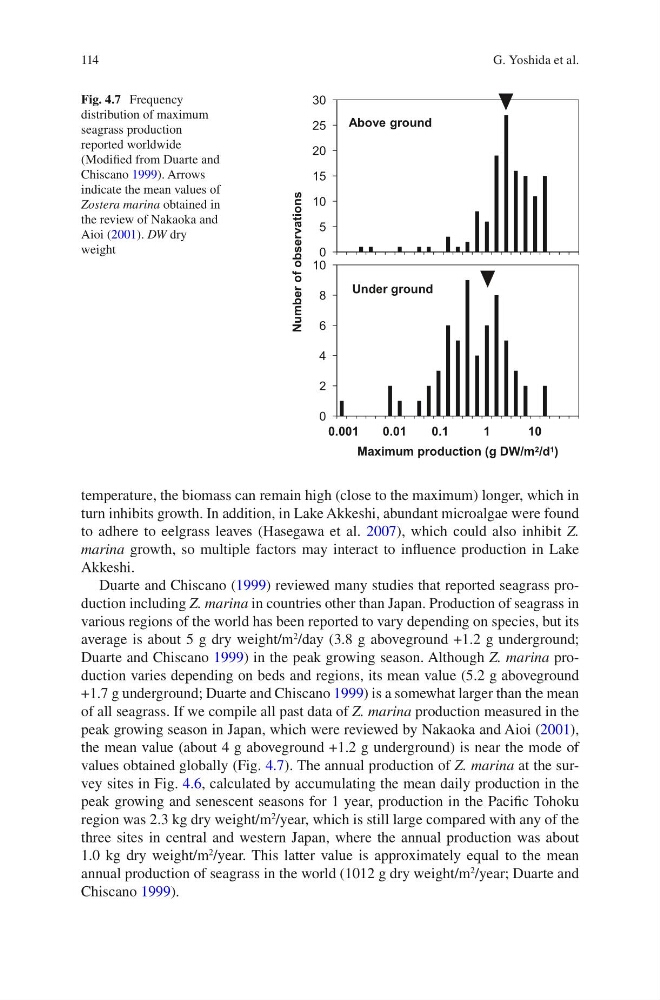
of all seagrass. If we compile all past data of Z. marina production measured in the
peak growing season in Japan, which were reviewed by Nakaoka and Aioi (2001),
the mean value (about 4 g aboveground +1.2 g underground) is near the mode of
values obtained globally (Fig. 4.7). The annual production of Z. marina at the survey sites in Fig. 4.6, calculated by accumulating the mean daily production in the
peak growing and senescent seasons for 1 year, production in the Pacific Tohoku
region was 2.3 kg dry weight/m
2
/year, which is still large compared with any of the
three sites in central and western Japan, where the annual production was about
1.0 kg dry weight/m
2
/year. This latter value is approximately equal to the mean
annual production of seagrass in the world (1012 g dry weight/m
2
/year; Duarte and
Chiscano 1999).
0
5
10
15
20
25
30
0
2
4
6
8
10
Above ground
Under ground
Number of observations
0.001
0.01
0.1
1
1 0
Maximum production (g DW/m 2 /d 1 )
Fig. 4.7 Frequency
distribution of maximum
seagrass production
reported worldwide
(Modified from Duarte and
Chiscano 1999). Arrows
indicate the mean values of
Zostera marina obtained in
the review of Nakaoka and
Aioi (2001). DW dry
weight
G. Yoshida et al.
temperature, the biomass can remain high (close to the maximum) longer, which in
turn inhibits growth. In addition, in Lake Akkeshi, abundant microalgae were found
to adhere to eelgrass leaves (Hasegawa et al. 2007), which could also inhibit Z.
marina growth, so multiple factors may interact to influence production in Lake
Akkeshi.
Duarte and Chiscano (1999) reviewed many studies that reported seagrass production including Z. marina in countries other than Japan. Production of seagrass in
various regions of the world has been reported to vary depending on species, but its
average is about 5 g dry weight/m
2
/day (3.8 g aboveground +1.2 g underground;
Duarte and Chiscano 1999) in the peak growing season. Although Z. marina production varies depending on beds and regions, its mean value (5.2 g aboveground
+1.7 g underground; Duarte and Chiscano 1999) is a somewhat larger than the mean
of all seagrass. If we compile all past data of Z. marina production measured in the
peak growing season in Japan, which were reviewed by Nakaoka and Aioi (2001),
the mean value (about 4 g aboveground +1.2 g underground) is near the mode of
values obtained globally (Fig. 4.7). The annual production of Z. marina at the survey sites in Fig. 4.6, calculated by accumulating the mean daily production in the
peak growing and senescent seasons for 1 year, production in the Pacific Tohoku
region was 2.3 kg dry weight/m
2
/year, which is still large compared with any of the
three sites in central and western Japan, where the annual production was about
1.0 kg dry weight/m
2
/year. This latter value is approximately equal to the mean
annual production of seagrass in the world (1012 g dry weight/m
2
/year; Duarte and
Chiscano 1999).
0
5
10
15
20
25
30
0
2
4
6
8
10
Above ground
Under ground
Number of observations
0.001
0.01
0.1
1
1 0
Maximum production (g DW/m 2 /d 1 )
Fig. 4.7 Frequency
distribution of maximum
seagrass production
reported worldwide
(Modified from Duarte and
Chiscano 1999). Arrows
indicate the mean values of
Zostera marina obtained in
the review of Nakaoka and
Aioi (2001). DW dry
weight
G. Yoshida et al.