

108
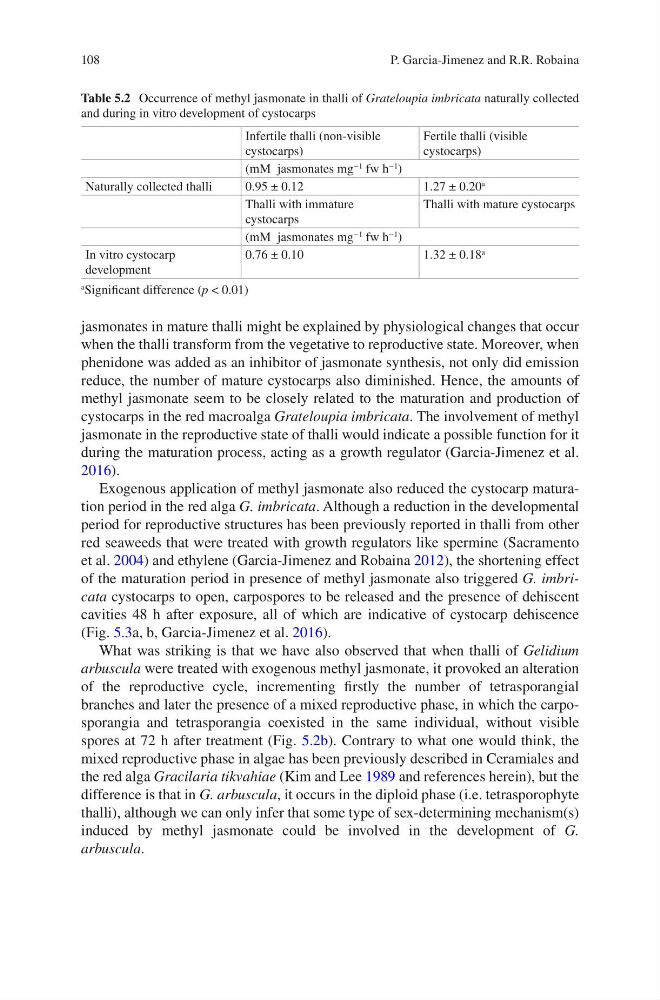
jasmonates in mature thalli might be explained by physiological changes that occur
when the thalli transform from the vegetative to reproductive state. Moreover, when
phenidone was added as an inhibitor of jasmonate synthesis, not only did emission
reduce, the number of mature cystocarps also diminished. Hence, the amounts of
methyl jasmonate seem to be closely related to the maturation and production of
cystocarps in the red macroalga Grateloupia imbricata. The involvement of methyl
jasmonate in the reproductive state of thalli would indicate a possible function for it
during the maturation process, acting as a growth regulator (Garcia-Jimenez et al.
2016).
Exogenous application of methyl jasmonate also reduced the cystocarp maturation period in the red alga G. imbricata. Although a reduction in the developmental
period for reproductive structures has been previously reported in thalli from other
red seaweeds that were treated with growth regulators like spermine (Sacramento
et al. 2004) and ethylene (Garcia-Jimenez and Robaina 2012), the shortening effect
of the maturation period in presence of methyl jasmonate also triggered G. imbricata cystocarps to open, carpospores to be released and the presence of dehiscent
cavities 48 h after exposure, all of which are indicative of cystocarp dehiscence
(Fig. 5.3a, b, Garcia-Jimenez et al. 2016).
What was striking is that we have also observed that when thalli of Gelidium
arbuscula were treated with exogenous methyl jasmonate, it provoked an alteration
of the reproductive cycle, incrementing firstly the number of tetrasporangial
branches and later the presence of a mixed reproductive phase, in which the carposporangia and tetrasporangia coexisted in the same individual, without visible
spores at 72 h after treatment (Fig. 5.2b). Contrary to what one would think, the
mixed reproductive phase in algae has been previously described in Ceramiales and
the red alga Gracilaria tikvahiae (Kim and Lee 1989 and references herein), but the
difference is that in G. arbuscula, it occurs in the diploid phase (i.e. tetrasporophyte
thalli), although we can only infer that some type of sex-determining mechanism(s)
induced by methyl jasmonate could be involved in the development of G.
arbuscula.
Table 5.2 Occurrence of methyl jasmonate in thalli of Grateloupia imbricata naturally collected
and during in vitro development of cystocarps
Infertile thalli (non-visible
cystocarps)
Fertile thalli (visible
cystocarps)
(mM jasmonates mg
−1 fw h
−1
)
Naturally collected thalli
0.95 ± 0.12
1.27 ± 0.20
a
Thalli with immature
cystocarps
Thalli with mature cystocarps
(mM jasmonates mg
−1 fw h
−1
)
In vitro cystocarp
development
0.76 ± 0.10
1.32 ± 0.18
a
a
Significant difference (p < 0.01)
P. Garcia-Jimenez and R.R. Robaina
jasmonates in mature thalli might be explained by physiological changes that occur
when the thalli transform from the vegetative to reproductive state. Moreover, when
phenidone was added as an inhibitor of jasmonate synthesis, not only did emission
reduce, the number of mature cystocarps also diminished. Hence, the amounts of
methyl jasmonate seem to be closely related to the maturation and production of
cystocarps in the red macroalga Grateloupia imbricata. The involvement of methyl
jasmonate in the reproductive state of thalli would indicate a possible function for it
during the maturation process, acting as a growth regulator (Garcia-Jimenez et al.
2016).
Exogenous application of methyl jasmonate also reduced the cystocarp maturation period in the red alga G. imbricata. Although a reduction in the developmental
period for reproductive structures has been previously reported in thalli from other
red seaweeds that were treated with growth regulators like spermine (Sacramento
et al. 2004) and ethylene (Garcia-Jimenez and Robaina 2012), the shortening effect
of the maturation period in presence of methyl jasmonate also triggered G. imbricata cystocarps to open, carpospores to be released and the presence of dehiscent
cavities 48 h after exposure, all of which are indicative of cystocarp dehiscence
(Fig. 5.3a, b, Garcia-Jimenez et al. 2016).
What was striking is that we have also observed that when thalli of Gelidium
arbuscula were treated with exogenous methyl jasmonate, it provoked an alteration
of the reproductive cycle, incrementing firstly the number of tetrasporangial
branches and later the presence of a mixed reproductive phase, in which the carposporangia and tetrasporangia coexisted in the same individual, without visible
spores at 72 h after treatment (Fig. 5.2b). Contrary to what one would think, the
mixed reproductive phase in algae has been previously described in Ceramiales and
the red alga Gracilaria tikvahiae (Kim and Lee 1989 and references herein), but the
difference is that in G. arbuscula, it occurs in the diploid phase (i.e. tetrasporophyte
thalli), although we can only infer that some type of sex-determining mechanism(s)
induced by methyl jasmonate could be involved in the development of G.
arbuscula.
Table 5.2 Occurrence of methyl jasmonate in thalli of Grateloupia imbricata naturally collected
and during in vitro development of cystocarps
Infertile thalli (non-visible
cystocarps)
Fertile thalli (visible
cystocarps)
(mM jasmonates mg
−1 fw h
−1
)
Naturally collected thalli
0.95 ± 0.12
1.27 ± 0.20
a
Thalli with immature
cystocarps
Thalli with mature cystocarps
(mM jasmonates mg
−1 fw h
−1
)
In vitro cystocarp
development
0.76 ± 0.10
1.32 ± 0.18
a
a
Significant difference (p < 0.01)
P. Garcia-Jimenez and R.R. Robaina