

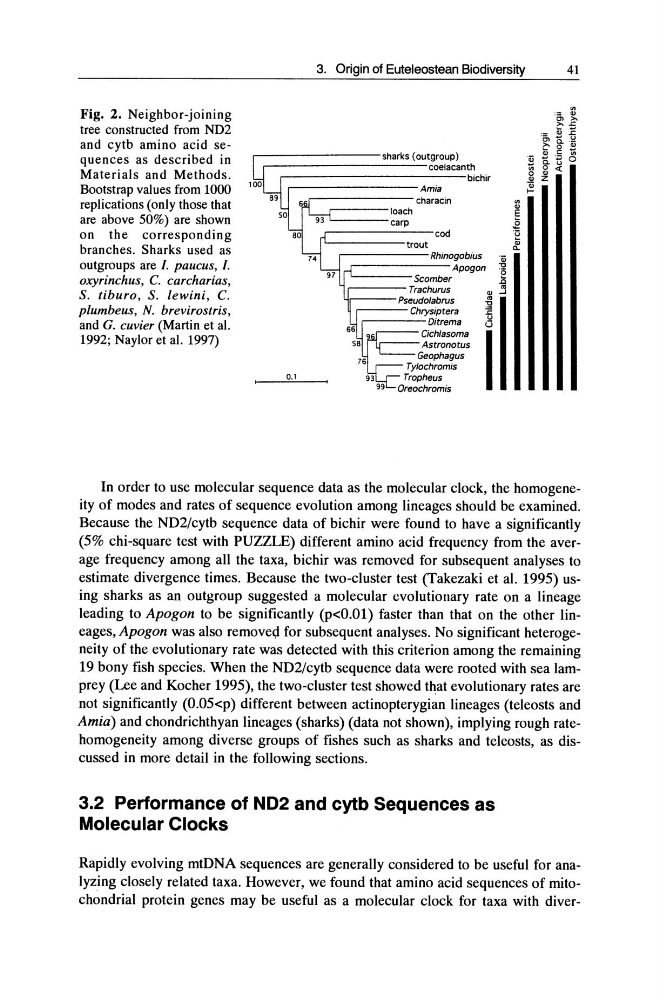
Fig. 2. Neighbor-joining
tree constructed from ND2
and cytb amino acid sequences as described in
Materials and Methods.
Bootstrap values from 1000
replications (only those that
are above 50%) are shown
on the corresponding
branches. Sharks used as
outgroups are J. paucus, J.
oxyrinchus, C. carcharias,
S. tiburo, S. lewini, C.
plumbeus, N. brevirostris,
and G. cuvier (Martin et al.
1992; Naylor et al. 1997)
3. Origin of Euteleostean Biodiversity
41
,----------sharks (outgroup)
.------------coelacanth
,.......-----------bichir
.------------Am~
--r--------characin
on
80
0.1
,..----Ioach
_~o93
carp
~::::::::~-tr-o-ut-COO
~
.--------Rhinogobius .Apogon ~
'-----Scomber
.::
, . . - - - - Trachurus
.. j
4r---Pseudolabrus
~
, . . - - - Chrysiptera
:s
.------Ditrema
U
.. . - - - Cichlasoma
Astronotus
Geophagus
Tylochromis
Tropheus
Oreochromis
I
In order to use molecular sequence data as the molecular clock, the homogeneity of modes and rates of sequence evolution among lineages should be examined.
Because the ND2/cytb sequence data of bichir were found to have a significantly
(5% chi-square test with PUZZLE) different amino acid frequency from the average frequency among all the taxa, bichir was removed for subsequent analyses to
estimate divergence times. Because the two-cluster test (Takezaki et al. 1995) using sharks as an outgroup suggested a molecular evolutionary rate on a lineage
leading to Apogon to be significantly (p
not significantly (O.05
3.2 Performance of ND2 and cytb Sequences as
Molecular Clocks
Rapidly evolving mtDNA sequences are generally considered to be useful for analyzing closely related taxa. However, we found that amino acid sequences of mitochondrial protein genes may be useful as a molecular clock for taxa with diver-
tree constructed from ND2
and cytb amino acid sequences as described in
Materials and Methods.
Bootstrap values from 1000
replications (only those that
are above 50%) are shown
on the corresponding
branches. Sharks used as
outgroups are J. paucus, J.
oxyrinchus, C. carcharias,
S. tiburo, S. lewini, C.
plumbeus, N. brevirostris,
and G. cuvier (Martin et al.
1992; Naylor et al. 1997)
3. Origin of Euteleostean Biodiversity
41
,----------sharks (outgroup)
.------------coelacanth
,.......-----------bichir
.------------Am~
--r--------characin
on
80
0.1
,..----Ioach
_~o93
carp
~::::::::~-tr-o-ut-COO
~
.--------Rhinogobius .Apogon ~
'-----Scomber
.::
, . . - - - - Trachurus
.. j
4r---Pseudolabrus
~
, . . - - - Chrysiptera
:s
.------Ditrema
U
.. . - - - Cichlasoma
Astronotus
Geophagus
Tylochromis
Tropheus
Oreochromis
I
In order to use molecular sequence data as the molecular clock, the homogeneity of modes and rates of sequence evolution among lineages should be examined.
Because the ND2/cytb sequence data of bichir were found to have a significantly
(5% chi-square test with PUZZLE) different amino acid frequency from the average frequency among all the taxa, bichir was removed for subsequent analyses to
estimate divergence times. Because the two-cluster test (Takezaki et al. 1995) using sharks as an outgroup suggested a molecular evolutionary rate on a lineage
leading to Apogon to be significantly (p
not significantly (O.05
3.2 Performance of ND2 and cytb Sequences as
Molecular Clocks
Rapidly evolving mtDNA sequences are generally considered to be useful for analyzing closely related taxa. However, we found that amino acid sequences of mitochondrial protein genes may be useful as a molecular clock for taxa with diver-