

42
Y. Kumazawa et al.
'" 1.5 A. mammals
!'l c
*
~ 1.0
'"
. ~
'm
0..
"0 0.5
II>
~
Cretaclous
Triasu::
CenolOlC:
JuraSStC
B. sharks
C . .
bony fishes
: unlikely r"te area
KIT tioundary
o I ~ __ ~ __ ~~~~ __ ~~~~~~ __ ~ __ ~~~~~~~~==~~~~
() o~
a
100
200
300
100
200
300
a
100
200
300
400
SOO
Divergence Time(MYA)
Divergence Time(MYA)
Dlvergence Time( MYA)
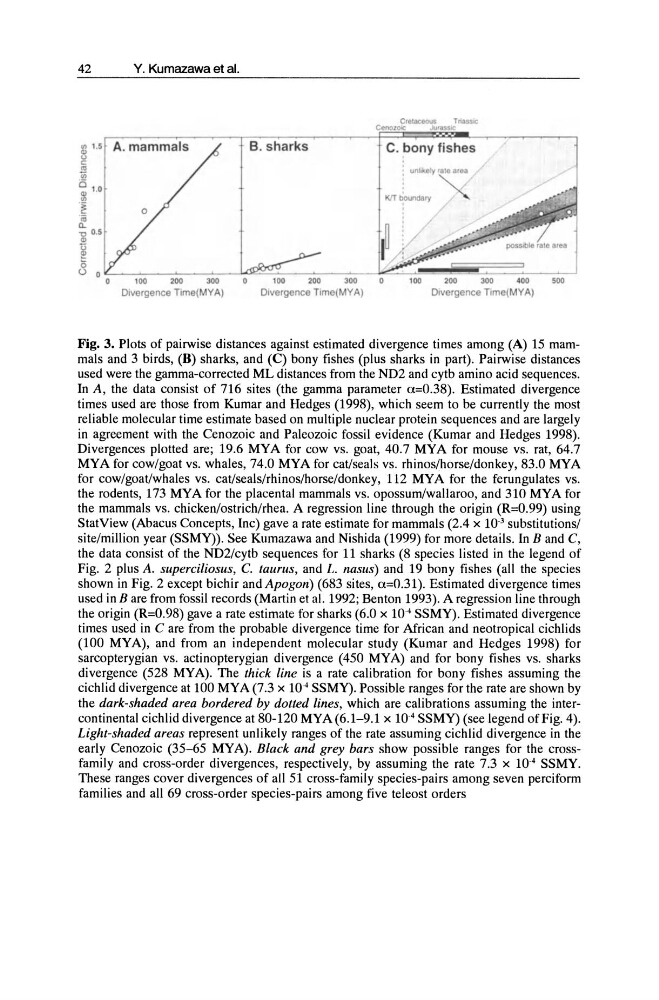
Fig. 3. Plots of pairwise distances against estimated divergence times among (A) 15 mammals and 3 birds, (B) sharks, and (C) bony fishes (plus sharks in part). Pairwise distances
used were the gamma-corrected ML distances from the ND2 and cytb amino acid sequences.
In A, the data consist of 716 sites (the gamma parameter a=0.38). Estimated divergence
times used are those from Kumar and Hedges (1998), which seem to be currently the most
reliable molecular time estimate based on multiple nuclear protein sequences and are largely
in agreement with the Cenozoic and Paleozoic fossil evidence (Kumar and Hedges 1998).
Divergences plotted are; 19.6 MYA for cow vs. goat, 40.7 MYA for mouse vs. rat, 64.7
MYA for cow/goat vs. whales, 74.0 MYA for cat/seals vs. rhinos/horse/donkey, 83.0 MYA
for cow/goat/whales vs. cat/seals/rhinos/horse/donkey, 112 MY A for the ferungulates vs.
the rodents, 173 MYA for the placental mammals vs. opossum/wallaroo, and 310 MYA for
the mammals vs. chicken/ostrich/rhea. A regression line through the origin (R=0.99) using
StatView (Abacus Concepts, Inc) gave a rate estimate for mammals (2.4 x 10- 3 substitutions/
site/million year (SSMY». See Kumazawa and Nishida (1999) for more details. In Band C,
the data consist of the ND2/cytb sequences for 11 sharks (8 species listed in the legend of
Fig. 2 plus A. superciliosus, C. taurus, and L. nasus) and 19 bony fishes (all the species
shown in Fig. 2 except bichir and Apogon) (683 sites, a=0.31). Estimated divergence times
used in B are from fossil records (Martin et al. 1992; Benton 1993). A regression line through
the origin (R=0.98) gave a rate estimate for sharks (6.0 x 10 4 SSMY). Estimated divergence
times used in C are from the probable divergence time for African and neotropical cichlids
(100 MYA), and from an independent molecular study (Kumar and Hedges 1998) for
sarcopterygian vs. actinopterygian divergence (450 MYA) and for bony fishes vs. sharks
divergence (528 MY A). The thick line is a rate calibration for bony fishes assuming the
cichlid divergence at 100 MYA (7.3 x 10 4 SSMY). Possible ranges for the rate are shown by
the dark-shaded area bordered by dotted lines, which are calibrations assuming the intercontinental cichlid divergence at 80-120 MYA(6.1-9.1 x 10- 4 SSMY) (see legend of Fig. 4).
Light-shaded areas represent unlikely ranges of the rate assuming cichlid divergence in the
early Cenozoic (35-65 MY A). Black and grey bars show possible ranges for the crossfamily and cross-order divergences, respectively, by assuming the rate 7.3 x 10- 4 SSMY.
These ranges cover divergences of all 51 cross-family species-pairs among seven perciform
families and all 69 cross-order species-pairs among five teleost orders
Y. Kumazawa et al.
'" 1.5 A. mammals
!'l c
*
~ 1.0
'"
. ~
'm
0..
"0 0.5
II>
~
Cretaclous
Triasu::
CenolOlC:
JuraSStC
B. sharks
C . .
bony fishes
: unlikely r"te area
KIT tioundary
o I ~ __ ~ __ ~~~~ __ ~~~~~~ __ ~ __ ~~~~~~~~==~~~~
() o~
a
100
200
300
100
200
300
a
100
200
300
400
SOO
Divergence Time(MYA)
Divergence Time(MYA)
Dlvergence Time( MYA)
Fig. 3. Plots of pairwise distances against estimated divergence times among (A) 15 mammals and 3 birds, (B) sharks, and (C) bony fishes (plus sharks in part). Pairwise distances
used were the gamma-corrected ML distances from the ND2 and cytb amino acid sequences.
In A, the data consist of 716 sites (the gamma parameter a=0.38). Estimated divergence
times used are those from Kumar and Hedges (1998), which seem to be currently the most
reliable molecular time estimate based on multiple nuclear protein sequences and are largely
in agreement with the Cenozoic and Paleozoic fossil evidence (Kumar and Hedges 1998).
Divergences plotted are; 19.6 MYA for cow vs. goat, 40.7 MYA for mouse vs. rat, 64.7
MYA for cow/goat vs. whales, 74.0 MYA for cat/seals vs. rhinos/horse/donkey, 83.0 MYA
for cow/goat/whales vs. cat/seals/rhinos/horse/donkey, 112 MY A for the ferungulates vs.
the rodents, 173 MYA for the placental mammals vs. opossum/wallaroo, and 310 MYA for
the mammals vs. chicken/ostrich/rhea. A regression line through the origin (R=0.99) using
StatView (Abacus Concepts, Inc) gave a rate estimate for mammals (2.4 x 10- 3 substitutions/
site/million year (SSMY». See Kumazawa and Nishida (1999) for more details. In Band C,
the data consist of the ND2/cytb sequences for 11 sharks (8 species listed in the legend of
Fig. 2 plus A. superciliosus, C. taurus, and L. nasus) and 19 bony fishes (all the species
shown in Fig. 2 except bichir and Apogon) (683 sites, a=0.31). Estimated divergence times
used in B are from fossil records (Martin et al. 1992; Benton 1993). A regression line through
the origin (R=0.98) gave a rate estimate for sharks (6.0 x 10 4 SSMY). Estimated divergence
times used in C are from the probable divergence time for African and neotropical cichlids
(100 MYA), and from an independent molecular study (Kumar and Hedges 1998) for
sarcopterygian vs. actinopterygian divergence (450 MYA) and for bony fishes vs. sharks
divergence (528 MY A). The thick line is a rate calibration for bony fishes assuming the
cichlid divergence at 100 MYA (7.3 x 10 4 SSMY). Possible ranges for the rate are shown by
the dark-shaded area bordered by dotted lines, which are calibrations assuming the intercontinental cichlid divergence at 80-120 MYA(6.1-9.1 x 10- 4 SSMY) (see legend of Fig. 4).
Light-shaded areas represent unlikely ranges of the rate assuming cichlid divergence in the
early Cenozoic (35-65 MY A). Black and grey bars show possible ranges for the crossfamily and cross-order divergences, respectively, by assuming the rate 7.3 x 10- 4 SSMY.
These ranges cover divergences of all 51 cross-family species-pairs among seven perciform
families and all 69 cross-order species-pairs among five teleost orders