

294
K. Omoto
pure descendants of the Jomonese, while the majority of the Japanese, called HondoJapanese or Wajin, are a strongly mixed group. Secondly, it is assumed that the
Jomonese were derived from the Upper Paleolithic population of Japan who originated in south-eastern Asia, while the Yayoi migrants were from north-eastern
Asia.
Japanese archaeologists, however, find that cultural remains such as the stone
tools of the Upper Paleolithic Times in Japan and also the pottery and pit type
dwellings of the Jomon Period have strong affinities to those of north-eastern Asia,
rather than to those of south-eastern Asia. Among geneticists, Nei (1995) criticized
Hanihara's model on the basis of genetic distance analysis using the data of classic
genetic markers, negating both the dual structure and the south-east Asian origin
of the Jomonese.
Recently, we have tested Hanihara's two sub-models separately by genetic distance analyses, using data from up to 25 genetic loci of classic genetic markers
(Omoto and Saitou 1997). In these analyses we used the "modified Cavalli-Sforza's"
genetic distance (Nei et al. 1983) and the neighbor-joining (NJ) method for constructing phylogenetic trees (Saitou and Nei 1987). The results supported Hanihara's
model only partly. While the "dual structure" is suggested to present genetically,
the origin of the native inhabitants as indicated by the Ainu and the Ryukyuan
genetic compositions does not seem to point to south-east Asia. Rather, they may
have been derived from north-eastern Asian populations (Fig. 4). This finding in
turn suggests that, contrary to the hitherto popular view of morphological anthropologists, there were at least two independent sources for human migrations in
eastern Asia during Upper Paleolithic Times from about 50000 to 20000 years BP.
I will come back to this point later.
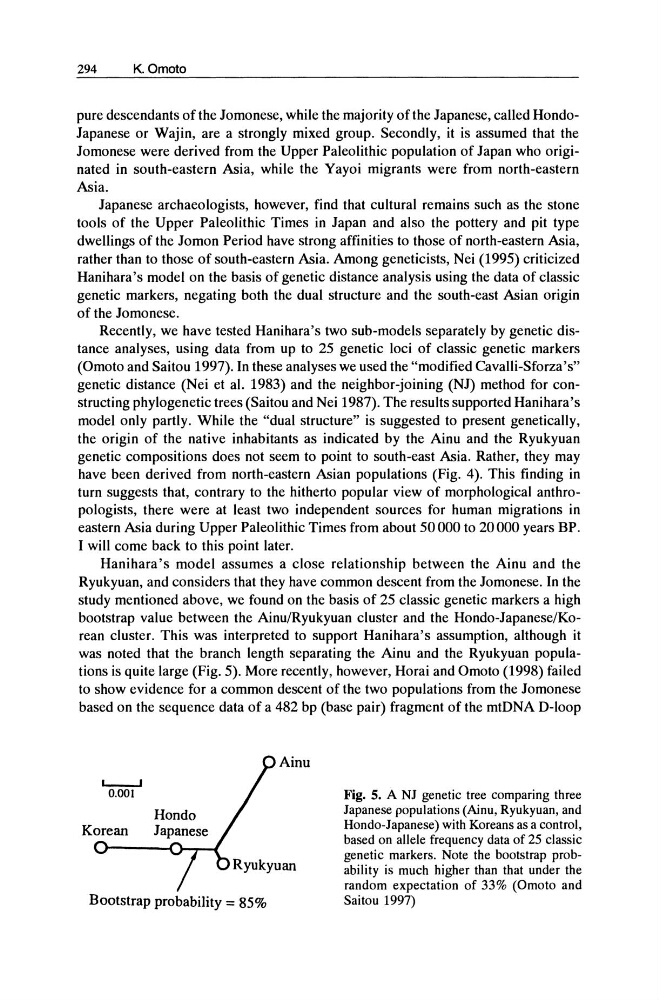
Hanihara's model assumes a close relationship between the Ainu and the
Ryukyuan, and considers that they have common descent from the Jomonese. In the
study mentioned above, we found on the basis of 25 classic genetic markers a high
bootstrap value between the Ainu/Ryukyuan cluster and the Hondo-Japanese/Korean cluster. This was interpreted to support Hanihara's assumption, although it
was noted that the branch length separating the Ainu and the Ryukyuan populations is quite large (Fig. 5). More recently, however, Horai and Omoto (1998) failed
to show evidence for a common descent of the two populations from the Jomonese
based on the sequence data of a 482 bp (base pair) fragment of the mtDNA D-loop
I---.J
0.001
Bootstrap probability = 85%
Ainu
Fig. 5. A NJ genetic tree comparing three
Japanese populations (Ainu, Ryukyuan, and
Hondo-Japanese) with Koreans as a control,
based on allele frequency data of 25 classic
genetic markers. Note the bootstrap probability is much higher than that under the
random expectation of 33% (Ornata and
Saitou 1997)
K. Omoto
pure descendants of the Jomonese, while the majority of the Japanese, called HondoJapanese or Wajin, are a strongly mixed group. Secondly, it is assumed that the
Jomonese were derived from the Upper Paleolithic population of Japan who originated in south-eastern Asia, while the Yayoi migrants were from north-eastern
Asia.
Japanese archaeologists, however, find that cultural remains such as the stone
tools of the Upper Paleolithic Times in Japan and also the pottery and pit type
dwellings of the Jomon Period have strong affinities to those of north-eastern Asia,
rather than to those of south-eastern Asia. Among geneticists, Nei (1995) criticized
Hanihara's model on the basis of genetic distance analysis using the data of classic
genetic markers, negating both the dual structure and the south-east Asian origin
of the Jomonese.
Recently, we have tested Hanihara's two sub-models separately by genetic distance analyses, using data from up to 25 genetic loci of classic genetic markers
(Omoto and Saitou 1997). In these analyses we used the "modified Cavalli-Sforza's"
genetic distance (Nei et al. 1983) and the neighbor-joining (NJ) method for constructing phylogenetic trees (Saitou and Nei 1987). The results supported Hanihara's
model only partly. While the "dual structure" is suggested to present genetically,
the origin of the native inhabitants as indicated by the Ainu and the Ryukyuan
genetic compositions does not seem to point to south-east Asia. Rather, they may
have been derived from north-eastern Asian populations (Fig. 4). This finding in
turn suggests that, contrary to the hitherto popular view of morphological anthropologists, there were at least two independent sources for human migrations in
eastern Asia during Upper Paleolithic Times from about 50000 to 20000 years BP.
I will come back to this point later.
Hanihara's model assumes a close relationship between the Ainu and the
Ryukyuan, and considers that they have common descent from the Jomonese. In the
study mentioned above, we found on the basis of 25 classic genetic markers a high
bootstrap value between the Ainu/Ryukyuan cluster and the Hondo-Japanese/Korean cluster. This was interpreted to support Hanihara's assumption, although it
was noted that the branch length separating the Ainu and the Ryukyuan populations is quite large (Fig. 5). More recently, however, Horai and Omoto (1998) failed
to show evidence for a common descent of the two populations from the Jomonese
based on the sequence data of a 482 bp (base pair) fragment of the mtDNA D-loop
I---.J
0.001
Bootstrap probability = 85%
Ainu
Fig. 5. A NJ genetic tree comparing three
Japanese populations (Ainu, Ryukyuan, and
Hondo-Japanese) with Koreans as a control,
based on allele frequency data of 25 classic
genetic markers. Note the bootstrap probability is much higher than that under the
random expectation of 33% (Ornata and
Saitou 1997)