

19. Human Genetic Diversity in Eastern Asia
293
His model can be divided into two sub-hypotheses as follows. Firstly, Hanihara
considers that present Japanese populations were formed by a mixture of two essentially independent populations: the native Jomonese and the migrant Yayoi populations. The former were the native people of Japan during the Neolithic Jomon Period (ca. 12000 - 2300 years BP (Before Present) ) and the latter were peoples of
north-eastern Asia who migrated to western Japan during the Eneolithic Yayoi
Period (2300 - 1700 years BP). The ethnic minorities of present-day Japan, namely
the Ainu of Hokkaido and the Ryukyuans of the Okinawa Islands are both relatively
San
96
39
13
14
2
100
Pygmy
Yoruba
English
Italian
Native North American
Native South American
39
Australian Aborigines
Papua New Guinean
Tibetan
Mongolian
Southern Chinese
22
14
Polynesian
'--_--"_ Micronesian
4
8
20
Thai
Filipino
Indonesian
,...--- Negritos (Aeta)
Negritos (Mamanwa)
0.05
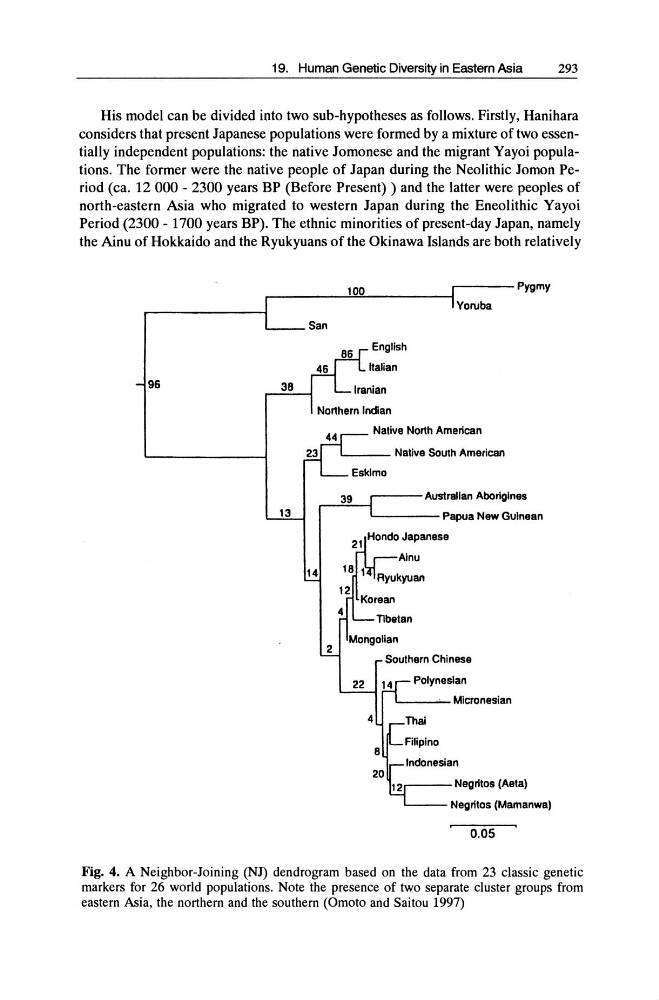
Fig. 4. A Neighbor-Joining (NJ) dendrogram based on the data from 23 classic genetic
markers for 26 world populations. Note the presence of two separate cluster groups from
eastern Asia, the northern and the southern (Omoto and Saitou 1997)
293
His model can be divided into two sub-hypotheses as follows. Firstly, Hanihara
considers that present Japanese populations were formed by a mixture of two essentially independent populations: the native Jomonese and the migrant Yayoi populations. The former were the native people of Japan during the Neolithic Jomon Period (ca. 12000 - 2300 years BP (Before Present) ) and the latter were peoples of
north-eastern Asia who migrated to western Japan during the Eneolithic Yayoi
Period (2300 - 1700 years BP). The ethnic minorities of present-day Japan, namely
the Ainu of Hokkaido and the Ryukyuans of the Okinawa Islands are both relatively
San
96
39
13
14
2
100
Pygmy
Yoruba
English
Italian
Native North American
Native South American
39
Australian Aborigines
Papua New Guinean
Tibetan
Mongolian
Southern Chinese
22
14
Polynesian
'--_--"_ Micronesian
4
8
20
Thai
Filipino
Indonesian
,...--- Negritos (Aeta)
Negritos (Mamanwa)
0.05
Fig. 4. A Neighbor-Joining (NJ) dendrogram based on the data from 23 classic genetic
markers for 26 world populations. Note the presence of two separate cluster groups from
eastern Asia, the northern and the southern (Omoto and Saitou 1997)