

292
K. Ornoto
of what is now Indonesian islands. Their phenotypic resemblance to the Mrican
Pygmy is probably due to conversion resulting from adaptive evolution in tropical
rain forests, since it was assumed that small size may have a selective advantage in
that environment (Omoto 1984).
It was further found, based on the presence or absence of several unique alleles
of red cell enzyme and serum protein types, that among the so-called Negrito populations of the Philippines, the Aeta of western-central Luzon and the Mamanwa of
northern Mindanao are genetically quite different from each other. Thus, it was
considered to be likely that during the Late Pleistocene Time, at least two different
waves of migration should have given rise to the Negritos (Fig. 2). One wave came
directly from Sundaland, perhaps via Borneo and Palawan to Luzon, and the other
from the island area to the west of Sundaland referred to as Wallacea northward to
Mindanao, and further north to the eastern coast of Luzon (Omoto 1984).
2 The Genetic Origins of the Japanese
The first main topic of this chapter is the origins of the Japanese peoples, that is,
the modern human populations of the Japanese archipelago. Since the time, in the
middle of the 19th Century, that Philip Franz von Siebold (1796-1866) considered
in his magnificent book Nippon that the original inhabitants of the Japanese archipelago were the Ainu, there have been a long list of publications concerning this
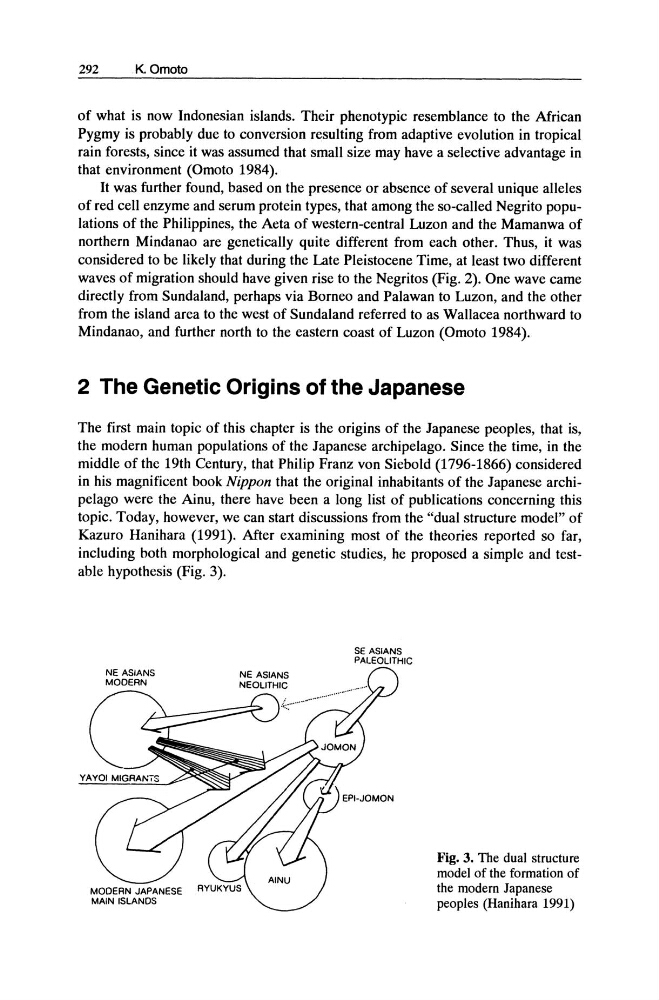
topic. Today, however, we can start discussions from the "dual structure model" of
Kazuro Hanihara (1991). Mter examining most of the theories reported so far,
including both morphological and genetic studies, he proposed a simple and testable hypothesis (Fig. 3).
SE ASIANS
PALEOLITHIC
Fig. 3. The dual structure
model of the formation of
the modem Japanese
peoples (Hanihara 1991)
K. Ornoto
of what is now Indonesian islands. Their phenotypic resemblance to the Mrican
Pygmy is probably due to conversion resulting from adaptive evolution in tropical
rain forests, since it was assumed that small size may have a selective advantage in
that environment (Omoto 1984).
It was further found, based on the presence or absence of several unique alleles
of red cell enzyme and serum protein types, that among the so-called Negrito populations of the Philippines, the Aeta of western-central Luzon and the Mamanwa of
northern Mindanao are genetically quite different from each other. Thus, it was
considered to be likely that during the Late Pleistocene Time, at least two different
waves of migration should have given rise to the Negritos (Fig. 2). One wave came
directly from Sundaland, perhaps via Borneo and Palawan to Luzon, and the other
from the island area to the west of Sundaland referred to as Wallacea northward to
Mindanao, and further north to the eastern coast of Luzon (Omoto 1984).
2 The Genetic Origins of the Japanese
The first main topic of this chapter is the origins of the Japanese peoples, that is,
the modern human populations of the Japanese archipelago. Since the time, in the
middle of the 19th Century, that Philip Franz von Siebold (1796-1866) considered
in his magnificent book Nippon that the original inhabitants of the Japanese archipelago were the Ainu, there have been a long list of publications concerning this
topic. Today, however, we can start discussions from the "dual structure model" of
Kazuro Hanihara (1991). Mter examining most of the theories reported so far,
including both morphological and genetic studies, he proposed a simple and testable hypothesis (Fig. 3).
SE ASIANS
PALEOLITHIC
Fig. 3. The dual structure
model of the formation of
the modem Japanese
peoples (Hanihara 1991)