

19. Human Genetic Diversity in Eastern Asia
291
(1967) were at the frontier of human popUlation genetic studies. Adopting these
methods, I was able to negate the popular notion in classic anthropology that the
Ainu are an old European race (Fig. 1). It was shown that they should belong to the
"Mongoloid" or the truly Asian population group who may have migrated to Japan
during the Upper Paleolithic Time (Omoto 1972, 1975).
1.2 The Genetic Origins of the Negritos
The study of the Philippine Negritos started in 1975 and lasted for about ten years.
I was able to obtain nearly 1000 blood samples of different tribal groups widely
scattered in remote areas of the Philippines. My main findings were twofold. Firstly,
I was able to show that the Negritos have little genetic affinities to the Africans,
contrary to the classic anthropological view based on morphological similarities,
such as dark skin, frizzle hair and small stature. My interpretation was that the
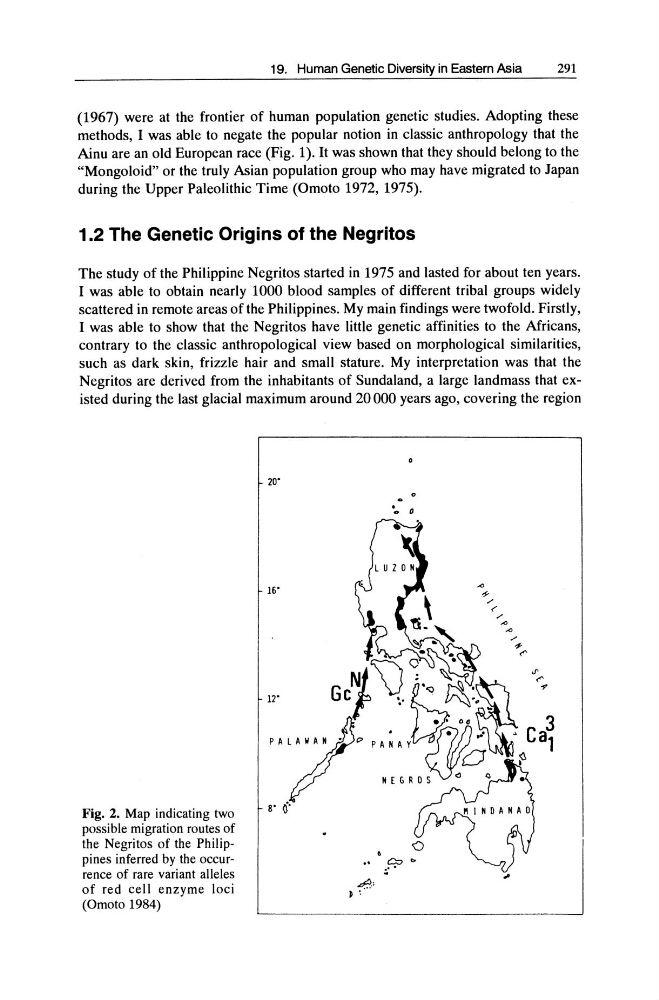
Negritos are derived from the inhabitants of Sundaland, a large landmass that existed during the last glacial maximum around 20000 years ago, covering the region
Fig. 2. Map indicating two
possible migration routes of
the Negritos of the Philippines inferred by the occurrence of rare variant alleles
of red cell enzyme loci
(Omoto 1984)
20'
16'
12'
o
... 0
Cob
;, ..
291
(1967) were at the frontier of human popUlation genetic studies. Adopting these
methods, I was able to negate the popular notion in classic anthropology that the
Ainu are an old European race (Fig. 1). It was shown that they should belong to the
"Mongoloid" or the truly Asian population group who may have migrated to Japan
during the Upper Paleolithic Time (Omoto 1972, 1975).
1.2 The Genetic Origins of the Negritos
The study of the Philippine Negritos started in 1975 and lasted for about ten years.
I was able to obtain nearly 1000 blood samples of different tribal groups widely
scattered in remote areas of the Philippines. My main findings were twofold. Firstly,
I was able to show that the Negritos have little genetic affinities to the Africans,
contrary to the classic anthropological view based on morphological similarities,
such as dark skin, frizzle hair and small stature. My interpretation was that the
Negritos are derived from the inhabitants of Sundaland, a large landmass that existed during the last glacial maximum around 20000 years ago, covering the region
Fig. 2. Map indicating two
possible migration routes of
the Negritos of the Philippines inferred by the occurrence of rare variant alleles
of red cell enzyme loci
(Omoto 1984)
20'
16'
12'
o
... 0
Cob
;, ..