

290
K. Omoto
this area by analyzing geographical and genetic diversities. The methods I used
were mainly a combination of field work on blood collections and laboratory work
on "classic" genetic markers such as blood groups and protein types, followed by
multivariate statistical analyses of genetic distance. Only after the 1980's was the
DNA data, mostly of mtDNA, made available using the samples I have collected,
largely resulting in similar findings of genetic relationship to those obtained by
"classic" markers.
Here, I will first briefly introduce my earlier studies on two indigenous populations of eastern Asia, namely the Ainu of northern Japan and the Negritos of the
Philippines. Then, I will focus on two topics which have arisen from my studies: (1)
the origins of the Japanese populations, and (2) the genetic diversity of the socalled Mongoloid group.
1.1 The Genetic Origins of the Ainu
My study on the Ainu was carried out as part of the International Biology Program
(IBP) and started in 1966, lasting for about 6 years. Altogether, I was able to obtain
about 500 blood samples from the Ainu individuals living in the region of Hidaka,
Hokkaido. At that time, studies on the protein polymorphisms detected by electrophoresis and genetic distance analysis with the construction of phylogenetic trees
for human ethnic groups developed by L. L. Cavalli-Sforza and A. W. F. Edwards
I
BANTU
I
ERGLISH
N.AMERICAN INDIANS
~
I
CHINESE
I
JAPANESE
AINU(ANC ESTRAL>
AUSTRALIA N ABORIGINES
I
MICRONESIAN
I
NEW GUINEAK
o
.1
.2
.3
.4
.5
.6
.7
.8
.9
1.0
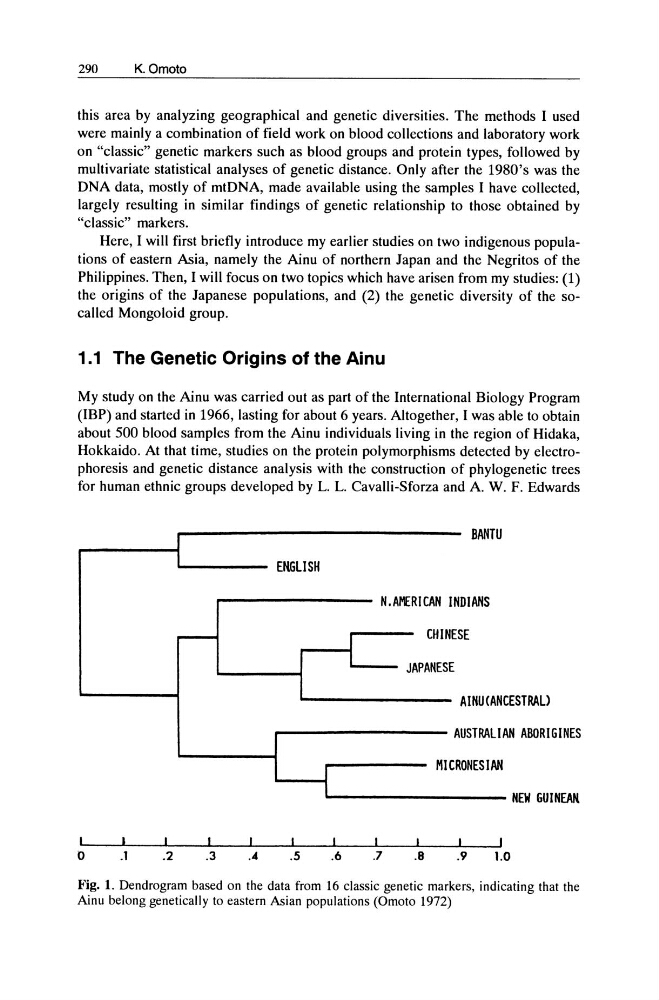
Fig. l. Dendrogram based on the data from 16 classic genetic markers, indicating that the
Ainu belong genetically to eastern Asian populations (Ornoto 1972)
K. Omoto
this area by analyzing geographical and genetic diversities. The methods I used
were mainly a combination of field work on blood collections and laboratory work
on "classic" genetic markers such as blood groups and protein types, followed by
multivariate statistical analyses of genetic distance. Only after the 1980's was the
DNA data, mostly of mtDNA, made available using the samples I have collected,
largely resulting in similar findings of genetic relationship to those obtained by
"classic" markers.
Here, I will first briefly introduce my earlier studies on two indigenous populations of eastern Asia, namely the Ainu of northern Japan and the Negritos of the
Philippines. Then, I will focus on two topics which have arisen from my studies: (1)
the origins of the Japanese populations, and (2) the genetic diversity of the socalled Mongoloid group.
1.1 The Genetic Origins of the Ainu
My study on the Ainu was carried out as part of the International Biology Program
(IBP) and started in 1966, lasting for about 6 years. Altogether, I was able to obtain
about 500 blood samples from the Ainu individuals living in the region of Hidaka,
Hokkaido. At that time, studies on the protein polymorphisms detected by electrophoresis and genetic distance analysis with the construction of phylogenetic trees
for human ethnic groups developed by L. L. Cavalli-Sforza and A. W. F. Edwards
I
BANTU
I
ERGLISH
N.AMERICAN INDIANS
~
I
CHINESE
I
JAPANESE
AINU(ANC ESTRAL>
AUSTRALIA N ABORIGINES
I
MICRONESIAN
I
NEW GUINEAK
o
.1
.2
.3
.4
.5
.6
.7
.8
.9
1.0
Fig. l. Dendrogram based on the data from 16 classic genetic markers, indicating that the
Ainu belong genetically to eastern Asian populations (Ornoto 1972)