

19. Human Genetic Diversity in Eastern Asia
295
region. Also, a recent morphological study using non-metrical traits of skulls indicates a remote relationship between the Ainu and the Ryukyuan (Dodo et al. 1998).
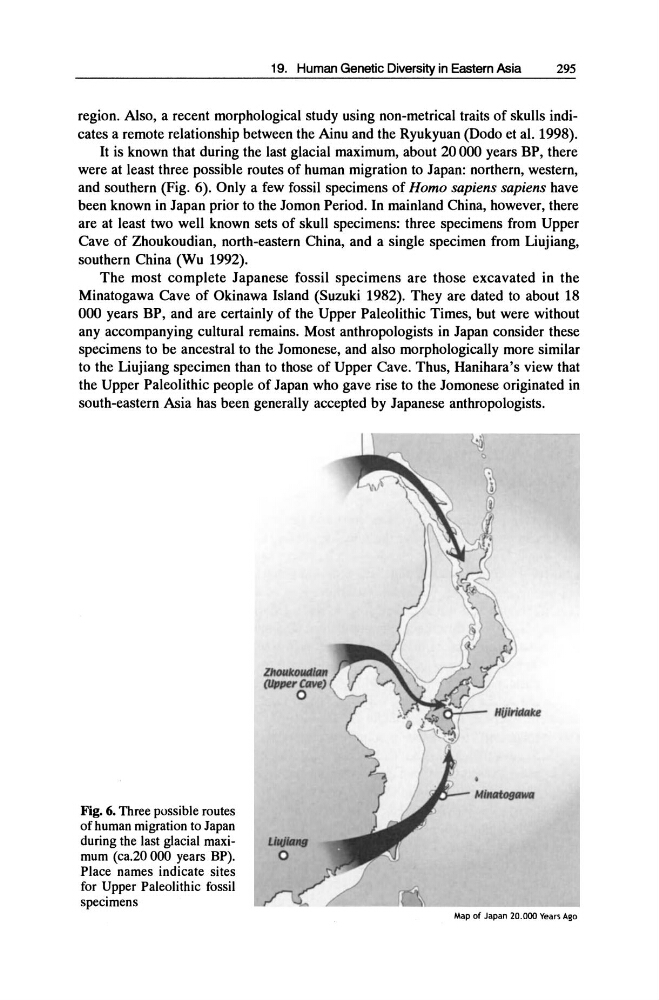
It is known that during the last glacial maximum, about 20 000 years BP, there
were at least three possible routes of human migration to Japan: northern, western,
and southern (Fig. 6). Only a few fossil specimens of Homo sapiens sapiens have
been known in Japan prior to the Jomon Period. In mainland China, however, there
are at least two well known sets of skull specimens: three specimens from Upper
Cave of Zhoukoudian, north-eastern China, and a single specimen from Liujiang,
southern China (Wu 1992).
The most complete Japanese fossil specimens are those excavated in the
Minatogawa Cave of Okinawa Island (Suzuki 1982). They are dated to about 18
000 years BP, and are certainly of the Upper Paleolithic Times, but were without
any accompanying cultural remains. Most anthropologists in Japan consider these
specimens to be ancestral to the Jomonese, and also morphologically more similar
to the Liujiang specimen than to those of Upper Cave. Thus, Hanihara's view that
the Upper Paleolithic people of Japan who gave rise to the Jomonese originated in
south-eastern Asia has been generally accepted by Japanese anthropologists.
Fig. 6. Three possible routes
of human migration to Japan
during the last glacial maximum (ca.20 000 years BP).
Place names indicate sites
for Upper Paleolithic fossil
specimens
LIIt/ItIIw
o
Map of Japan 20.000 Years Ago
295
region. Also, a recent morphological study using non-metrical traits of skulls indicates a remote relationship between the Ainu and the Ryukyuan (Dodo et al. 1998).
It is known that during the last glacial maximum, about 20 000 years BP, there
were at least three possible routes of human migration to Japan: northern, western,
and southern (Fig. 6). Only a few fossil specimens of Homo sapiens sapiens have
been known in Japan prior to the Jomon Period. In mainland China, however, there
are at least two well known sets of skull specimens: three specimens from Upper
Cave of Zhoukoudian, north-eastern China, and a single specimen from Liujiang,
southern China (Wu 1992).
The most complete Japanese fossil specimens are those excavated in the
Minatogawa Cave of Okinawa Island (Suzuki 1982). They are dated to about 18
000 years BP, and are certainly of the Upper Paleolithic Times, but were without
any accompanying cultural remains. Most anthropologists in Japan consider these
specimens to be ancestral to the Jomonese, and also morphologically more similar
to the Liujiang specimen than to those of Upper Cave. Thus, Hanihara's view that
the Upper Paleolithic people of Japan who gave rise to the Jomonese originated in
south-eastern Asia has been generally accepted by Japanese anthropologists.
Fig. 6. Three possible routes
of human migration to Japan
during the last glacial maximum (ca.20 000 years BP).
Place names indicate sites
for Upper Paleolithic fossil
specimens
LIIt/ItIIw
o
Map of Japan 20.000 Years Ago