

12. Functional Differentiation and Positive Feedback
189
160
140
120
100
E
80
~
60
...
Q)
40
Cil
E 20
ctI
'0
.~
0
is
0.0001
D..
0.001
0.01 0.0001
0.001
0.01 0.0001
0.001
0.01
0.1
E 160
>UJ
ctI
140
(ij
~ 120
Q)
is 100
a..
80
60
40
20
0
0.0001
0.001
0.01 0.0001
0.001
0.01 0.0001
0.001
0.01
0.1
-2 -1
Potential recruitment rate (em yr )
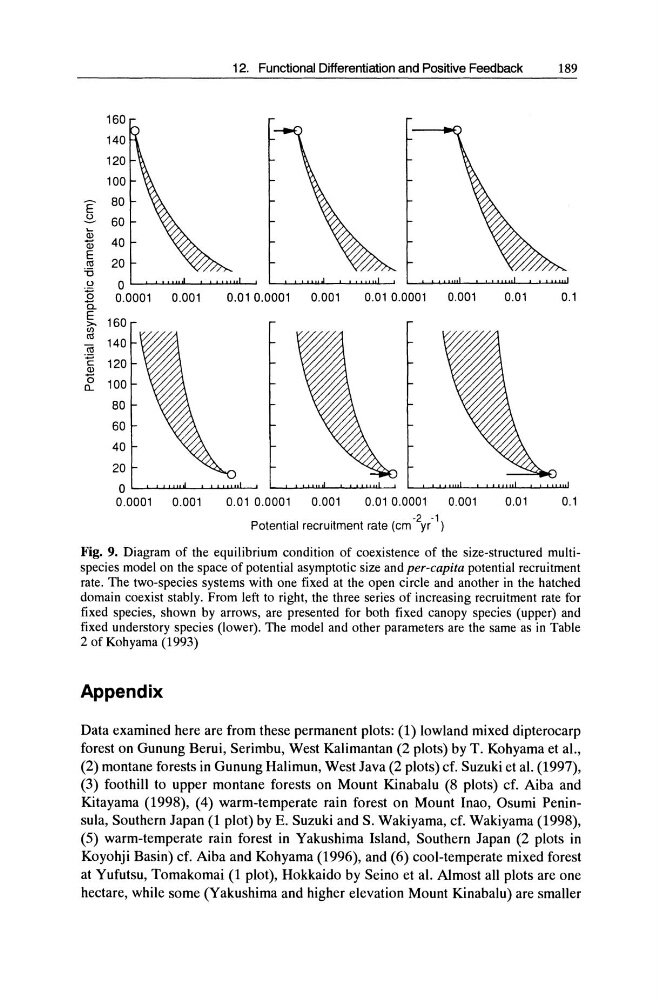
Fig. 9. Diagram of the equilibrium condition of coexistence of the size-structured multispecies model on the space of potential asymptotic size and per-capita potential recruitment
rate. The two-species systems with one fixed at the open circle and another in the hatched
domain coexist stably. From left to right, the three series of increasing recruitment rate for
fixed species, shown by arrows, are presented for both fixed canopy species (upper) and
fixed understory species (lower). The model and other parameters are the same as in Table
2 of Kohyama (1993)
Appendix
Data examined here are from these permanent plots: (1) lowland mixed dipterocarp
forest on Gunung Berui, Serimbu, West Kalimantan (2 plots) by T. Kohyama et aI.,
(2) montane forests in Gunung Halimun, West Java (2 plots) cf. Suzuki et al. (1997),
(3) foothill to upper montane forests on Mount Kinabalu (8 plots) cf. Aiba and
Kitayama (1998), (4) warm-temperate rain forest on Mount Inao, Osumi Peninsula, Southern Japan (1 plot) by E. Suzuki and S. Wakiyama, cf. Wakiyama (1998),
(5) warm-temperate rain forest in Yakushima Island, Southern Japan (2 plots in
Koyohji Basin) cf. Aiba and Kohyama (1996), and (6) cool-temperate mixed forest
at Yufutsu, Tomakomai (1 plot), Hokkaido by Seino et al. Almost all plots are one
hectare, while some (Yakushima and higher elevation Mount Kinabalu) are smaller
189
160
140
120
100
E
80
~
60
...
Q)
40
Cil
E 20
ctI
'0
.~
0
is
0.0001
D..
0.001
0.01 0.0001
0.001
0.01 0.0001
0.001
0.01
0.1
E 160
>UJ
ctI
140
(ij
~ 120
Q)
is 100
a..
80
60
40
20
0
0.0001
0.001
0.01 0.0001
0.001
0.01 0.0001
0.001
0.01
0.1
-2 -1
Potential recruitment rate (em yr )
Fig. 9. Diagram of the equilibrium condition of coexistence of the size-structured multispecies model on the space of potential asymptotic size and per-capita potential recruitment
rate. The two-species systems with one fixed at the open circle and another in the hatched
domain coexist stably. From left to right, the three series of increasing recruitment rate for
fixed species, shown by arrows, are presented for both fixed canopy species (upper) and
fixed understory species (lower). The model and other parameters are the same as in Table
2 of Kohyama (1993)
Appendix
Data examined here are from these permanent plots: (1) lowland mixed dipterocarp
forest on Gunung Berui, Serimbu, West Kalimantan (2 plots) by T. Kohyama et aI.,
(2) montane forests in Gunung Halimun, West Java (2 plots) cf. Suzuki et al. (1997),
(3) foothill to upper montane forests on Mount Kinabalu (8 plots) cf. Aiba and
Kitayama (1998), (4) warm-temperate rain forest on Mount Inao, Osumi Peninsula, Southern Japan (1 plot) by E. Suzuki and S. Wakiyama, cf. Wakiyama (1998),
(5) warm-temperate rain forest in Yakushima Island, Southern Japan (2 plots in
Koyohji Basin) cf. Aiba and Kohyama (1996), and (6) cool-temperate mixed forest
at Yufutsu, Tomakomai (1 plot), Hokkaido by Seino et al. Almost all plots are one
hectare, while some (Yakushima and higher elevation Mount Kinabalu) are smaller