

184
T. Kohyama et al.
a
b
(J)
N
'Vi
II
i5
Ci.
E
>(/)
a>
e.g. capacity of recruitment
(J)
N
'Vi
II
B a.
E
>(/)
a>
lose
toA&B
win
over A&B
e.g. capacity of recruitment
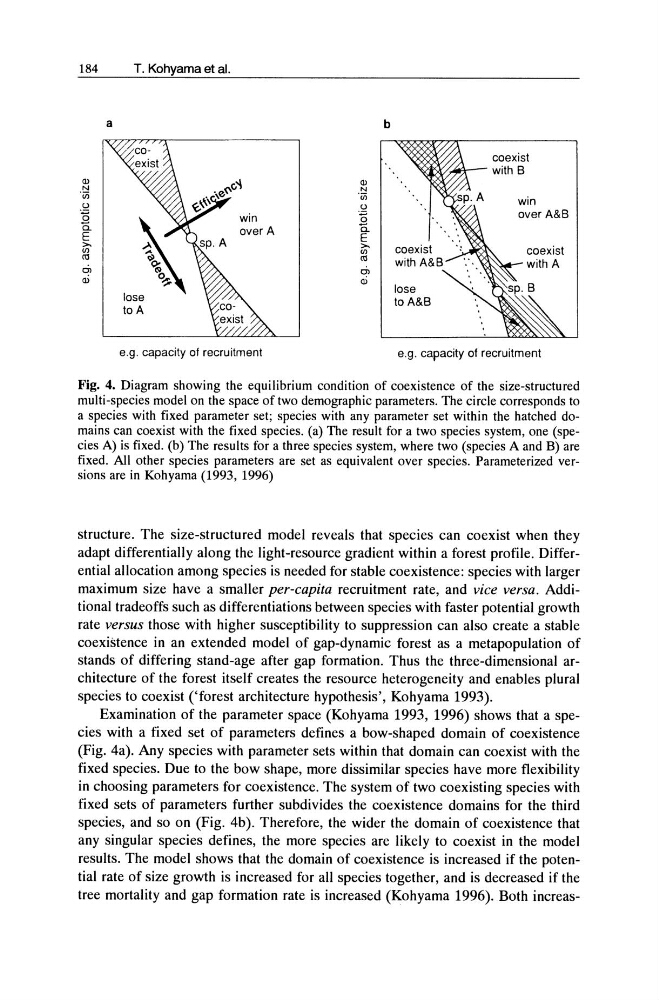
Fig. 4. Diagram showing the equilibrium condition of coexistence of the size-structured
multi-species model on the space of two demographic parameters. The circle corresponds to
a species with fixed parameter set; species with any parameter set within the hatched domains can coexist with the fixed species. (a) The result for a two species system, one (species A) is fixed. (b) The results for a three species system, where two (species A and B) are
fixed. All other species parameters are set as equivalent over species. Parameterized versions are in Kohyama (1993, 1996)
structure. The size-structured model reveals that species can coexist when they
adapt differentially along the light-resource gradient within a forest profile. Differential allocation among species is needed for stable coexistence: species with larger
maximum size have a smaller per-capita recruitment rate, and vice versa. Additional tradeoffs such as differentiations between species with faster potential growth
rate versus those with higher susceptibility to suppression can also create a stable
coexistence in an extended model of gap-dynamic forest as a metapopulation of
stands of differing stand-age after gap formation. Thus the three-dimensional architecture of the forest itself creates the resource heterogeneity and enables plural
species to coexist (,forest architecture hypothesis', Kohyama 1993).
Examination of the parameter space (Kohyama 1993, 1996) shows that a species with a fixed set of parameters defines a bow-shaped domain of coexistence
(Fig. 4a). Any species with parameter sets within that domain can coexist with the
fixed species. Due to the bow shape, more dissimilar species have more flexibility
in choosing parameters for coexistence. The system of two coexisting species with
fixed sets of parameters further subdivides the coexistence domains for the third
species, and so on (Fig. 4b). Therefore, the wider the domain of coexistence that
any singular species defines, the more species are likely to coexist in the model
results. The model shows that the domain of coexistence is increased if the potential rate of size growth is increased for all species together, and is decreased if the
tree mortality and gap formation rate is increased (Kohyama 1996). Both increas-
T. Kohyama et al.
a
b
(J)
N
'Vi
II
i5
Ci.
E
>(/)
a>
e.g. capacity of recruitment
(J)
N
'Vi
II
B a.
E
>(/)
a>
lose
toA&B
win
over A&B
e.g. capacity of recruitment
Fig. 4. Diagram showing the equilibrium condition of coexistence of the size-structured
multi-species model on the space of two demographic parameters. The circle corresponds to
a species with fixed parameter set; species with any parameter set within the hatched domains can coexist with the fixed species. (a) The result for a two species system, one (species A) is fixed. (b) The results for a three species system, where two (species A and B) are
fixed. All other species parameters are set as equivalent over species. Parameterized versions are in Kohyama (1993, 1996)
structure. The size-structured model reveals that species can coexist when they
adapt differentially along the light-resource gradient within a forest profile. Differential allocation among species is needed for stable coexistence: species with larger
maximum size have a smaller per-capita recruitment rate, and vice versa. Additional tradeoffs such as differentiations between species with faster potential growth
rate versus those with higher susceptibility to suppression can also create a stable
coexistence in an extended model of gap-dynamic forest as a metapopulation of
stands of differing stand-age after gap formation. Thus the three-dimensional architecture of the forest itself creates the resource heterogeneity and enables plural
species to coexist (,forest architecture hypothesis', Kohyama 1993).
Examination of the parameter space (Kohyama 1993, 1996) shows that a species with a fixed set of parameters defines a bow-shaped domain of coexistence
(Fig. 4a). Any species with parameter sets within that domain can coexist with the
fixed species. Due to the bow shape, more dissimilar species have more flexibility
in choosing parameters for coexistence. The system of two coexisting species with
fixed sets of parameters further subdivides the coexistence domains for the third
species, and so on (Fig. 4b). Therefore, the wider the domain of coexistence that
any singular species defines, the more species are likely to coexist in the model
results. The model shows that the domain of coexistence is increased if the potential rate of size growth is increased for all species together, and is decreased if the
tree mortality and gap formation rate is increased (Kohyama 1996). Both increas-