

12. Functional Differentiation and Positive Feedback
185
E
~
Q; 160
b=0.0122
160
b=0.0400
160
b=0.0823
OJ
0=0.005
0=0.010
0=0.015
E
C1l 120
120
120
'6
g
~
80
80
80
E
:>.
IJJ
40
40
40
C1l
~
C
0
0
0
Ql
a 0.0001 0.001 0.01 0.1 0.0001 0.001 0.01 0.1 0.0001 0.001 0.01 0.1
0..
Potential recruitment rate (cm
-2 -1
yr )
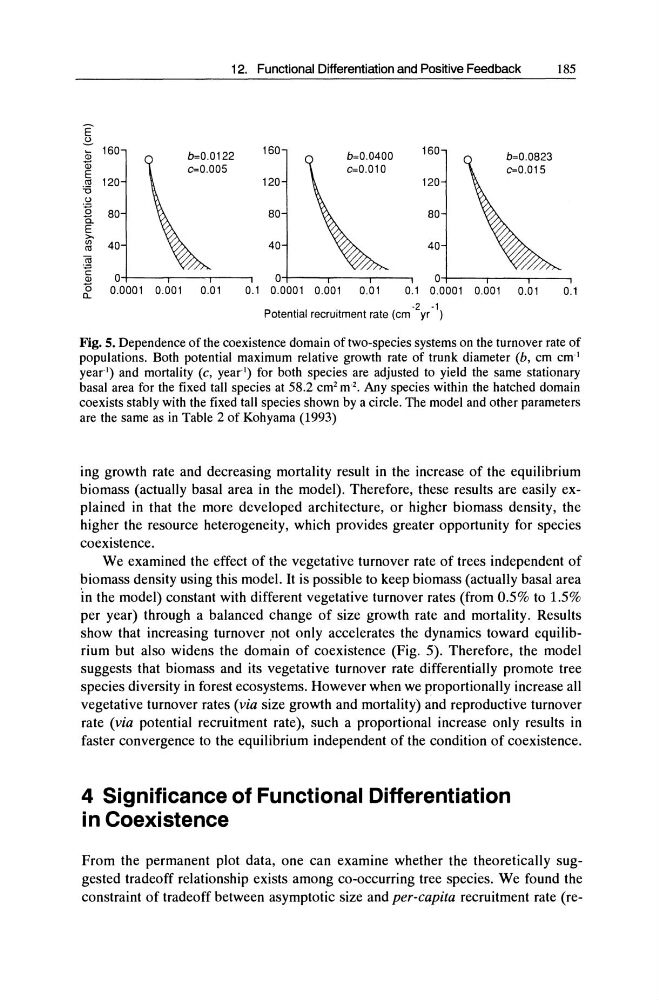
Fig. 5. Dependence of the coexistence domain of two-species systems on the turnover rate of
populations. Both potential maximum relative growth rate of trunk diameter (b, cm cm l
year· l ) and mortality (c, year· l ) for both species are adjusted to yield the same stationary
basal area for the fixed tall species at 58.2 cm 2 m· 2 • Any species within the hatched domain
coexists stably with the fixed tall species shown by a circle. The model and other parameters
are the same as in Table 2 of Kohyama (1993)
ing growth rate and decreasing mortality result in the increase of the equilibrium
biomass (actually basal area in the model). Therefore, these results are easily explained in that the more developed architecture, or higher biomass density, the
higher the resource heterogeneity, which provides greater opportunity for species
coexistence.
We examined the effect of the vegetative turnover rate of trees independent of
biomass density using this model. It is possible to keep biomass (actually basal area
in the model) constant with different vegetative turnover rates (from 0.5% to 1.5%
per year) through a balanced change of size growth rate and mortality. Results
show that increasing turnover not only accelerates the dynamics toward equilibrium but also widens the domain of coexistence (Fig. 5). Therefore, the model
suggests that biomass and its vegetative turnover rate differentially promote tree
species diversity in forest ecosystems. However when we proportionally increase all
vegetative turnover rates (via size growth and mortality) and reproductive turnover
rate (via potential recruitment rate), such a proportional increase only results in
faster convergence to the equilibrium independent of the condition of coexistence.
4 Significance of Functional Differentiation
in Coexistence
From the permanent plot data, one can examine whether the theoretically suggested tradeoff relationship exists among co-occurring tree species. We found the
constraint of tradeoff between asymptotic size and per-capita recruitment rate (re-
185
E
~
Q; 160
b=0.0122
160
b=0.0400
160
b=0.0823
OJ
0=0.005
0=0.010
0=0.015
E
C1l 120
120
120
'6
g
~
80
80
80
E
:>.
IJJ
40
40
40
C1l
~
C
0
0
0
Ql
a 0.0001 0.001 0.01 0.1 0.0001 0.001 0.01 0.1 0.0001 0.001 0.01 0.1
0..
Potential recruitment rate (cm
-2 -1
yr )
Fig. 5. Dependence of the coexistence domain of two-species systems on the turnover rate of
populations. Both potential maximum relative growth rate of trunk diameter (b, cm cm l
year· l ) and mortality (c, year· l ) for both species are adjusted to yield the same stationary
basal area for the fixed tall species at 58.2 cm 2 m· 2 • Any species within the hatched domain
coexists stably with the fixed tall species shown by a circle. The model and other parameters
are the same as in Table 2 of Kohyama (1993)
ing growth rate and decreasing mortality result in the increase of the equilibrium
biomass (actually basal area in the model). Therefore, these results are easily explained in that the more developed architecture, or higher biomass density, the
higher the resource heterogeneity, which provides greater opportunity for species
coexistence.
We examined the effect of the vegetative turnover rate of trees independent of
biomass density using this model. It is possible to keep biomass (actually basal area
in the model) constant with different vegetative turnover rates (from 0.5% to 1.5%
per year) through a balanced change of size growth rate and mortality. Results
show that increasing turnover not only accelerates the dynamics toward equilibrium but also widens the domain of coexistence (Fig. 5). Therefore, the model
suggests that biomass and its vegetative turnover rate differentially promote tree
species diversity in forest ecosystems. However when we proportionally increase all
vegetative turnover rates (via size growth and mortality) and reproductive turnover
rate (via potential recruitment rate), such a proportional increase only results in
faster convergence to the equilibrium independent of the condition of coexistence.
4 Significance of Functional Differentiation
in Coexistence
From the permanent plot data, one can examine whether the theoretically suggested tradeoff relationship exists among co-occurring tree species. We found the
constraint of tradeoff between asymptotic size and per-capita recruitment rate (re-