

12. Functional Differentiation and Positive Feedback
183
b
(,!l
a
...::
c
600
~
100
~L
10
OJ
•
>•
I
80
~\"
8
., 400
.- • .I:
o:s
1: 60
6
.I:
~
~
Cl
:;;
'ijj
en
.r:
40
>
4
0
en 200
u
E
C\l
E
~ 20
a 2
0
iii
en
E
en
>0
OS
-400 -200
0 «
-1 00 -80 -60 ·40 -20 0
0
-4
-2
0
iii
-0.144A-l0.2L
-0.022SA-l.54L
-D.0014SA-O.l09L
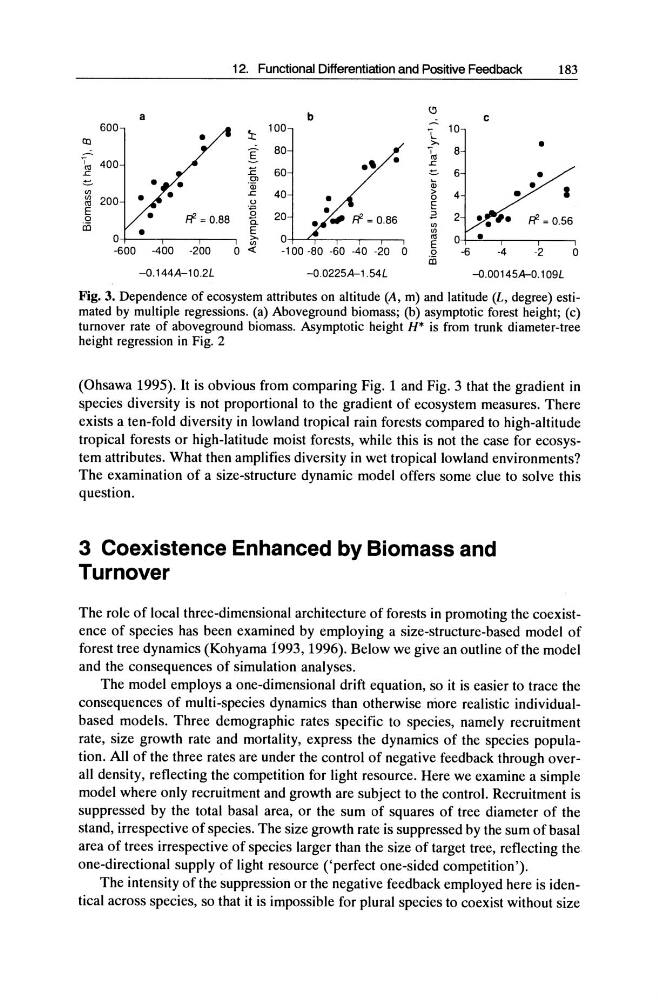
Fig. 3. Dependence of ecosystem attributes on altitude (A, m) and latitude (L, degree) estimated by multiple regressions. (a) Aboveground biomass; (b) asymptotic forest height; (c)
turnover rate of aboveground biomass. Asymptotic height H* is from trunk diameter-tree
height regression in Fig. 2
(Ohsawa 1995). It is obvious from comparing Fig. 1 and Fig. 3 that the gradient in
&pecies diversity is not proportional to the gradient of ecosystem measures. There
exists a ten-fold diversity in lowland tropical rain forests compared to high-altitude
tropical forests or high-latitude moist forests, while this is not the case for ecosystem attributes. What then amplifies diversity in wet tropical lowland environments?
The examination of a size-structure dynamic model offers some clue to solve this
question.
3 Coexistence Enhanced by Biomass and
Turnover
The role of local three-dimensional architecture of forests in promoting the coexistence of species has been examined by employing a size-structure-based model of
forest tree dynamics (Kohyama 1993, 1996). Below we give an outline of the model
and the consequences of simulation analyses.
The model employs a one-dimensional drift equation, so it is easier to trace the
consequences of multi-species dynamics than otherwise more realistic individualbased models. Three demographic rates specific to species, namely recruitment
rate, size growth rate and mortality, express the dynamics of the species population. All of the three rates are under the control of negative feedback through overall density, reflecting the competition for light resource. Here we examine a simple
model where only recruitment and growth are subject to the control. Recruitment is
suppressed by the total basal area, or the sum of squares of tree diameter of the
stand, irrespective of species. The size growth rate is suppressed by the sum of basal
area of trees irrespective of species larger than the size of target tree, reflecting the
one-directional supply of light resource ('perfect one-sided competition').
The intensity of the suppression or the negative feedback employed here is identical across species, so that it is impossible for plural species to coexist without size
183
b
(,!l
a
...::
c
600
~
100
~L
10
OJ
•
>•
I
80
~\"
8
., 400
.- • .I:
o:s
1: 60
6
.I:
~
~
Cl
:;;
'ijj
en
.r:
40
>
4
0
en 200
u
E
C\l
E
~ 20
a 2
0
iii
en
E
en
>0
OS
-400 -200
0 «
-1 00 -80 -60 ·40 -20 0
0
-4
-2
0
iii
-0.144A-l0.2L
-0.022SA-l.54L
-D.0014SA-O.l09L
Fig. 3. Dependence of ecosystem attributes on altitude (A, m) and latitude (L, degree) estimated by multiple regressions. (a) Aboveground biomass; (b) asymptotic forest height; (c)
turnover rate of aboveground biomass. Asymptotic height H* is from trunk diameter-tree
height regression in Fig. 2
(Ohsawa 1995). It is obvious from comparing Fig. 1 and Fig. 3 that the gradient in
&pecies diversity is not proportional to the gradient of ecosystem measures. There
exists a ten-fold diversity in lowland tropical rain forests compared to high-altitude
tropical forests or high-latitude moist forests, while this is not the case for ecosystem attributes. What then amplifies diversity in wet tropical lowland environments?
The examination of a size-structure dynamic model offers some clue to solve this
question.
3 Coexistence Enhanced by Biomass and
Turnover
The role of local three-dimensional architecture of forests in promoting the coexistence of species has been examined by employing a size-structure-based model of
forest tree dynamics (Kohyama 1993, 1996). Below we give an outline of the model
and the consequences of simulation analyses.
The model employs a one-dimensional drift equation, so it is easier to trace the
consequences of multi-species dynamics than otherwise more realistic individualbased models. Three demographic rates specific to species, namely recruitment
rate, size growth rate and mortality, express the dynamics of the species population. All of the three rates are under the control of negative feedback through overall density, reflecting the competition for light resource. Here we examine a simple
model where only recruitment and growth are subject to the control. Recruitment is
suppressed by the total basal area, or the sum of squares of tree diameter of the
stand, irrespective of species. The size growth rate is suppressed by the sum of basal
area of trees irrespective of species larger than the size of target tree, reflecting the
one-directional supply of light resource ('perfect one-sided competition').
The intensity of the suppression or the negative feedback employed here is identical across species, so that it is impossible for plural species to coexist without size