

182
T. Kohyama et al.
100
a
100
b
::r:
I
:E
10
OJ
ID
.c
a.>
~
I1+-~~~r-~~~~~--'
1+-~~~~--r-~~~r-~
2
10
100 200
2
10
100 200
Trunk diameter (em), 0
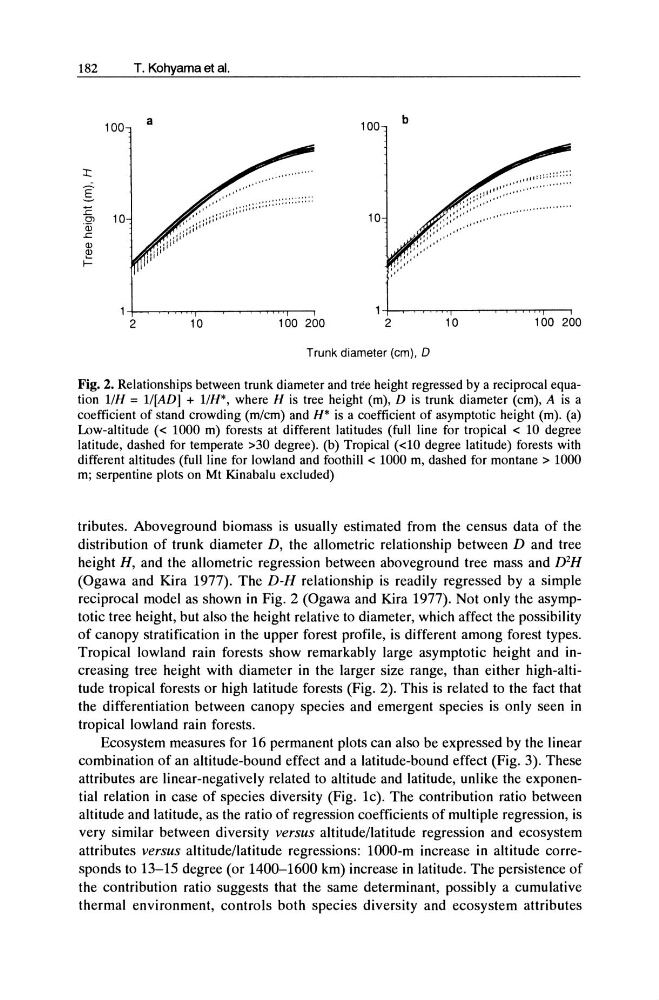
Fig. 2. Relationships between trunk diameter and tree height regressed by a reciprocal equation l/H = l/[AD] + 1/H*, where H is tree height (m), D is trunk diameter (cm), A is a
coefficient of stand crowding (m/cm) and H* is a coefficient of asymptotic height (m). (a)
Low-altitude « 1000 m) forests at different latitudes (full line for tropical < 10 degree
latitude, dashed for temperate >30 degree). (b) Tropical «10 degree latitude) forests with
different altitudes (full line for lowland and foothill < 1000 m, dashed for montane> 1000
m; serpentine plots on Mt Kinabalu excluded)
tributes. Aboveground biomass is usually estimated from the census data of the
distribution of trunk diameter D, the allometric relationship between D and tree
height H, and the allometric regression between aboveground tree mass and D2H
(Ogawa and Kira 1977). The D-H relationship is readily regressed by a simple
reciprocal model as shown in Fig. 2 (Ogawa and Kira 1977). Not only the asymptotic tree height, but also the height relative to diameter, which affect the possibility
of canopy stratification in the upper forest profile, is different among forest types.
Tropical lowland rain forests show remarkably large asymptotic height and increasing tree height with diameter in the larger size range, than either high-altitude tropical forests or high latitude forests (Fig. 2). This is related to the fact that
the differentiation between canopy species and emergent species is only seen in
tropical lowland rain forests.
Ecosystem measures for 16 permanent plots can also be expressed by the linear
combination of an altitude-bound effect and a latitude-bound effect (Fig. 3). These
attributes are linear-negatively related to altitude and latitude, unlike the exponential relation in case of species diversity (Fig. lc). The contribution ratio between
altitude and latitude, as the ratio of regression coefficients of multiple regression, is
very similar between diversity versus altitude/latitude regression and ecosystem
attributes versus altitude/latitude regressions: lOOO-m increase in altitude corresponds to 13-15 degree (or 1400-1600 km) increase in latitude. The persistence of
the contribution ratio suggests that the same determinant, possibly a cumulative
thermal environment, controls both species diversity and ecosystem attributes
T. Kohyama et al.
100
a
100
b
::r:
I
:E
10
OJ
ID
.c
a.>
~
I1+-~~~r-~~~~~--'
1+-~~~~--r-~~~r-~
2
10
100 200
2
10
100 200
Trunk diameter (em), 0
Fig. 2. Relationships between trunk diameter and tree height regressed by a reciprocal equation l/H = l/[AD] + 1/H*, where H is tree height (m), D is trunk diameter (cm), A is a
coefficient of stand crowding (m/cm) and H* is a coefficient of asymptotic height (m). (a)
Low-altitude « 1000 m) forests at different latitudes (full line for tropical < 10 degree
latitude, dashed for temperate >30 degree). (b) Tropical «10 degree latitude) forests with
different altitudes (full line for lowland and foothill < 1000 m, dashed for montane> 1000
m; serpentine plots on Mt Kinabalu excluded)
tributes. Aboveground biomass is usually estimated from the census data of the
distribution of trunk diameter D, the allometric relationship between D and tree
height H, and the allometric regression between aboveground tree mass and D2H
(Ogawa and Kira 1977). The D-H relationship is readily regressed by a simple
reciprocal model as shown in Fig. 2 (Ogawa and Kira 1977). Not only the asymptotic tree height, but also the height relative to diameter, which affect the possibility
of canopy stratification in the upper forest profile, is different among forest types.
Tropical lowland rain forests show remarkably large asymptotic height and increasing tree height with diameter in the larger size range, than either high-altitude tropical forests or high latitude forests (Fig. 2). This is related to the fact that
the differentiation between canopy species and emergent species is only seen in
tropical lowland rain forests.
Ecosystem measures for 16 permanent plots can also be expressed by the linear
combination of an altitude-bound effect and a latitude-bound effect (Fig. 3). These
attributes are linear-negatively related to altitude and latitude, unlike the exponential relation in case of species diversity (Fig. lc). The contribution ratio between
altitude and latitude, as the ratio of regression coefficients of multiple regression, is
very similar between diversity versus altitude/latitude regression and ecosystem
attributes versus altitude/latitude regressions: lOOO-m increase in altitude corresponds to 13-15 degree (or 1400-1600 km) increase in latitude. The persistence of
the contribution ratio suggests that the same determinant, possibly a cumulative
thermal environment, controls both species diversity and ecosystem attributes