

23. Large-Scale Water Manipulations
cipitation treatments at the plot scale, including
normal precipitation quantity and timing, 30% reductions in precipitation, and 30% reductions
and/or extended dry periods.
With this brief introduction to the general types
of precipitation and ecosystem manipulations that
have been reported, consideration will be given to
methodological issues important for appropriate application of water manipulations to large-scale field
studies.
Artificial Rainfall
Controlled studies designed to assess the effects of
rain or mist chemistries on test plants must consider
several chemical and physical design criteria if results are to meaningfully address effects appropriate to field conditions. Among the parameters traditionally considered important are those related to
solution chemistry (pH, ionic composition), solution physics (drop size and velocity), and the temporal and spatial characteristics of precipitation
events (uniform distribution, intensity, and volume). Artificial rainfall systems can be designed in
a variety of ways to meet a variety of experimental
goals. Simple irrigation systems consisting of dippers, watering cans, or hoses have been used to
amend soil water and nutrient levels periodically.
Automated drip irrigation systems function in the
same way, but do not allow for the interaction between rain and foliage characteristic of natural rainfall. The addition of water and nutrients through
overhead nozzles or rotating booms represents an
additional step in complexity that allows for this
contact.
The primary goal of any artificial rain system for
use in controlled experiments should be to imitate
the chemical and physical features of natural rain
events in an appropriate temporal scale and under
reasonable environmental conditions. A summary
of the variables of ambient rainfall that have been
incorporated into existing rain simulation systems
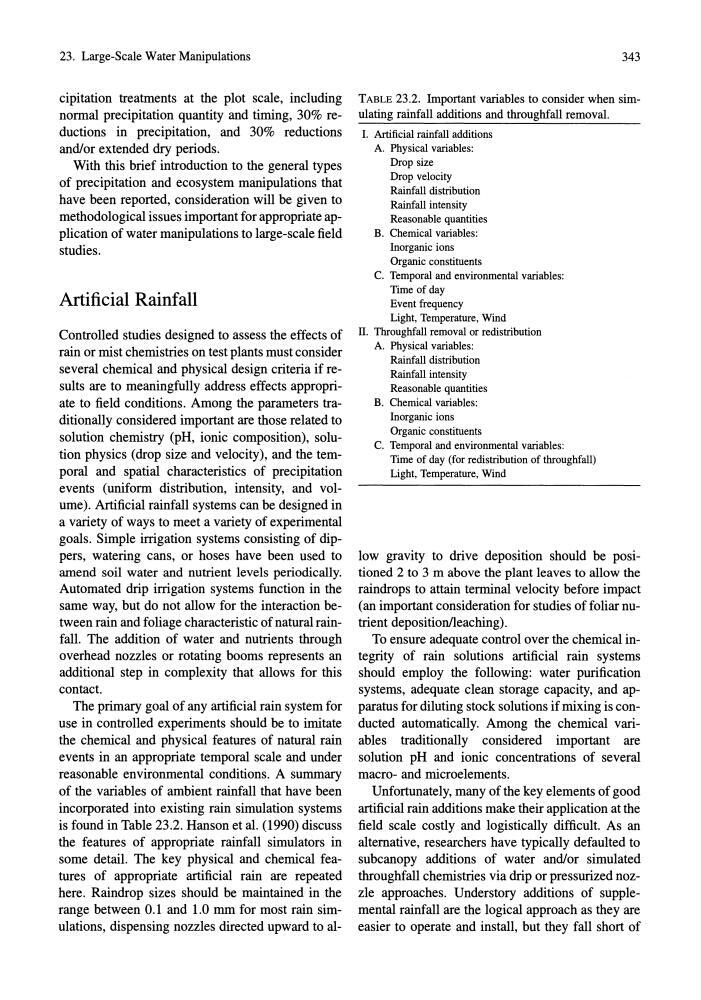
is found in Table 23.2. Hanson et al. (1990) discuss
the features of appropriate rainfall simulators in
some detail. The key physical and chemical features of appropriate artificial rain are repeated
here. Raindrop sizes should be maintained in the
range between 0.1 and 1.0 mm for most rain simulations, dispensing nozzles directed upward to al343
TABLE 23.2. Important variables to consider when simulating rainfall additions and throughfall removal.
I. Artificial rainfall additions
A. Physical variables:
Drop size
Drop velocity
Rainfall distribution
Rainfall intensity
Reasonable quantities
B. Chemical variables:
Inorganic ions
Organic constituents
C. Temporal and environmental variables:
Time of day
Event frequency
Light, Temperature, Wind
II. Throughfall removal or redistribution
A. Physical variables:
Rainfall distribution
Rainfall intensity
Reasonable quantities
B. Chemical variables:
Inorganic ions
Organic constituents
C. Temporal and environmental variables:
Time of day (for redistribution of throughfall)
Light, Temperature, Wind
low gravity to drive deposition should be positioned 2 to 3 m above the plant leaves to allow the
raindrops to attain terminal velocity before impact
(an important consideration for studies of foliar nutrient deposition/leaching).
To ensure adequate control over the chemical integrity of rain solutions artificial rain systems
should employ the following: water purification
systems, adequate clean storage capacity, and apparatus for diluting stock solutions if mixing is conducted automatically. Among the chemical variables traditionally considered important are
solution pH and ionic concentrations of several
macro- and microelements.
Unfortunately, many of the key elements of good
artificial rain additions make their application at the
field scale costly and logistically difficult. As an
alternative, researchers have typically defaulted to
subcanopy additions of water and/or simulated
throughfall chemistries via drip or pressurized nozzle approaches. Understory additions of supplemental rainfall are the logical approach as they are
easier to operate and install, but they fall short of
cipitation treatments at the plot scale, including
normal precipitation quantity and timing, 30% reductions in precipitation, and 30% reductions
and/or extended dry periods.
With this brief introduction to the general types
of precipitation and ecosystem manipulations that
have been reported, consideration will be given to
methodological issues important for appropriate application of water manipulations to large-scale field
studies.
Artificial Rainfall
Controlled studies designed to assess the effects of
rain or mist chemistries on test plants must consider
several chemical and physical design criteria if results are to meaningfully address effects appropriate to field conditions. Among the parameters traditionally considered important are those related to
solution chemistry (pH, ionic composition), solution physics (drop size and velocity), and the temporal and spatial characteristics of precipitation
events (uniform distribution, intensity, and volume). Artificial rainfall systems can be designed in
a variety of ways to meet a variety of experimental
goals. Simple irrigation systems consisting of dippers, watering cans, or hoses have been used to
amend soil water and nutrient levels periodically.
Automated drip irrigation systems function in the
same way, but do not allow for the interaction between rain and foliage characteristic of natural rainfall. The addition of water and nutrients through
overhead nozzles or rotating booms represents an
additional step in complexity that allows for this
contact.
The primary goal of any artificial rain system for
use in controlled experiments should be to imitate
the chemical and physical features of natural rain
events in an appropriate temporal scale and under
reasonable environmental conditions. A summary
of the variables of ambient rainfall that have been
incorporated into existing rain simulation systems
is found in Table 23.2. Hanson et al. (1990) discuss
the features of appropriate rainfall simulators in
some detail. The key physical and chemical features of appropriate artificial rain are repeated
here. Raindrop sizes should be maintained in the
range between 0.1 and 1.0 mm for most rain simulations, dispensing nozzles directed upward to al343
TABLE 23.2. Important variables to consider when simulating rainfall additions and throughfall removal.
I. Artificial rainfall additions
A. Physical variables:
Drop size
Drop velocity
Rainfall distribution
Rainfall intensity
Reasonable quantities
B. Chemical variables:
Inorganic ions
Organic constituents
C. Temporal and environmental variables:
Time of day
Event frequency
Light, Temperature, Wind
II. Throughfall removal or redistribution
A. Physical variables:
Rainfall distribution
Rainfall intensity
Reasonable quantities
B. Chemical variables:
Inorganic ions
Organic constituents
C. Temporal and environmental variables:
Time of day (for redistribution of throughfall)
Light, Temperature, Wind
low gravity to drive deposition should be positioned 2 to 3 m above the plant leaves to allow the
raindrops to attain terminal velocity before impact
(an important consideration for studies of foliar nutrient deposition/leaching).
To ensure adequate control over the chemical integrity of rain solutions artificial rain systems
should employ the following: water purification
systems, adequate clean storage capacity, and apparatus for diluting stock solutions if mixing is conducted automatically. Among the chemical variables traditionally considered important are
solution pH and ionic concentrations of several
macro- and microelements.
Unfortunately, many of the key elements of good
artificial rain additions make their application at the
field scale costly and logistically difficult. As an
alternative, researchers have typically defaulted to
subcanopy additions of water and/or simulated
throughfall chemistries via drip or pressurized nozzle approaches. Understory additions of supplemental rainfall are the logical approach as they are
easier to operate and install, but they fall short of