

342
have been used at the plot or stand level in natural
ecosystems or forest plantations for studying the
impacts of anthropogenic stressors (i.e., acid precipitation and/or climate change) on ecosystem and
plant processes. Large-scale manipulations are defined in this chapter as those field experiments that
are of sufficient size and complexity to handle questions of individual plant response as well as standlevel carbon, water, and nutrient cycling responses.
Active Versus Passive
Manipulations
Precipitation manipulation studies can be divided
into two general categories: active versus passive
approaches. Active precipitation manipulation
studies involve the use of above-canopy irrigation
methods to supplement natural rainfall or add modified rainfall chemistries. Passive approaches employ understory troughs or complete "roofs" to intercept natural throughfall or rainfall for diversion
away from treatment plots. The diverted water can
be discarded or channeled to alternate plots for
complementary irrigation. Studies described by
Abrahamsen et al. (1977), Irving and Miller (1981),
and Johnston et al. (1986) all employed active irrigation methods for use in small field studies of
acid precipitation impacts on crops and tree seedPaul J. Hanson
lings. Active plot-scale irrigations were also employed by Sala and Lauenroth (1982) and more recently by Golluscio et al. (1998) to evaluate
grassland ecosystems. A good example of the passive approach would be the throughfall displacement experiment described by Hanson et al. (1995,
1998) for manipulation of rainfall quantity in an
upland oak forest. A combination of active and passive approaches was employed at the plot scale by
the EXMAN (experimental manipulation) projects
in forest ecosystems in Europe (Beier et al. 1995)
and at the watershed scale (Moldan et al. 1995;
Hultberg et al. 1993) for studies of the impact of
rainfall chemistries on growth and nutrient cycling
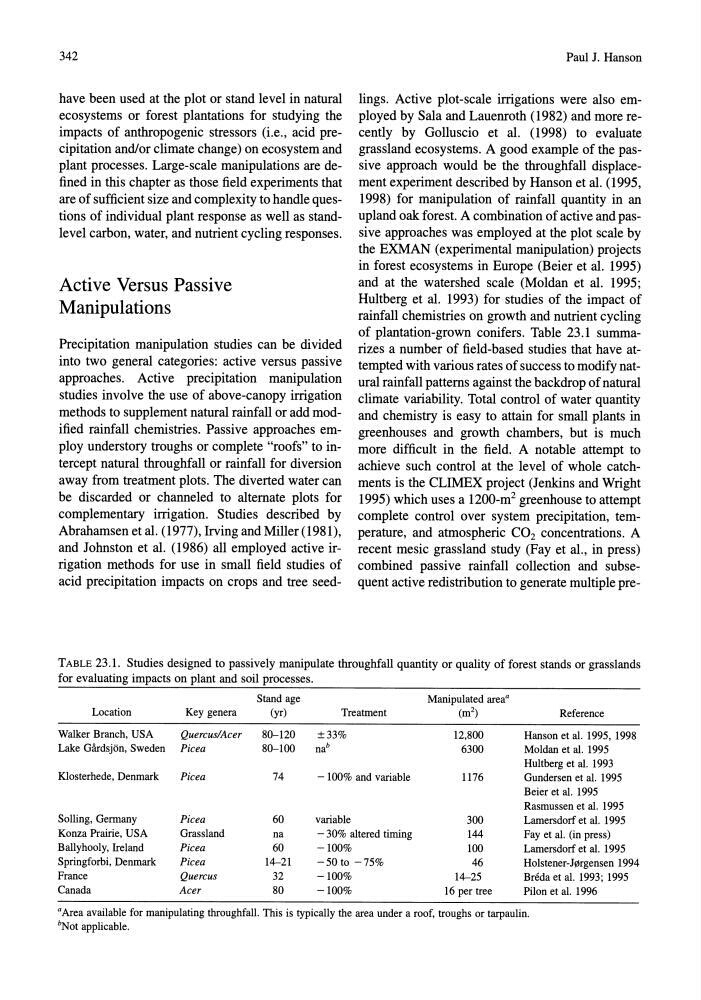
of plantation-grown conifers. Table 23.1 summarizes a number of field-based studies that have attempted with various rates of success to modify natural rainfall patterns against the backdrop of natural
climate variability. Total control of water quantity
and chemistry is easy to attain for small plants in
greenhouses and growth chambers, but is much
more difficult in the field. A notable attempt to
achieve such control at the level of whole catchments is the CLIMEX project (Jenkins and Wright
1995) which uses a 1200-m 2 greenhouse to attempt
complete control over system precipitation, temperature, and atmospheric CO 2 concentrations. A
recent mesic grassland study (Fay et al., in press)
combined passive rainfall collection and subsequent active redistribution to generate mUltiple preTABLE 23.1. Studies designed to passively manipulate throughfall quantity or quality of forest stands or grasslands
for evaluating impacts on plant and soil processes.
Stand age
Manipulated area a
Location
Key genera
(yr)
Treatment
(m 2 )
Reference
Walker Branch, USA
QuercuS/Acer
80-120
±33%
12,800
Hanson et aI. 1995, 1998
Lake Gardsjon, Sweden Picea
80-100
nab
6300
Moldan et aI. 1995
Hultberg et aI. 1993
Klosterhede, Denmark
Picea
74
- 100% and variable
1176
Gundersen et aI. 1995
Beier et aI. 1995
Rasmussen et aI. 1995
Soiling, Germany
Picea
60
variable
300
Lamersdorf et aI. 1995
Konza Prairie, USA
Grassland
na
- 30% altered timing
144
Fay et aI. (in press)
Ballyhooly, Ireland
Picea
60
-100%
100
Lamersdorf et aI. 1995
Springforbi, Denmark
Picea
14-21
-50 to -75%
46
Holstener-J!1lrgensen 1994
France
Quercus
32
-100%
14-25
Breda et aI. 1993; 1995
Canada
Acer
80
-100%
16 per tree
Pilon et aI. 1996
a Area available for manipulating throughfall. This is typically the area under a roof, troughs or tarpaulin.
bNot applicable.
have been used at the plot or stand level in natural
ecosystems or forest plantations for studying the
impacts of anthropogenic stressors (i.e., acid precipitation and/or climate change) on ecosystem and
plant processes. Large-scale manipulations are defined in this chapter as those field experiments that
are of sufficient size and complexity to handle questions of individual plant response as well as standlevel carbon, water, and nutrient cycling responses.
Active Versus Passive
Manipulations
Precipitation manipulation studies can be divided
into two general categories: active versus passive
approaches. Active precipitation manipulation
studies involve the use of above-canopy irrigation
methods to supplement natural rainfall or add modified rainfall chemistries. Passive approaches employ understory troughs or complete "roofs" to intercept natural throughfall or rainfall for diversion
away from treatment plots. The diverted water can
be discarded or channeled to alternate plots for
complementary irrigation. Studies described by
Abrahamsen et al. (1977), Irving and Miller (1981),
and Johnston et al. (1986) all employed active irrigation methods for use in small field studies of
acid precipitation impacts on crops and tree seedPaul J. Hanson
lings. Active plot-scale irrigations were also employed by Sala and Lauenroth (1982) and more recently by Golluscio et al. (1998) to evaluate
grassland ecosystems. A good example of the passive approach would be the throughfall displacement experiment described by Hanson et al. (1995,
1998) for manipulation of rainfall quantity in an
upland oak forest. A combination of active and passive approaches was employed at the plot scale by
the EXMAN (experimental manipulation) projects
in forest ecosystems in Europe (Beier et al. 1995)
and at the watershed scale (Moldan et al. 1995;
Hultberg et al. 1993) for studies of the impact of
rainfall chemistries on growth and nutrient cycling
of plantation-grown conifers. Table 23.1 summarizes a number of field-based studies that have attempted with various rates of success to modify natural rainfall patterns against the backdrop of natural
climate variability. Total control of water quantity
and chemistry is easy to attain for small plants in
greenhouses and growth chambers, but is much
more difficult in the field. A notable attempt to
achieve such control at the level of whole catchments is the CLIMEX project (Jenkins and Wright
1995) which uses a 1200-m 2 greenhouse to attempt
complete control over system precipitation, temperature, and atmospheric CO 2 concentrations. A
recent mesic grassland study (Fay et al., in press)
combined passive rainfall collection and subsequent active redistribution to generate mUltiple preTABLE 23.1. Studies designed to passively manipulate throughfall quantity or quality of forest stands or grasslands
for evaluating impacts on plant and soil processes.
Stand age
Manipulated area a
Location
Key genera
(yr)
Treatment
(m 2 )
Reference
Walker Branch, USA
QuercuS/Acer
80-120
±33%
12,800
Hanson et aI. 1995, 1998
Lake Gardsjon, Sweden Picea
80-100
nab
6300
Moldan et aI. 1995
Hultberg et aI. 1993
Klosterhede, Denmark
Picea
74
- 100% and variable
1176
Gundersen et aI. 1995
Beier et aI. 1995
Rasmussen et aI. 1995
Soiling, Germany
Picea
60
variable
300
Lamersdorf et aI. 1995
Konza Prairie, USA
Grassland
na
- 30% altered timing
144
Fay et aI. (in press)
Ballyhooly, Ireland
Picea
60
-100%
100
Lamersdorf et aI. 1995
Springforbi, Denmark
Picea
14-21
-50 to -75%
46
Holstener-J!1lrgensen 1994
France
Quercus
32
-100%
14-25
Breda et aI. 1993; 1995
Canada
Acer
80
-100%
16 per tree
Pilon et aI. 1996
a Area available for manipulating throughfall. This is typically the area under a roof, troughs or tarpaulin.
bNot applicable.