

344
being an accurate simulation of increased precipitation because they do not allow for the interaction
of precipitation with canopy foliage, branches, and
stems, and the concurrent uptake (N03, HN4) or
leaching (base cations and organics) of chemicals
that takes place during normal rainfall events.
Throughfall Interception
As a passive means of modifying ecosystem water
budgets, the interception of throughfall has proven
very useful in a number of studies (see Table 23.1).
Typical applications have used either complete understory roofs (Gundersen et al. 1995) or partial
coverage of the ground area with gutters or troughs
(Holstener-JS'Srgensen 1994; Hanson et al. 1995;
Hanson et al. 1998) to manipulate the amount of
water reaching the forest floor. The largest field manipulation of water attempted to date is the Walker
Branch Throughfall Displacement Experiment
(TDE) which includes 12,800 m 2 of manipulated
area (Hanson et al. 1998; Hanson et al. 1995). The
TDE was developed for an upland oak ecosystem
located in the eastern United States (lat. 35°58'N,
long. 84°17'W). Mean annual precipitation is 140
cm and mean temperature is 13.3°C. Depth to bedrock at this location is approximately 30 m. The
site is dominated by Quercus alba L., Quercus prinus L., and Acer rub rum L., but it contains 16 other
tree species with a total stand basal area that averages 20 to 25 m 2 ha - 1. Briefly, the manipulations
of throughfall levels reaching the forest floor are
made with a system designed to passively transfer
precipitation from one experimental plot to another.
There are three plots in the TDE: one wet, one dry,
and one ambient. Each 80 X 80 m plot is divided
into one hundred 8 X 8 m subplots that serve as
the locations for repetitive, nondestructive measurements of soil and plant characteristics.
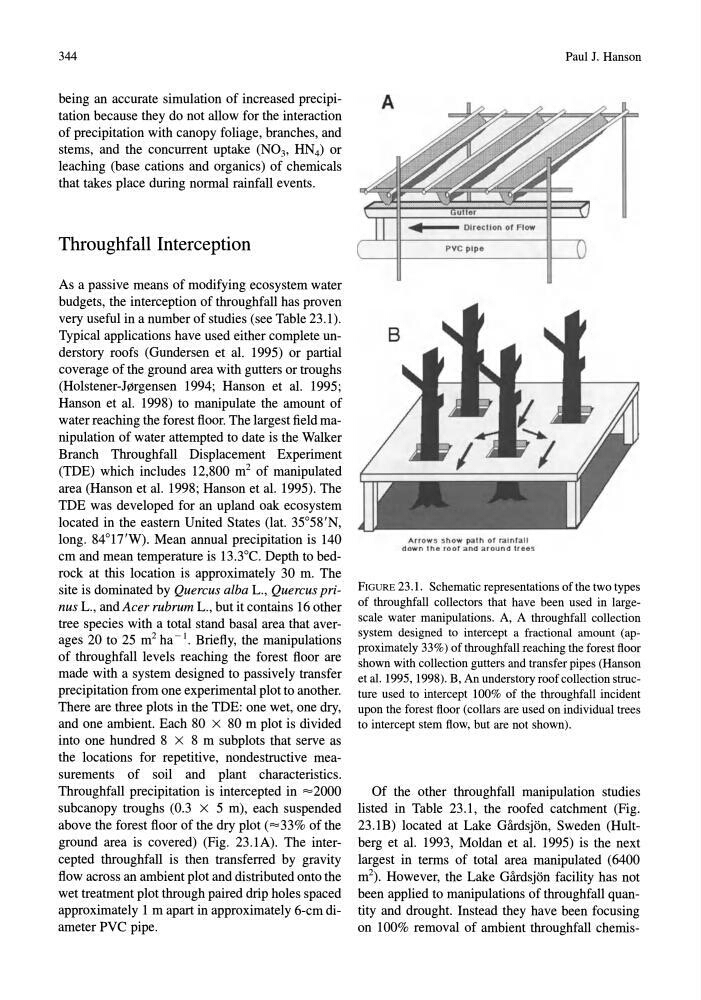
Throughfall precipitation is intercepted in =2000
subcanopy troughs (0.3 X 5 m), each suspended
above the forest floor of the dry plot (=33% of the
ground area is covered) (Fig. 23.1A). The intercepted throughfall is then transferred by gravity
flow across an ambient plot and distributed onto the
wet treatment plot through paired drip holes spaced
approximately 1 m apart in approximately 6-cm diameter PVC pipe.
Arrow s sh ow palh ot rainfall
down Ina roof anCi arounCi tree s
Paul J. Hanson
FIGURE 23.1. Schematic representations ofthe two types
of throughfall collectors that have been used in largescale water manipulations. A, A throughfall collection
system designed to intercept a fractional amount (approximately 33%) of throughfall reaching the forest floor
shown with collection gutters and transfer pipes (Hanson
et al. 1995, 1998). B, An understory roof collection structure used to intercept 100% of the throughfall incident
upon the forest floor (collars are used on individual trees
to intercept stem flow, but are not shown).
Of the other throughfall manipulation studies
listed in Table 23.1, the roofed catchment (Fig.
23.lB) located at Lake Gardsjon, Sweden (Hultberg et al. 1993, Moldan et al. 1995) is the next
largest in terms of total area manipulated (6400
m 2 ). However, the Lake Gardsjon facility has not
been applied to manipulations of throughfall quantity and drought. Instead they have been focusing
on 100% removal of ambient throughfall chemis-
being an accurate simulation of increased precipitation because they do not allow for the interaction
of precipitation with canopy foliage, branches, and
stems, and the concurrent uptake (N03, HN4) or
leaching (base cations and organics) of chemicals
that takes place during normal rainfall events.
Throughfall Interception
As a passive means of modifying ecosystem water
budgets, the interception of throughfall has proven
very useful in a number of studies (see Table 23.1).
Typical applications have used either complete understory roofs (Gundersen et al. 1995) or partial
coverage of the ground area with gutters or troughs
(Holstener-JS'Srgensen 1994; Hanson et al. 1995;
Hanson et al. 1998) to manipulate the amount of
water reaching the forest floor. The largest field manipulation of water attempted to date is the Walker
Branch Throughfall Displacement Experiment
(TDE) which includes 12,800 m 2 of manipulated
area (Hanson et al. 1998; Hanson et al. 1995). The
TDE was developed for an upland oak ecosystem
located in the eastern United States (lat. 35°58'N,
long. 84°17'W). Mean annual precipitation is 140
cm and mean temperature is 13.3°C. Depth to bedrock at this location is approximately 30 m. The
site is dominated by Quercus alba L., Quercus prinus L., and Acer rub rum L., but it contains 16 other
tree species with a total stand basal area that averages 20 to 25 m 2 ha - 1. Briefly, the manipulations
of throughfall levels reaching the forest floor are
made with a system designed to passively transfer
precipitation from one experimental plot to another.
There are three plots in the TDE: one wet, one dry,
and one ambient. Each 80 X 80 m plot is divided
into one hundred 8 X 8 m subplots that serve as
the locations for repetitive, nondestructive measurements of soil and plant characteristics.
Throughfall precipitation is intercepted in =2000
subcanopy troughs (0.3 X 5 m), each suspended
above the forest floor of the dry plot (=33% of the
ground area is covered) (Fig. 23.1A). The intercepted throughfall is then transferred by gravity
flow across an ambient plot and distributed onto the
wet treatment plot through paired drip holes spaced
approximately 1 m apart in approximately 6-cm diameter PVC pipe.
Arrow s sh ow palh ot rainfall
down Ina roof anCi arounCi tree s
Paul J. Hanson
FIGURE 23.1. Schematic representations ofthe two types
of throughfall collectors that have been used in largescale water manipulations. A, A throughfall collection
system designed to intercept a fractional amount (approximately 33%) of throughfall reaching the forest floor
shown with collection gutters and transfer pipes (Hanson
et al. 1995, 1998). B, An understory roof collection structure used to intercept 100% of the throughfall incident
upon the forest floor (collars are used on individual trees
to intercept stem flow, but are not shown).
Of the other throughfall manipulation studies
listed in Table 23.1, the roofed catchment (Fig.
23.lB) located at Lake Gardsjon, Sweden (Hultberg et al. 1993, Moldan et al. 1995) is the next
largest in terms of total area manipulated (6400
m 2 ). However, the Lake Gardsjon facility has not
been applied to manipulations of throughfall quantity and drought. Instead they have been focusing
on 100% removal of ambient throughfall chemis-