

22. Assessing the Effects of Acidification on Aquatic Ecosystems: Insights from Lake Experiments
337
300.----------------------------------.--~._--------------------------_.
Tropocyclops extensus
250
200
Reference
= 150
E
o
iii
Treatment
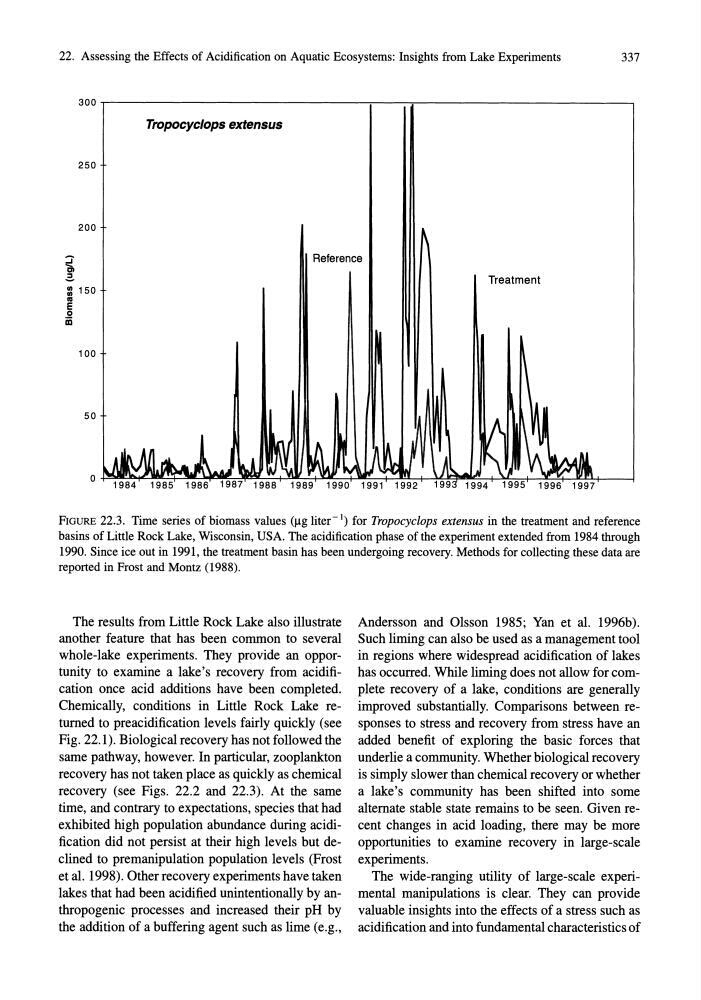
FIGURE 22.3. Time series of biomass values (JJg liter-I) for Tropocyclops extensus in the treatment and reference
basins of Little Rock Lake, Wisconsin, USA. The acidification phase of the experiment extended from 1984 through
1990. Since ice out in 1991, the treatment basin has been undergoing recovery. Methods for collecting these data are
reported in Frost and Montz (1988).
The results from Little Rock Lake also illustrate
another feature that has been common to several
whole-lake experiments. They provide an opportunity to examine a lake's recovery from acidification once acid additions have been completed.
Chemically, conditions in Little Rock Lake returned to preacidification levels fairly quickly (see
Fig. 22.1). Biological recovery has not followed the
same pathway, however. In particular, zooplankton
recovery has not taken place as quickly as chemical
recovery (see Figs. 22.2 and 22.3). At the same
time, and contrary to expectations, species that had
exhibited high population abundance during acidification did not persist at their high levels but declined to premanipulation population levels (Frost
et al. 1998). Other recovery experiments have taken
lakes that had been acidified unintentionally by anthropogenic processes and increased their pH by
the addition of a buffering agent such as lime (e.g.,
Andersson and Olsson 1985; Yan et al. 1996b).
Such liming can also be used as a management tool
in regions where widespread acidification of lakes
has occurred. While liming does not allow for complete recovery of a lake, conditions are generally
improved substantially. Comparisons between responses to stress and recovery from stress have an
added benefit of exploring the basic forces that
underlie a community. Whether biological recovery
is simply slower than chemical recovery or whether
a lake's community has been shifted into some
alternate stable state remains to be seen. Given recent changes in acid loading, there may be more
opportunities to examine recovery in large-scale
experiments.
The wide-ranging utility of large-scale experimental manipulations is clear. They can provide
valuable insights into the effects of a stress such as
acidification and into fundamental characteristics of
337
300.----------------------------------.--~._--------------------------_.
Tropocyclops extensus
250
200
Reference
= 150
E
o
iii
Treatment
FIGURE 22.3. Time series of biomass values (JJg liter-I) for Tropocyclops extensus in the treatment and reference
basins of Little Rock Lake, Wisconsin, USA. The acidification phase of the experiment extended from 1984 through
1990. Since ice out in 1991, the treatment basin has been undergoing recovery. Methods for collecting these data are
reported in Frost and Montz (1988).
The results from Little Rock Lake also illustrate
another feature that has been common to several
whole-lake experiments. They provide an opportunity to examine a lake's recovery from acidification once acid additions have been completed.
Chemically, conditions in Little Rock Lake returned to preacidification levels fairly quickly (see
Fig. 22.1). Biological recovery has not followed the
same pathway, however. In particular, zooplankton
recovery has not taken place as quickly as chemical
recovery (see Figs. 22.2 and 22.3). At the same
time, and contrary to expectations, species that had
exhibited high population abundance during acidification did not persist at their high levels but declined to premanipulation population levels (Frost
et al. 1998). Other recovery experiments have taken
lakes that had been acidified unintentionally by anthropogenic processes and increased their pH by
the addition of a buffering agent such as lime (e.g.,
Andersson and Olsson 1985; Yan et al. 1996b).
Such liming can also be used as a management tool
in regions where widespread acidification of lakes
has occurred. While liming does not allow for complete recovery of a lake, conditions are generally
improved substantially. Comparisons between responses to stress and recovery from stress have an
added benefit of exploring the basic forces that
underlie a community. Whether biological recovery
is simply slower than chemical recovery or whether
a lake's community has been shifted into some
alternate stable state remains to be seen. Given recent changes in acid loading, there may be more
opportunities to examine recovery in large-scale
experiments.
The wide-ranging utility of large-scale experimental manipulations is clear. They can provide
valuable insights into the effects of a stress such as
acidification and into fundamental characteristics of