

336
70
60
50
~40
2.. .. to
E
~ 30
20
10
~
Thomas M. Frost and Janet M. Fischer
Holopedium gibberum
Treatment
" ~
Reference
, M. At I \. \. ~ ~
o
1985 1986 1987
1988 1989
1990 1991
1984
1992 1993 1994
1995 1996 1997
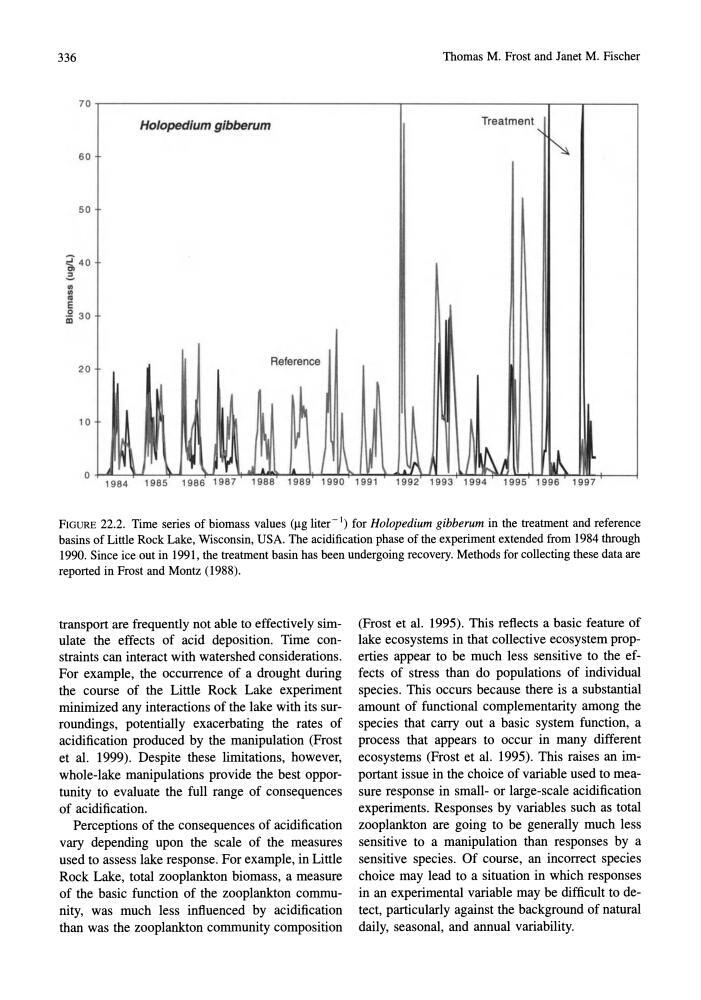
FIGURE 22.2. Time series of biomass values (~g liter-l) for Holopedium gibberum in the treatment and reference
basins of Little Rock Lake, Wisconsin, USA. The acidification phase of the experiment extended from 1984 through
1990. Since ice out in 1991, the treatment basin has been undergoing recovery. Methods for collecting these data are
reported in Frost and Montz (1988).
transport are frequently not able to effectively simulate the effects of acid deposition. Time constraints can interact with watershed considerations.
For example, the occurrence of a drought during
the course of the Little Rock Lake experiment
minimized any interactions of the lake with its surroundings, potentially exacerbating the rates of
acidification produced by the manipulation (Frost
et al. 1999). Despite these limitations, however,
whole-lake manipulations provide the best opportunity to evaluate the full range of consequences
of acidification.
Perceptions of the consequences of acidification
vary depending upon the scale of the measures
used to assess lake response. For example, in Little
Rock Lake, total zooplankton biomass, a measure
of the basic function of the zooplankton community, was much less influenced by acidification
than was the zooplankton community composition
(Frost et al. 1995). This reflects a basic feature of
lake ecosystems in that collective ecosystem properties appear to be much less sensitive to the effects of stress than do populations of individual
species. This occurs because there is a substantial
amount of functional complementarity among the
species that carry out a basic system function, a
process that appears to occur in many different
ecosystems (Frost et al. 1995). This raises an important issue in the choice of variable used to measure response in small- or large-scale acidification
experiments. Responses by variables such as total
zooplankton are going to be generally much less
sensitive to a manipUlation than responses by a
sensitive species. Of course, an incorrect species
choice may lead to a situation in which responses
in an experimental variable may be difficult to detect, particularly against the background of natural
daily, seasonal, and annual variability.
70
60
50
~40
2.. .. to
E
~ 30
20
10
~
Thomas M. Frost and Janet M. Fischer
Holopedium gibberum
Treatment
" ~
Reference
, M. At I \. \. ~ ~
o
1985 1986 1987
1988 1989
1990 1991
1984
1992 1993 1994
1995 1996 1997
FIGURE 22.2. Time series of biomass values (~g liter-l) for Holopedium gibberum in the treatment and reference
basins of Little Rock Lake, Wisconsin, USA. The acidification phase of the experiment extended from 1984 through
1990. Since ice out in 1991, the treatment basin has been undergoing recovery. Methods for collecting these data are
reported in Frost and Montz (1988).
transport are frequently not able to effectively simulate the effects of acid deposition. Time constraints can interact with watershed considerations.
For example, the occurrence of a drought during
the course of the Little Rock Lake experiment
minimized any interactions of the lake with its surroundings, potentially exacerbating the rates of
acidification produced by the manipulation (Frost
et al. 1999). Despite these limitations, however,
whole-lake manipulations provide the best opportunity to evaluate the full range of consequences
of acidification.
Perceptions of the consequences of acidification
vary depending upon the scale of the measures
used to assess lake response. For example, in Little
Rock Lake, total zooplankton biomass, a measure
of the basic function of the zooplankton community, was much less influenced by acidification
than was the zooplankton community composition
(Frost et al. 1995). This reflects a basic feature of
lake ecosystems in that collective ecosystem properties appear to be much less sensitive to the effects of stress than do populations of individual
species. This occurs because there is a substantial
amount of functional complementarity among the
species that carry out a basic system function, a
process that appears to occur in many different
ecosystems (Frost et al. 1995). This raises an important issue in the choice of variable used to measure response in small- or large-scale acidification
experiments. Responses by variables such as total
zooplankton are going to be generally much less
sensitive to a manipUlation than responses by a
sensitive species. Of course, an incorrect species
choice may lead to a situation in which responses
in an experimental variable may be difficult to detect, particularly against the background of natural
daily, seasonal, and annual variability.