

17. Deposition of Nutrients and Pollutants to Ecosystems
movement of air over the impact surfaces, which
typically consist of Teflon strings that lead to a collection bottle (e.g., Weathers et al. 1988). Because
it is important to exclude rain droplets as much as
possible, active cloud collectors are typically designed to draw air in a manner (e.g., from below
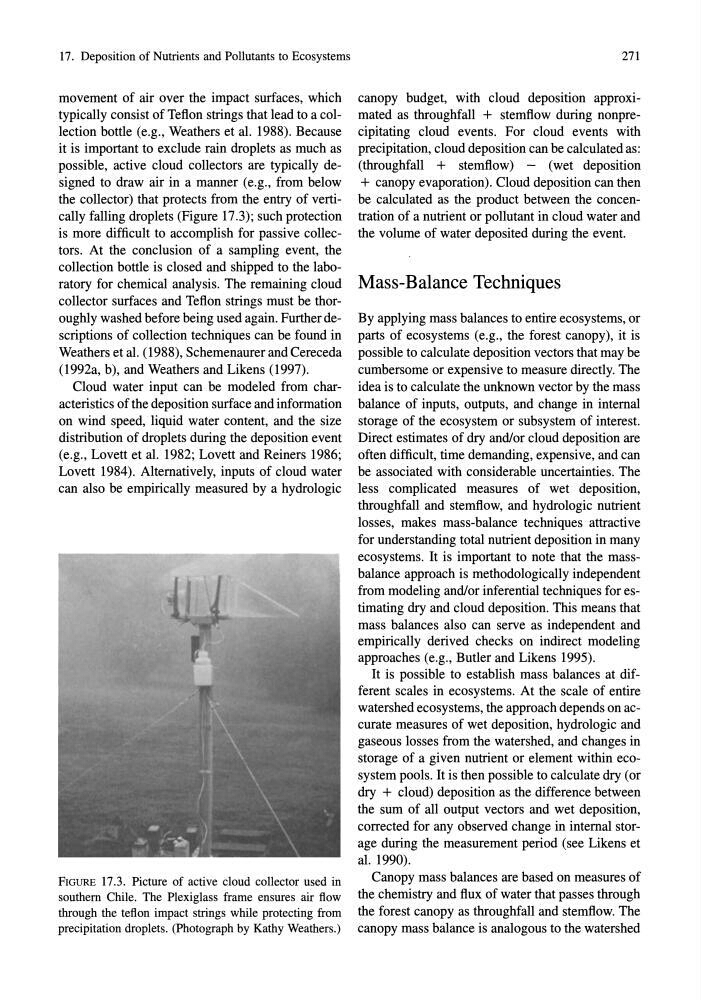
the collector) that protects from the entry of vertically falling droplets (Figure 17.3); such protection
is more difficult to accomplish for passive collectors. At the conclusion of a sampling event, the
collection bottle is closed and shipped to the laboratory for chemical analysis. The remaining cloud
collector surfaces and Teflon strings must be thoroughly washed before being used again. Further descriptions of collection techniques can be found in
Weathers et al. (1988), Schemenaurer and Cereceda
(1992a, b), and Weathers and Likens (1997).
Cloud water input can be modeled from characteristics of the deposition surface and information
on wind speed, liquid water content, and the size
distribution of droplets during the deposition event
(e.g., Lovett et al. 1982; Lovett and Reiners 1986;
Lovett 1984). Alternatively, inputs of cloud water
can also be empirically measured by a hydrologic
FIGURE 17.3. Picture of active cloud collector used in
southem Chile. The Plexiglass frame ensures air flow
through the teflon impact strings while protecting from
precipitation droplets. (Photograph by Kathy Weathers.)
271
canopy budget, with cloud deposition approximated as throughfall + stemflow during nonprecipitating cloud events. For cloud events with
precipitation, cloud deposition can be calculated as:
(throughfall + stemflow) - (wet deposition
+ canopy evaporation). Cloud deposition can then
be calculated as the product between the concentration of a nutrient or pollutant in cloud water and
the volume of water deposited during the event.
Mass-Balance Techniques
By applying mass balances to entire ecosystems, or
parts of ecosystems (e.g., the forest canopy), it is
possible to calculate deposition vectors that may be
cumbersome or expensive to measure directly. The
idea is to calculate the unknown vector by the mass
balance of inputs, outputs, and change in internal
storage of the ecosystem or subsystem of interest.
Direct estimates of dry and/or cloud deposition are
often difficult, time demanding, expensive, and can
be associated with considerable uncertainties. The
less complicated measures of wet deposition,
throughfall and stemflow, and hydrologic nutrient
losses, makes mass-balance techniques attractive
for understanding total nutrient deposition in many
ecosystems. It is important to note that the massbalance approach is methodologically independent
from modeling and/or inferential techniques for estimating dry and cloud deposition. This means that
mass balances also can serve as independent and
empirically derived checks on indirect modeling
approaches (e.g., Butler and Likens 1995).
It is possible to establish mass balances at different scales in ecosystems. At the scale of entire
watershed ecosystems, the approach depends on accurate measures of wet deposition, hydrologic and
gaseous losses from the watershed, and changes in
storage of a given nutrient or element within ecosystem pools. It is then possible to calculate dry (or
dry + cloud) deposition as the difference between
the sum of all output vectors and wet deposition,
corrected for any observed change in internal storage during the measurement period (see Likens et
al. 1990).
Canopy mass balances are based on measures of
the chemistry and flux of water that passes through
the forest canopy as throughfall and stemflow. The
canopy mass balance is analogous to the watershed
movement of air over the impact surfaces, which
typically consist of Teflon strings that lead to a collection bottle (e.g., Weathers et al. 1988). Because
it is important to exclude rain droplets as much as
possible, active cloud collectors are typically designed to draw air in a manner (e.g., from below
the collector) that protects from the entry of vertically falling droplets (Figure 17.3); such protection
is more difficult to accomplish for passive collectors. At the conclusion of a sampling event, the
collection bottle is closed and shipped to the laboratory for chemical analysis. The remaining cloud
collector surfaces and Teflon strings must be thoroughly washed before being used again. Further descriptions of collection techniques can be found in
Weathers et al. (1988), Schemenaurer and Cereceda
(1992a, b), and Weathers and Likens (1997).
Cloud water input can be modeled from characteristics of the deposition surface and information
on wind speed, liquid water content, and the size
distribution of droplets during the deposition event
(e.g., Lovett et al. 1982; Lovett and Reiners 1986;
Lovett 1984). Alternatively, inputs of cloud water
can also be empirically measured by a hydrologic
FIGURE 17.3. Picture of active cloud collector used in
southem Chile. The Plexiglass frame ensures air flow
through the teflon impact strings while protecting from
precipitation droplets. (Photograph by Kathy Weathers.)
271
canopy budget, with cloud deposition approximated as throughfall + stemflow during nonprecipitating cloud events. For cloud events with
precipitation, cloud deposition can be calculated as:
(throughfall + stemflow) - (wet deposition
+ canopy evaporation). Cloud deposition can then
be calculated as the product between the concentration of a nutrient or pollutant in cloud water and
the volume of water deposited during the event.
Mass-Balance Techniques
By applying mass balances to entire ecosystems, or
parts of ecosystems (e.g., the forest canopy), it is
possible to calculate deposition vectors that may be
cumbersome or expensive to measure directly. The
idea is to calculate the unknown vector by the mass
balance of inputs, outputs, and change in internal
storage of the ecosystem or subsystem of interest.
Direct estimates of dry and/or cloud deposition are
often difficult, time demanding, expensive, and can
be associated with considerable uncertainties. The
less complicated measures of wet deposition,
throughfall and stemflow, and hydrologic nutrient
losses, makes mass-balance techniques attractive
for understanding total nutrient deposition in many
ecosystems. It is important to note that the massbalance approach is methodologically independent
from modeling and/or inferential techniques for estimating dry and cloud deposition. This means that
mass balances also can serve as independent and
empirically derived checks on indirect modeling
approaches (e.g., Butler and Likens 1995).
It is possible to establish mass balances at different scales in ecosystems. At the scale of entire
watershed ecosystems, the approach depends on accurate measures of wet deposition, hydrologic and
gaseous losses from the watershed, and changes in
storage of a given nutrient or element within ecosystem pools. It is then possible to calculate dry (or
dry + cloud) deposition as the difference between
the sum of all output vectors and wet deposition,
corrected for any observed change in internal storage during the measurement period (see Likens et
al. 1990).
Canopy mass balances are based on measures of
the chemistry and flux of water that passes through
the forest canopy as throughfall and stemflow. The
canopy mass balance is analogous to the watershed