

270
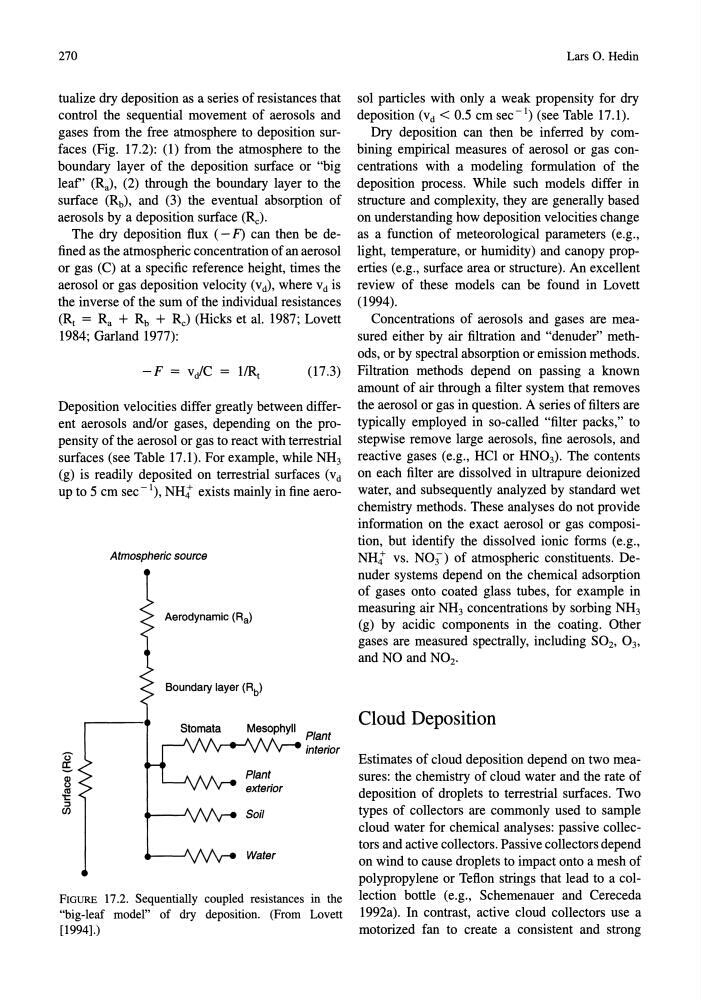
tualize dry deposition as a series of resistances that
control the sequential movement of aerosols and
gases from the free atmosphere to deposition surfaces (Fig. 17.2): (1) from the atmosphere to the
boundary layer of the deposition surface or "big
leaf' (R a ), (2) through the boundary layer to the
surface (R b ), and (3) the eventual absorption of
aerosols by a deposition surface (Re).
The dry deposition flux (- F) can then be defined as the atmospheric concentration of an aerosol
or gas (C) at a specific reference height, times the
aerosol or gas deposition velocity (Vd), where Vd is
the inverse of the sum of the individual resistances
(Rt = Ra + Rb + Re) (Hicks et al. 1987; Lovett
1984; Garland 1977):
-F = viC = lIRt
(17.3)
Deposition velocities differ greatly between different aerosols and/or gases, depending on the propensity of the aerosol or gas to react with terrestrial
surfaces (see Table 17.1). For example, while NH3
(g) is readily deposited on terrestrial surfaces (Vd
up to 5 cm sec - I), NHt exists mainly in fine aeroAtmospheric source
Aerodynamic (Ra)
Boundary layer (R b )
Soil
Water
Plant
interior
FIGURE 17.2. Sequentially coupled resistances in the
"big-leaf model" of dry deposition. (From Lovett
[1994].)
Lars O. Hedin
sol particles with only a weak propensity for dry
deposition (Vd < 0.5 cm sec-I) (see Table 17.1).
Dry deposition can then be inferred by combining empirical measures of aerosol or gas concentrations with a modeling formulation of the
deposition process. While such models differ in
structure and complexity, they are generally based
on understanding how deposition velocities change
as a function of meteorological parameters (e.g.,
light, temperature, or humidity) and canopy properties (e.g., surface area or structure). An excellent
review of these models can be found in Lovett
(1994).
Concentrations of aerosols and gases are measured either by air filtration and "denuder" methods, or by spectral absorption or emission methods.
Filtration methods depend on passing a known
amount of air through a filter system that removes
the aerosol or gas in question. A series of filters are
typically employed in so-called "filter packs," to
stepwise remove large aerosols, fine aerosols, and
reactive gases (e.g., HCl or HN0 3 ). The contents
on each filter are dissolved in ultrapure deionized
water, and subsequently analyzed by standard wet
chemistry methods. These analyses do not provide
information on the exact aerosol or gas composition, but identify the dissolved ionic forms (e.g.,
NHt vs. NO;) of atmospheric constituents. Denuder systems depend on the chemical adsorption
of gases onto coated glass tubes, for example in
measuring air NH3 concentrations by sorbing NH3
(g) by acidic components in the coating. Other
gases are measured spectrally, including S02, °3,
and NO and N02.
Cloud Deposition
Estimates of cloud deposition depend on two measures: the chemistry of cloud water and the rate of
deposition of droplets to terrestrial surfaces. Two
types of collectors are commonly used to sample
cloud water for chemical analyses: passive collectors and active collectors. Passive collectors depend
on wind to cause droplets to impact onto a mesh of
polypropylene or Teflon strings that lead to a collection bottle (e.g., Schemenauer and Cereceda
1992a). In contrast, active cloud collectors use a
motorized fan to create a consistent and strong
tualize dry deposition as a series of resistances that
control the sequential movement of aerosols and
gases from the free atmosphere to deposition surfaces (Fig. 17.2): (1) from the atmosphere to the
boundary layer of the deposition surface or "big
leaf' (R a ), (2) through the boundary layer to the
surface (R b ), and (3) the eventual absorption of
aerosols by a deposition surface (Re).
The dry deposition flux (- F) can then be defined as the atmospheric concentration of an aerosol
or gas (C) at a specific reference height, times the
aerosol or gas deposition velocity (Vd), where Vd is
the inverse of the sum of the individual resistances
(Rt = Ra + Rb + Re) (Hicks et al. 1987; Lovett
1984; Garland 1977):
-F = viC = lIRt
(17.3)
Deposition velocities differ greatly between different aerosols and/or gases, depending on the propensity of the aerosol or gas to react with terrestrial
surfaces (see Table 17.1). For example, while NH3
(g) is readily deposited on terrestrial surfaces (Vd
up to 5 cm sec - I), NHt exists mainly in fine aeroAtmospheric source
Aerodynamic (Ra)
Boundary layer (R b )
Soil
Water
Plant
interior
FIGURE 17.2. Sequentially coupled resistances in the
"big-leaf model" of dry deposition. (From Lovett
[1994].)
Lars O. Hedin
sol particles with only a weak propensity for dry
deposition (Vd < 0.5 cm sec-I) (see Table 17.1).
Dry deposition can then be inferred by combining empirical measures of aerosol or gas concentrations with a modeling formulation of the
deposition process. While such models differ in
structure and complexity, they are generally based
on understanding how deposition velocities change
as a function of meteorological parameters (e.g.,
light, temperature, or humidity) and canopy properties (e.g., surface area or structure). An excellent
review of these models can be found in Lovett
(1994).
Concentrations of aerosols and gases are measured either by air filtration and "denuder" methods, or by spectral absorption or emission methods.
Filtration methods depend on passing a known
amount of air through a filter system that removes
the aerosol or gas in question. A series of filters are
typically employed in so-called "filter packs," to
stepwise remove large aerosols, fine aerosols, and
reactive gases (e.g., HCl or HN0 3 ). The contents
on each filter are dissolved in ultrapure deionized
water, and subsequently analyzed by standard wet
chemistry methods. These analyses do not provide
information on the exact aerosol or gas composition, but identify the dissolved ionic forms (e.g.,
NHt vs. NO;) of atmospheric constituents. Denuder systems depend on the chemical adsorption
of gases onto coated glass tubes, for example in
measuring air NH3 concentrations by sorbing NH3
(g) by acidic components in the coating. Other
gases are measured spectrally, including S02, °3,
and NO and N02.
Cloud Deposition
Estimates of cloud deposition depend on two measures: the chemistry of cloud water and the rate of
deposition of droplets to terrestrial surfaces. Two
types of collectors are commonly used to sample
cloud water for chemical analyses: passive collectors and active collectors. Passive collectors depend
on wind to cause droplets to impact onto a mesh of
polypropylene or Teflon strings that lead to a collection bottle (e.g., Schemenauer and Cereceda
1992a). In contrast, active cloud collectors use a
motorized fan to create a consistent and strong