

17. Deposition of Nutrients and Pollutants to Ecosystems
sive measures of this process. Nitrogen is a good
example since different atmospheric forms of N are
deposited via different pathways, each subject to
different mechanistic controls. For example, dry
deposition of (NH4hS04 aerosols primarily occurs
by impaction onto surfaces, the gas nitrogen dioxide (NO z ) is mainly deposited inside stomatal cavities of plant leaves, while the gases NH3 or nitric
acid (HN0 3 ) are adsorbed directly onto vegetation
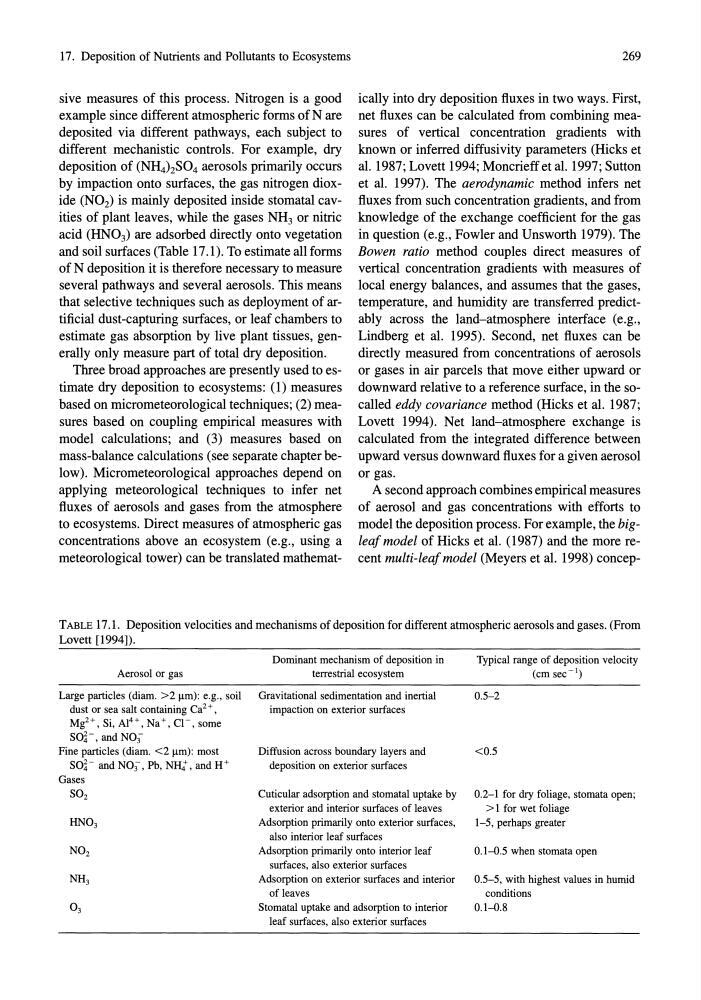
and soil surfaces (Table 17.1). To estimate all forms
of N deposition it is therefore necessary to measure
several pathways and several aerosols. This means
that selective techniques such as deployment of artificial dust-capturing surfaces, or leaf chambers to
estimate gas absorption by live plant tissues, generally only measure part of total dry deposition.
Three broad approaches are presently used to estimate dry deposition to ecosystems: (1) measures
based on micrometeorological techniques; (2) measures based on coupling empirical measures with
model calculations; and (3) measures based on
mass-balance calculations (see separate chapter below). Micrometeorological approaches depend on
applying meteorological techniques to infer net
fluxes of aerosols and gases from the atmosphere
to ecosystems. Direct measures of atmospheric gas
concentrations above an ecosystem (e.g., using a
meteorological tower) can be translated mathemat269
ically into dry deposition fluxes in two ways. First,
net fluxes can be calculated from combining measures of vertical concentration gradients with
known or inferred diffusivity parameters (Hicks et
al. 1987; Lovett 1994; Moncrieff et al. 1997; Sutton
et al. 1997). The aerodynamic method infers net
fluxes from such concentration gradients, and from
knowledge of the exchange coefficient for the gas
in question (e.g., Fowler and Unsworth 1979). The
Bowen ratio method couples direct measures of
vertical concentration gradients with measures of
local energy balances, and assumes that the gases,
temperature, and humidity are transferred predictably across the land-atmosphere interface (e.g.,
Lindberg et al. 1995). Second, net fluxes can be
directly measured from concentrations of aerosols
or gases in air parcels that move either upward or
downward relative to a reference surface, in the socalled eddy covariance method (Hicks et al. 1987;
Lovett 1994). Net land-atmosphere exchange is
calculated from the integrated difference between
upward versus downward fluxes for a given aerosol
or gas.
A second approach combines empirical measures
of aerosol and gas concentrations with efforts to
model the deposition process. For example, the bigleaf model of Hicks et al. (1987) and the more recent multi-leaf model (Meyers et al. 1998) concepTABLE 17.1. Deposition velocities and mechanisms of deposition for different atmospheric aerosols and gases. (From
Lovett [1994]).
Aerosol or gas
Large particles (diam. >2 !Lm): e.g., soil
dust or sea salt containing Ca 2 + ,
Mg2+, Si, AI 4 +, Na+, C1~, some
SO~ - , and NO;
Fine particles (diam. <2 !Lm): most
SO~~ and NO;, Pb, NHt, and H+
Gases
S02
NH3
Dominant mechanism of deposition in
terrestrial ecosystem
Gravitational sedimentation and inertial
impaction on exterior surfaces
Diffusion across boundary layers and
deposition on exterior surfaces
Cuticular adsorption and stomatal uptake by
exterior and interior surfaces of leaves
Adsorption primarily onto exterior surfaces,
also interior leaf surfaces
Adsorption primarily onto interior leaf
surfaces, also exterior surfaces
Adsorption on exterior surfaces and interior
of leaves
Stomatal uptake and adsorption to interior
leaf surfaces, also exterior surfaces
Typical range of deposition velocity
(cm sec~l)
0.5-2
<0.5
0.2-1 for dry foliage, stomata open;
> 1 for wet foliage
1-5, perhaps greater
0.1-0.5 when stomata open
0.5-5, with highest values in humid
conditions
0.1-0.8
sive measures of this process. Nitrogen is a good
example since different atmospheric forms of N are
deposited via different pathways, each subject to
different mechanistic controls. For example, dry
deposition of (NH4hS04 aerosols primarily occurs
by impaction onto surfaces, the gas nitrogen dioxide (NO z ) is mainly deposited inside stomatal cavities of plant leaves, while the gases NH3 or nitric
acid (HN0 3 ) are adsorbed directly onto vegetation
and soil surfaces (Table 17.1). To estimate all forms
of N deposition it is therefore necessary to measure
several pathways and several aerosols. This means
that selective techniques such as deployment of artificial dust-capturing surfaces, or leaf chambers to
estimate gas absorption by live plant tissues, generally only measure part of total dry deposition.
Three broad approaches are presently used to estimate dry deposition to ecosystems: (1) measures
based on micrometeorological techniques; (2) measures based on coupling empirical measures with
model calculations; and (3) measures based on
mass-balance calculations (see separate chapter below). Micrometeorological approaches depend on
applying meteorological techniques to infer net
fluxes of aerosols and gases from the atmosphere
to ecosystems. Direct measures of atmospheric gas
concentrations above an ecosystem (e.g., using a
meteorological tower) can be translated mathemat269
ically into dry deposition fluxes in two ways. First,
net fluxes can be calculated from combining measures of vertical concentration gradients with
known or inferred diffusivity parameters (Hicks et
al. 1987; Lovett 1994; Moncrieff et al. 1997; Sutton
et al. 1997). The aerodynamic method infers net
fluxes from such concentration gradients, and from
knowledge of the exchange coefficient for the gas
in question (e.g., Fowler and Unsworth 1979). The
Bowen ratio method couples direct measures of
vertical concentration gradients with measures of
local energy balances, and assumes that the gases,
temperature, and humidity are transferred predictably across the land-atmosphere interface (e.g.,
Lindberg et al. 1995). Second, net fluxes can be
directly measured from concentrations of aerosols
or gases in air parcels that move either upward or
downward relative to a reference surface, in the socalled eddy covariance method (Hicks et al. 1987;
Lovett 1994). Net land-atmosphere exchange is
calculated from the integrated difference between
upward versus downward fluxes for a given aerosol
or gas.
A second approach combines empirical measures
of aerosol and gas concentrations with efforts to
model the deposition process. For example, the bigleaf model of Hicks et al. (1987) and the more recent multi-leaf model (Meyers et al. 1998) concepTABLE 17.1. Deposition velocities and mechanisms of deposition for different atmospheric aerosols and gases. (From
Lovett [1994]).
Aerosol or gas
Large particles (diam. >2 !Lm): e.g., soil
dust or sea salt containing Ca 2 + ,
Mg2+, Si, AI 4 +, Na+, C1~, some
SO~ - , and NO;
Fine particles (diam. <2 !Lm): most
SO~~ and NO;, Pb, NHt, and H+
Gases
S02
NH3
Dominant mechanism of deposition in
terrestrial ecosystem
Gravitational sedimentation and inertial
impaction on exterior surfaces
Diffusion across boundary layers and
deposition on exterior surfaces
Cuticular adsorption and stomatal uptake by
exterior and interior surfaces of leaves
Adsorption primarily onto exterior surfaces,
also interior leaf surfaces
Adsorption primarily onto interior leaf
surfaces, also exterior surfaces
Adsorption on exterior surfaces and interior
of leaves
Stomatal uptake and adsorption to interior
leaf surfaces, also exterior surfaces
Typical range of deposition velocity
(cm sec~l)
0.5-2
<0.5
0.2-1 for dry foliage, stomata open;
> 1 for wet foliage
1-5, perhaps greater
0.1-0.5 when stomata open
0.5-5, with highest values in humid
conditions
0.1-0.8