

268
take, such as organic acids, amino acids, or other
forms of dissolved organic carbon (DOC) and
DON (Keene, et aI., 1989; Scudlark, et aI., 1998).
To minimize bacterial uptake or other chemical
transformations within the collection vessel, it is
preferable to limit sampling to as short a period as
possible, down to single precipitation events. It is
generally advisable to evaluate empirically the stability of a nutrient in question in the field collection vessel, in sample bottles, and with and without preservatives. Detailed procedures for assuring
the quality of sample collection and handling, and
for selecting an appropriate location for precipitation collectors, can be found in operator manuals
for high-quality precipitation networks, such as
NADP/AIRMoN (1997) and Bigelow and Dossett
(1988).
Dry Deposition
Dry deposition is an exceedingly complex process
that depends on a series of mechanisms that influence how aerosols and gases move from the atmosphere to deposition surfaces (e.g., Hicks et al.
1987; Fowler et al. 1991; Lovett 1994). The advective movement of aerosols and gases from the free
atmosphere to the atmosphere within the ecosystem
is affected by meteorological variables, including
wind speed, wind direction, and stability of the air
column. The subsequent movement of aerosols and
gases to deposition surfaces (e.g., a leaf) is influLars O. Hedin
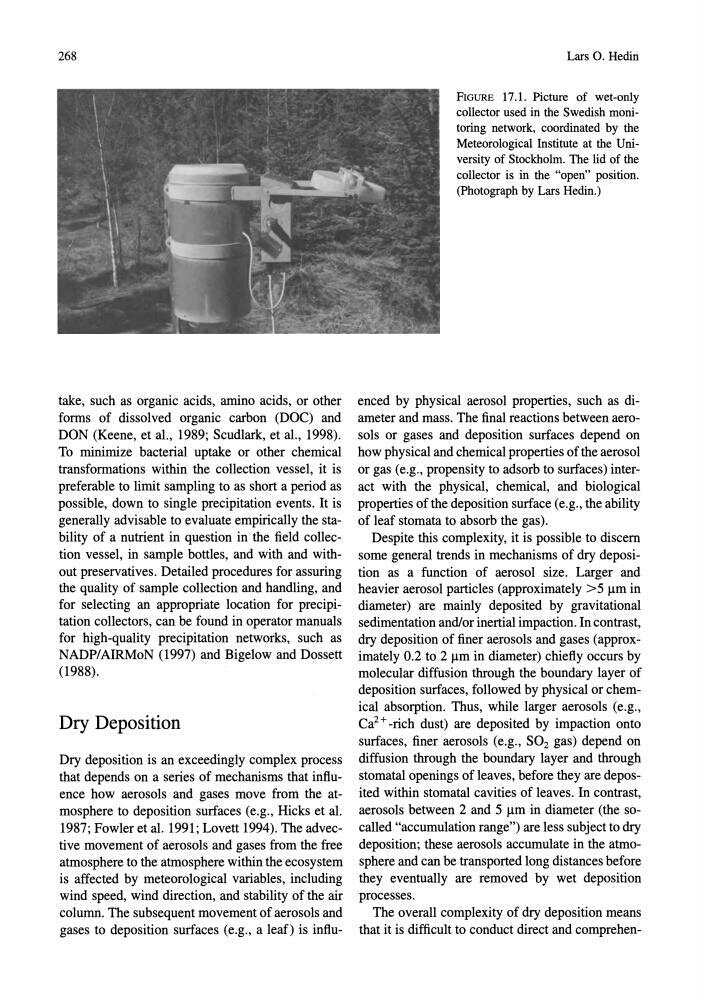
FIGURE 17.1. Picture of wet-only
collector used in the Swedish monitoring network, coordinated by the
Meteorological Institute at the University of Stockholm. The lid of the
collector is in the "open" position.
(Photograph by Lars Hedin.)
enced by physical aerosol properties, such as diameter and mass. The final reactions between aerosols or gases and deposition surfaces depend on
how physical and chemical properties of the aerosol
or gas (e.g., propensity to adsorb to surfaces) interact with the physical, chemical, and biological
properties of the deposition surface (e.g., the ability
of leaf stomata to absorb the gas).
Despite this complexity, it is possible to discern
some general trends in mechanisms of dry deposition as a function of aerosol size. Larger and
heavier aerosol particles (approximately >5 J.1m in
diameter) are mainly deposited by gravitational
sedimentation and/or inertial impaction. In contrast,
dry deposition of finer aerosols and gases (approximately 0.2 to 2 J.1m in diameter) chiefly occurs by
molecular diffusion through the boundary layer of
deposition surfaces, followed by physical or chemical absorption. Thus, while larger aerosols (e.g.,
Ca2+ -rich dust) are deposited by impaction onto
surfaces, finer aerosols (e.g., S02 gas) depend on
diffusion through the boundary layer and through
stomatal openings of leaves, before they are deposited within stomatal cavities of leaves. In contrast,
aerosols between 2 and 5 J.1m in diameter (the socalled "accumulation range") are less subject to dry
deposition; these aerosols accumulate in the atmosphere and can be transported long distances before
they eventually are removed by wet deposition
processes.
The overall complexity of dry deposition means
that it is difficult to conduct direct and comprehen-
take, such as organic acids, amino acids, or other
forms of dissolved organic carbon (DOC) and
DON (Keene, et aI., 1989; Scudlark, et aI., 1998).
To minimize bacterial uptake or other chemical
transformations within the collection vessel, it is
preferable to limit sampling to as short a period as
possible, down to single precipitation events. It is
generally advisable to evaluate empirically the stability of a nutrient in question in the field collection vessel, in sample bottles, and with and without preservatives. Detailed procedures for assuring
the quality of sample collection and handling, and
for selecting an appropriate location for precipitation collectors, can be found in operator manuals
for high-quality precipitation networks, such as
NADP/AIRMoN (1997) and Bigelow and Dossett
(1988).
Dry Deposition
Dry deposition is an exceedingly complex process
that depends on a series of mechanisms that influence how aerosols and gases move from the atmosphere to deposition surfaces (e.g., Hicks et al.
1987; Fowler et al. 1991; Lovett 1994). The advective movement of aerosols and gases from the free
atmosphere to the atmosphere within the ecosystem
is affected by meteorological variables, including
wind speed, wind direction, and stability of the air
column. The subsequent movement of aerosols and
gases to deposition surfaces (e.g., a leaf) is influLars O. Hedin
FIGURE 17.1. Picture of wet-only
collector used in the Swedish monitoring network, coordinated by the
Meteorological Institute at the University of Stockholm. The lid of the
collector is in the "open" position.
(Photograph by Lars Hedin.)
enced by physical aerosol properties, such as diameter and mass. The final reactions between aerosols or gases and deposition surfaces depend on
how physical and chemical properties of the aerosol
or gas (e.g., propensity to adsorb to surfaces) interact with the physical, chemical, and biological
properties of the deposition surface (e.g., the ability
of leaf stomata to absorb the gas).
Despite this complexity, it is possible to discern
some general trends in mechanisms of dry deposition as a function of aerosol size. Larger and
heavier aerosol particles (approximately >5 J.1m in
diameter) are mainly deposited by gravitational
sedimentation and/or inertial impaction. In contrast,
dry deposition of finer aerosols and gases (approximately 0.2 to 2 J.1m in diameter) chiefly occurs by
molecular diffusion through the boundary layer of
deposition surfaces, followed by physical or chemical absorption. Thus, while larger aerosols (e.g.,
Ca2+ -rich dust) are deposited by impaction onto
surfaces, finer aerosols (e.g., S02 gas) depend on
diffusion through the boundary layer and through
stomatal openings of leaves, before they are deposited within stomatal cavities of leaves. In contrast,
aerosols between 2 and 5 J.1m in diameter (the socalled "accumulation range") are less subject to dry
deposition; these aerosols accumulate in the atmosphere and can be transported long distances before
they eventually are removed by wet deposition
processes.
The overall complexity of dry deposition means
that it is difficult to conduct direct and comprehen-