

14. Nutrient Transformations
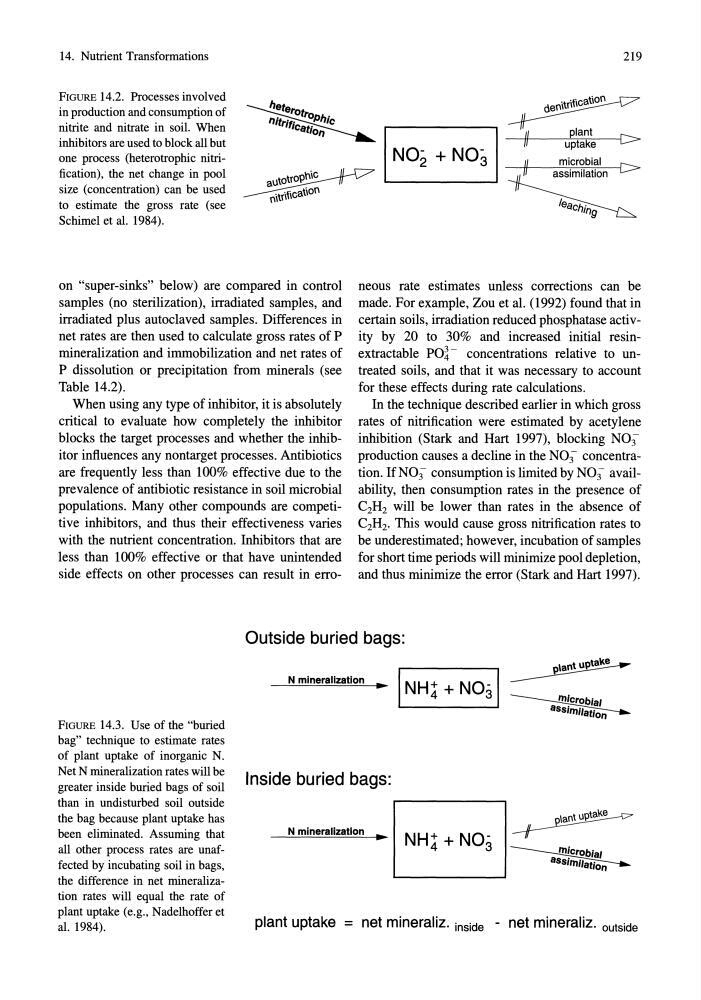
FIGURE 14.2. Processes involved
in production and consumption of
nitrite and nitrate in soil. When
inhibitors are used to block all but
one process (heterotrophic nitrification), the net change in pool
size (concentration) can be used
to estimate the gross rate (see
Schlmel et al. 1984).
on "super-sinks" below) are compared in control
samples (no sterilization), irradiated samples, and
irradiated plus autoclaved samples. Differences in
net rates are then used to calculate gross rates of P
mineralization and immobilization and net rates of
P dissolution or precipitation from minerals (see
Table 14.2).
When using any type of inhibitor, it is absolutely
critical to evaluate how completely the inhibitor
blocks the target processes and whether the inhibitor influences any nontarget processes. Antibiotics
are frequently less than 100% effective due to the
prevalence of antibiotic resistance in soil microbial
populations. Many other compounds are competitive inhibitors, and thus their effectiveness varies
with the nutrient concentration. Inhibitors that are
less than 100% effective or that have unintended
side effects on other processes can result in erro219
~ /I plant r----/I
uptake
~
/I
microbial
r----~
/I
assimilation ~
leaCh'
Ing
neous rate estimates unless corrections can be
made. For example, Zou et al. (1992) found that in
certain soils, irradiation reduced phosphatase activity by 20 to 30% and increased initial resinextractable PO~ - concentrations relative to untreated soils, and that it was necessary to account
for these effects during rate calculations.
In the technique described earlier in which gross
rates of nitrification were estimated by acetylene
inhibition (Stark and Hart 1997), blocking NO;
production causes a decline in the NO; concentration. If NO; consumption is limited by NO; availability, then consumption rates in the presence of
C2H2 will be lower than rates in the absence of
C2H2• This would cause gross nitrification rates to
be underestimated; however, incubation of samples
for short time periods will minimize pool depletion,
and thus minimize the error (Stark and Hart 1997).
Outside buried bags:
FIGURE 14.3. Use of the "buried
bag" technique to estimate rates
of plant uptake of inorganic N.
Net N mineralization rates will be
greater inside buried bags of soil
than in undisturbed soil outside
the bag because plant uptake has
been eliminated. Assuming that
all other process rates are unaffected by incubating soil in bags,
the difference in net mineralization rates will equal the rate of
plant uptake (e.g., Nadelhoffer et
al. 1984).
N mineralization ..
Inside buried bags:
N mineralization.
~
I NH 4 + N03 1
.
. ~roblal
ass;~
NH+ + NO4
3
~
~roblal
ass;~
plant uptake = net mineraliz. inside - net mineraliz. outside
FIGURE 14.2. Processes involved
in production and consumption of
nitrite and nitrate in soil. When
inhibitors are used to block all but
one process (heterotrophic nitrification), the net change in pool
size (concentration) can be used
to estimate the gross rate (see
Schlmel et al. 1984).
on "super-sinks" below) are compared in control
samples (no sterilization), irradiated samples, and
irradiated plus autoclaved samples. Differences in
net rates are then used to calculate gross rates of P
mineralization and immobilization and net rates of
P dissolution or precipitation from minerals (see
Table 14.2).
When using any type of inhibitor, it is absolutely
critical to evaluate how completely the inhibitor
blocks the target processes and whether the inhibitor influences any nontarget processes. Antibiotics
are frequently less than 100% effective due to the
prevalence of antibiotic resistance in soil microbial
populations. Many other compounds are competitive inhibitors, and thus their effectiveness varies
with the nutrient concentration. Inhibitors that are
less than 100% effective or that have unintended
side effects on other processes can result in erro219
~ /I plant r----/I
uptake
~
/I
microbial
r----~
/I
assimilation ~
leaCh'
Ing
neous rate estimates unless corrections can be
made. For example, Zou et al. (1992) found that in
certain soils, irradiation reduced phosphatase activity by 20 to 30% and increased initial resinextractable PO~ - concentrations relative to untreated soils, and that it was necessary to account
for these effects during rate calculations.
In the technique described earlier in which gross
rates of nitrification were estimated by acetylene
inhibition (Stark and Hart 1997), blocking NO;
production causes a decline in the NO; concentration. If NO; consumption is limited by NO; availability, then consumption rates in the presence of
C2H2 will be lower than rates in the absence of
C2H2• This would cause gross nitrification rates to
be underestimated; however, incubation of samples
for short time periods will minimize pool depletion,
and thus minimize the error (Stark and Hart 1997).
Outside buried bags:
FIGURE 14.3. Use of the "buried
bag" technique to estimate rates
of plant uptake of inorganic N.
Net N mineralization rates will be
greater inside buried bags of soil
than in undisturbed soil outside
the bag because plant uptake has
been eliminated. Assuming that
all other process rates are unaffected by incubating soil in bags,
the difference in net mineralization rates will equal the rate of
plant uptake (e.g., Nadelhoffer et
al. 1984).
N mineralization ..
Inside buried bags:
N mineralization.
~
I NH 4 + N03 1
.
. ~roblal
ass;~
NH+ + NO4
3
~
~roblal
ass;~
plant uptake = net mineraliz. inside - net mineraliz. outside