

11. Canopy Fluxes
roughness layer is that micrometeorological methods that rely on establishing eddy diffusivities are
difficult to apply in this layer. By going beyond
the roughness sub layer however, concentration
gradients can become small and difficult to measure over rough vegetation and this poses further
problems.
The top of the surface layer is not physically as
well defined as the top of ABL. Although most
tower-based flux measurements are made within
the SBL, the evolving structure of the ABL over a
day does present opportunities for other measurements using aircraft, tethersondes, and ABL budget
methods, which we shall mention in passing.
Net Ecosystem Exchange
Fluxes of carbon and water measured by micrometeorological methods above the canopy are the
net fluxes from the whole system and are measures
of the net ecosystem exchange of carbon (NEE) or
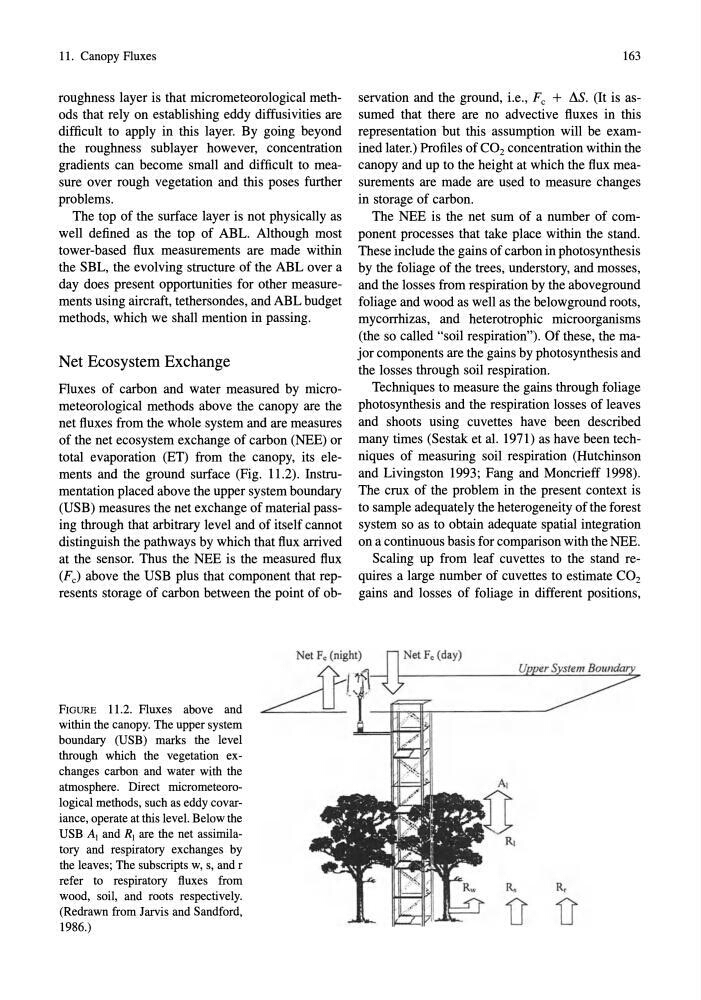
total evaporation (ET) from the canopy, its elements and the ground surface (Fig. 11.2). Instrumentation placed above the upper system boundary
(USB) measures the net exchange of material passing through that arbitrary level and of itself cannot
distinguish the pathways by which that flux arrived
at the sensor. Thus the NEE is the measured flux
(Fc) above the USB plus that component that represents storage of carbon between the point of ob163
servation and the ground, i.e., Fc + I1S. (It is assumed that there are no advective fluxes in this
representation but this assumption will be examined later.) Profiles of CO 2 concentration within the
canopy and up to the height at which the flux measurements are made are used to measure changes
in storage of carbon.
The NEE is the net sum of a number of component processes that take place within the stand.
These include the gains of carbon in photosynthesis
by the foliage of the trees, understory, and mosses,
and the losses from respiration by the aboveground
foliage and wood as well as the belowground roots,
mycorrhizas, and heterotrophic microorganisms
(the so called "soil respiration"). Of these, the major components are the gains by photosynthesis and
the losses through soil respiration.
Techniques to measure the gains through foliage
photosynthesis and the respiration losses of leaves
and shoots using cuvettes have been described
many times (Sestak et al. 1971) as have been techniques of measuring soil respiration (Hutchinson
and Livingston 1993; Fang and Moncrieff 1998).
The crux of the problem in the present context is
to sample adequately the heterogeneity of the forest
system so as to obtain adequate spatial integration
on a continuous basis for comparison with the NEE.
Scaling up from leaf cuvettes to the stand requires a large number of cuvettes to estimate CO 2
gains and losses of foliage in different positions,
Net Fe (night)
FIGURE 11.2. Fluxes above and
within the canopy. The upper system
boundary (USB) marks the level
through which the vegetation exchanges carbon and water with the
atmosphere. Direct micrometeorological methods, such as eddy covariance, operate at this level. Below the
USB Al and RI are the net assimilatory and respiratory exchanges by
the leaves; The subscripts w, s, and r
refer to respiratory fluxes from
wood, soil, and roots respectively.
(Redrawn from Jarvis and Sandford,
1986.)
A
R,
roughness layer is that micrometeorological methods that rely on establishing eddy diffusivities are
difficult to apply in this layer. By going beyond
the roughness sub layer however, concentration
gradients can become small and difficult to measure over rough vegetation and this poses further
problems.
The top of the surface layer is not physically as
well defined as the top of ABL. Although most
tower-based flux measurements are made within
the SBL, the evolving structure of the ABL over a
day does present opportunities for other measurements using aircraft, tethersondes, and ABL budget
methods, which we shall mention in passing.
Net Ecosystem Exchange
Fluxes of carbon and water measured by micrometeorological methods above the canopy are the
net fluxes from the whole system and are measures
of the net ecosystem exchange of carbon (NEE) or
total evaporation (ET) from the canopy, its elements and the ground surface (Fig. 11.2). Instrumentation placed above the upper system boundary
(USB) measures the net exchange of material passing through that arbitrary level and of itself cannot
distinguish the pathways by which that flux arrived
at the sensor. Thus the NEE is the measured flux
(Fc) above the USB plus that component that represents storage of carbon between the point of ob163
servation and the ground, i.e., Fc + I1S. (It is assumed that there are no advective fluxes in this
representation but this assumption will be examined later.) Profiles of CO 2 concentration within the
canopy and up to the height at which the flux measurements are made are used to measure changes
in storage of carbon.
The NEE is the net sum of a number of component processes that take place within the stand.
These include the gains of carbon in photosynthesis
by the foliage of the trees, understory, and mosses,
and the losses from respiration by the aboveground
foliage and wood as well as the belowground roots,
mycorrhizas, and heterotrophic microorganisms
(the so called "soil respiration"). Of these, the major components are the gains by photosynthesis and
the losses through soil respiration.
Techniques to measure the gains through foliage
photosynthesis and the respiration losses of leaves
and shoots using cuvettes have been described
many times (Sestak et al. 1971) as have been techniques of measuring soil respiration (Hutchinson
and Livingston 1993; Fang and Moncrieff 1998).
The crux of the problem in the present context is
to sample adequately the heterogeneity of the forest
system so as to obtain adequate spatial integration
on a continuous basis for comparison with the NEE.
Scaling up from leaf cuvettes to the stand requires a large number of cuvettes to estimate CO 2
gains and losses of foliage in different positions,
Net Fe (night)
FIGURE 11.2. Fluxes above and
within the canopy. The upper system
boundary (USB) marks the level
through which the vegetation exchanges carbon and water with the
atmosphere. Direct micrometeorological methods, such as eddy covariance, operate at this level. Below the
USB Al and RI are the net assimilatory and respiratory exchanges by
the leaves; The subscripts w, s, and r
refer to respiratory fluxes from
wood, soil, and roots respectively.
(Redrawn from Jarvis and Sandford,
1986.)
A
R,