

164
from leaves of different ages. Branches represent
an intermediate scale that can be more readily
scaled up to the stand if the sample is sufficient.
Recently, branches in bags (branch bags) have
been used as chambers within which photosynthesis can be measured continuously from spring
to fall to scale up the gains and losses of the
foliage on branches to stand scale in boreal forests (Rayment and Jarvis 1999). Similarly, open,
air-sealed soil chambers have been used to measure the soil CO 2 efflux from spring to fall (Rayment and Jarvis 1997). In both cases, the main
problem is not methodological but is a classical
sampling problem-how many replicates are required to give an estimate within appropriate confidence limits (Livingston and Hutchinson 1995)?
The data obtained with such techniques can be
used to compute detailed carbon budgets by summation of the component fluxes to yield estimates
of NEE that can be compared with the measurements of NEE obtained by eddy covariance and, if
the sample is adequate, used to validate the estimates of NEE by eddy covariance. Perhaps more
importantly, the component fluxes measured in this
way may explain how the NEE is made up and thus
enable predictions of the likely effects of global
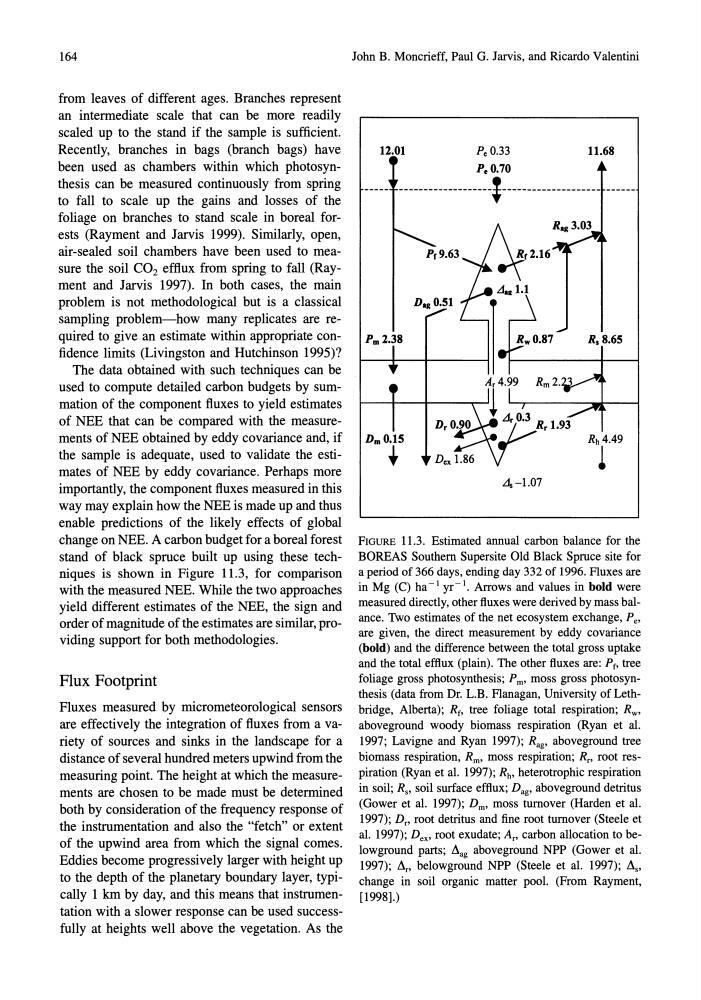
change on NEE. A carbon budget for a boreal forest
stand of black spruce built up using these techniques is shown in Figure 11.3, for comparison
with the measured NEE. While the two approaches
yield different estimates of the NEE, the sign and
order of magnitude of the estimates are similar, providing support for both methodologies.
Flux Footprint
Fluxes measured by micrometeorological sensors
are effectively the integration of fluxes from a variety of sources and sinks in the landscape for a
distance of several hundred meters upwind from the
measuring point. The height at which the measurements are chosen to be made must be determined
both by consideration of the frequency response of
the instrumentation and also the "fetch" or extent
of the upwind area from which the signal comes.
Eddies become progressively larger with height up
to the depth of the planetary boundary layer, typically 1 km by day, and this means that instrumentation with a slower response can be used successfully at heights well above the vegetation. As the
John B. Moncrieff, Paul G. Jarvis, and Ricardo Valentini
12.01
P.0.33
11.68
P.0.70
-------------------;-------------------- -----Pr9.63
D.,,0.51
Pm 2.38
R.8.65
Dm O.15
• LIs -1.07
FIGURE 11.3. Estimated annual carbon balance for the
BOREAS Southern Supersite Old Black Spruce site for
a period of 366 days, ending day 332 of 1996. Fluxes are
in Mg (C) ha- 1 yr-l. Arrows and values in bold were
measured directly, other fluxes were derived by mass balance. Two estimates of the net ecosystem exchange, Pe,
are given, the direct measurement by eddy covariance
(bold) and the difference between the total gross uptake
and the total efflux (plain). The other fluxes are: Pr, tree
foliage gross photosynthesis; Pm' moss gross photosynthesis (data from Dr. L.B. Flanagan, University of Lethbridge, Alberta); Rr, tree foliage total respiration; Rw,
aboveground woody biomass respiration (Ryan et al.
1997; Lavigne and Ryan 1997); Rag' aboveground tree
biomass respiration, Rm, moss respiration; R" root respiration (Ryan et al. 1997); Rh, heterotrophic respiration
in soil; R" soil surface efflux; Dag, aboveground detritus
(Gower et al. 1997); Dm, moss turnover (Harden et al.
1997); D" root detritus and fine root turnover (Steele et
al. 1997); Dex' root exudate; A" carbon allocation to below ground parts; L\ag aboveground NPP (Gower et al.
1997); L\r, belowground NPP (Steele et al. 1997); L\"
change in soil organic matter pool. (From Rayment,
[1998].)
from leaves of different ages. Branches represent
an intermediate scale that can be more readily
scaled up to the stand if the sample is sufficient.
Recently, branches in bags (branch bags) have
been used as chambers within which photosynthesis can be measured continuously from spring
to fall to scale up the gains and losses of the
foliage on branches to stand scale in boreal forests (Rayment and Jarvis 1999). Similarly, open,
air-sealed soil chambers have been used to measure the soil CO 2 efflux from spring to fall (Rayment and Jarvis 1997). In both cases, the main
problem is not methodological but is a classical
sampling problem-how many replicates are required to give an estimate within appropriate confidence limits (Livingston and Hutchinson 1995)?
The data obtained with such techniques can be
used to compute detailed carbon budgets by summation of the component fluxes to yield estimates
of NEE that can be compared with the measurements of NEE obtained by eddy covariance and, if
the sample is adequate, used to validate the estimates of NEE by eddy covariance. Perhaps more
importantly, the component fluxes measured in this
way may explain how the NEE is made up and thus
enable predictions of the likely effects of global
change on NEE. A carbon budget for a boreal forest
stand of black spruce built up using these techniques is shown in Figure 11.3, for comparison
with the measured NEE. While the two approaches
yield different estimates of the NEE, the sign and
order of magnitude of the estimates are similar, providing support for both methodologies.
Flux Footprint
Fluxes measured by micrometeorological sensors
are effectively the integration of fluxes from a variety of sources and sinks in the landscape for a
distance of several hundred meters upwind from the
measuring point. The height at which the measurements are chosen to be made must be determined
both by consideration of the frequency response of
the instrumentation and also the "fetch" or extent
of the upwind area from which the signal comes.
Eddies become progressively larger with height up
to the depth of the planetary boundary layer, typically 1 km by day, and this means that instrumentation with a slower response can be used successfully at heights well above the vegetation. As the
John B. Moncrieff, Paul G. Jarvis, and Ricardo Valentini
12.01
P.0.33
11.68
P.0.70
-------------------;-------------------- -----Pr9.63
D.,,0.51
Pm 2.38
R.8.65
Dm O.15
• LIs -1.07
FIGURE 11.3. Estimated annual carbon balance for the
BOREAS Southern Supersite Old Black Spruce site for
a period of 366 days, ending day 332 of 1996. Fluxes are
in Mg (C) ha- 1 yr-l. Arrows and values in bold were
measured directly, other fluxes were derived by mass balance. Two estimates of the net ecosystem exchange, Pe,
are given, the direct measurement by eddy covariance
(bold) and the difference between the total gross uptake
and the total efflux (plain). The other fluxes are: Pr, tree
foliage gross photosynthesis; Pm' moss gross photosynthesis (data from Dr. L.B. Flanagan, University of Lethbridge, Alberta); Rr, tree foliage total respiration; Rw,
aboveground woody biomass respiration (Ryan et al.
1997; Lavigne and Ryan 1997); Rag' aboveground tree
biomass respiration, Rm, moss respiration; R" root respiration (Ryan et al. 1997); Rh, heterotrophic respiration
in soil; R" soil surface efflux; Dag, aboveground detritus
(Gower et al. 1997); Dm, moss turnover (Harden et al.
1997); D" root detritus and fine root turnover (Steele et
al. 1997); Dex' root exudate; A" carbon allocation to below ground parts; L\ag aboveground NPP (Gower et al.
1997); L\r, belowground NPP (Steele et al. 1997); L\"
change in soil organic matter pool. (From Rayment,
[1998].)