

8. Stable Isotope Tracers and Mathematical Models in Soil Organic Matter Studies
129
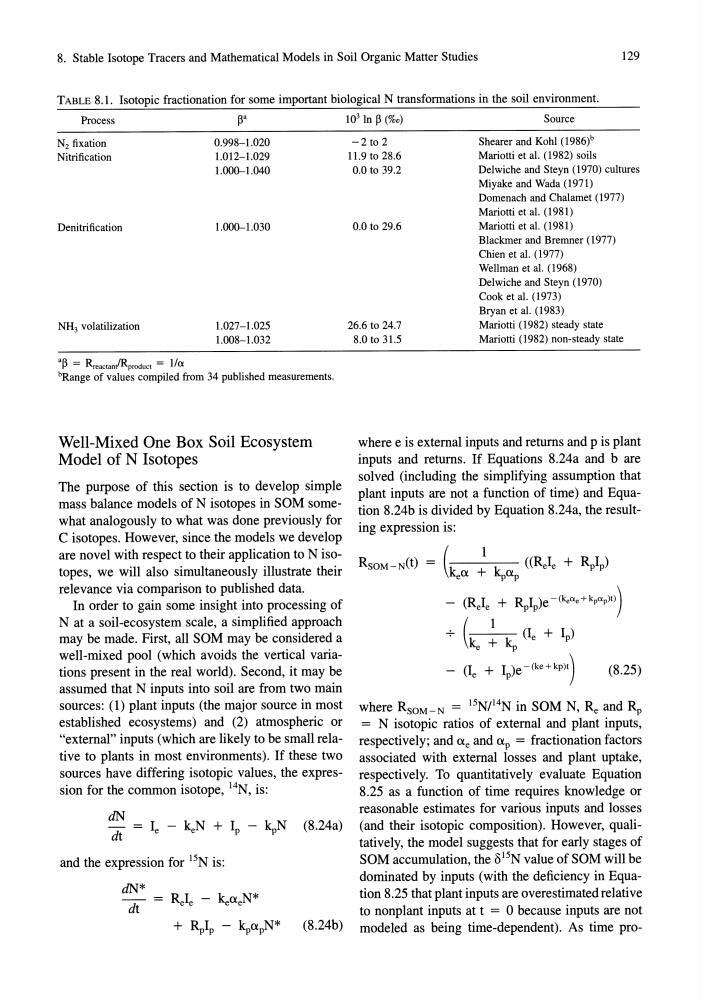
TABLE 8.1. Isotopic fractionation for some important biological N transformations in the soil environment.
Process
W
10 3 In ~ (%0)
Source
N2 fixation
Nitrification
Denitrification
NH3 volatilization
a~ = R...ctan,!Rproduct = 1/(1
0.998-l.020
l.012-l.029
l. 000-l.040
l.000--l.030
l.027-l.025
l.008-l.032
bRange of values compiled from 34 published measurements.
Well-Mixed One Box Soil Ecosystem
Model of N Isotopes
The purpose of this section is to develop simple
mass balance models of N isotopes in SOM somewhat analogously to what was done previously for
C isotopes. However, since the models we develop
are novel with respect to their application to N isotopes, we will also simultaneously illustrate their
relevance via comparison to published data.
In order to gain some insight into processing of
N at a soil-ecosystem scale, a simplified approach
may be made. First, all SOM may be considered a
well-mixed pool (which avoids the vertical variations present in the real world). Second, it may be
assumed that N inputs into soil are from two main
sources: (1) plant inputs (the major source in most
established ecosystems) and (2) atmospheric or
"external" inputs (which are likely to be small relative to plants in most environments). If these two
sources have differing isotopic values, the expression for the common isotope, 14N, is:
dN
- = I - 1r N + I - 1r l\T (8.24a)
dt
e
"e
p~'
and the expression for 15N is:
dN*
dt
(8.24b)
-2 to 2
1l.9 to 28.6
0.0 to 39.2
0.0 to 29.6
26.6 to 24.7
8.0 to 3l.5
Shearer and Kohl (1986)b
Mariotti et al. (1982) soils
Delwiche and Steyn (1970) cultures
Miyake and Wada (1971)
Domenach and Chalamet (1977)
Mariotti et al. (1981)
Mariotti et al. (1981)
Blackmer and Bremner (1977)
Chien et al. (1977)
Wellman et al. (1968)
Delwiche and Steyn (1970)
Cook et al. (1973)
Bryan et al. (1983)
Mariotti (1982) steady state
Mariotti (1982) non-steady state
where e is external inputs and returns and p is plant
inputs and returns. If Equations 8.24a and b are
solved (including the simplifying assumption that
plant inputs are not a function of time) and Equation 8.24b is divided by Equation 8.24a, the resulting expression is:
RSOM-N(t) = (keel : kpClp «Re~ + Rplp)
(Rele + ~Ip)e - (k"o:. + kp"'P)I) )
(ke ~ kp (Ie + Ip)
- (Ie + Ip)e-(ke+kp)l)
(8.25)
where R SOM - N = 15N/14N in SOM N, Re and ~
= N isotopic ratios of external and plant inputs,
respectively; and
respectively. To quantitatively evaluate Equation
8.25 as a function of time requires knowledge or
reasonable estimates for various inputs and losses
(and their isotopic composition). However, qualitatively, the model suggests that for early stages of
SOM accumulation, the 0 15 N value of SOM will be
dominated by inputs (with the deficiency in Equation 8.25 that plant inputs are overestimated relative
to nonplant inputs at t = 0 because inputs are not
modeled as being time-dependent). As time pro-
129
TABLE 8.1. Isotopic fractionation for some important biological N transformations in the soil environment.
Process
W
10 3 In ~ (%0)
Source
N2 fixation
Nitrification
Denitrification
NH3 volatilization
a~ = R...ctan,!Rproduct = 1/(1
0.998-l.020
l.012-l.029
l. 000-l.040
l.000--l.030
l.027-l.025
l.008-l.032
bRange of values compiled from 34 published measurements.
Well-Mixed One Box Soil Ecosystem
Model of N Isotopes
The purpose of this section is to develop simple
mass balance models of N isotopes in SOM somewhat analogously to what was done previously for
C isotopes. However, since the models we develop
are novel with respect to their application to N isotopes, we will also simultaneously illustrate their
relevance via comparison to published data.
In order to gain some insight into processing of
N at a soil-ecosystem scale, a simplified approach
may be made. First, all SOM may be considered a
well-mixed pool (which avoids the vertical variations present in the real world). Second, it may be
assumed that N inputs into soil are from two main
sources: (1) plant inputs (the major source in most
established ecosystems) and (2) atmospheric or
"external" inputs (which are likely to be small relative to plants in most environments). If these two
sources have differing isotopic values, the expression for the common isotope, 14N, is:
dN
- = I - 1r N + I - 1r l\T (8.24a)
dt
e
"e
p~'
and the expression for 15N is:
dN*
dt
(8.24b)
-2 to 2
1l.9 to 28.6
0.0 to 39.2
0.0 to 29.6
26.6 to 24.7
8.0 to 3l.5
Shearer and Kohl (1986)b
Mariotti et al. (1982) soils
Delwiche and Steyn (1970) cultures
Miyake and Wada (1971)
Domenach and Chalamet (1977)
Mariotti et al. (1981)
Mariotti et al. (1981)
Blackmer and Bremner (1977)
Chien et al. (1977)
Wellman et al. (1968)
Delwiche and Steyn (1970)
Cook et al. (1973)
Bryan et al. (1983)
Mariotti (1982) steady state
Mariotti (1982) non-steady state
where e is external inputs and returns and p is plant
inputs and returns. If Equations 8.24a and b are
solved (including the simplifying assumption that
plant inputs are not a function of time) and Equation 8.24b is divided by Equation 8.24a, the resulting expression is:
RSOM-N(t) = (keel : kpClp «Re~ + Rplp)
(Rele + ~Ip)e - (k"o:. + kp"'P)I) )
(ke ~ kp (Ie + Ip)
- (Ie + Ip)e-(ke+kp)l)
(8.25)
where R SOM - N = 15N/14N in SOM N, Re and ~
= N isotopic ratios of external and plant inputs,
respectively; and
respectively. To quantitatively evaluate Equation
8.25 as a function of time requires knowledge or
reasonable estimates for various inputs and losses
(and their isotopic composition). However, qualitatively, the model suggests that for early stages of
SOM accumulation, the 0 15 N value of SOM will be
dominated by inputs (with the deficiency in Equation 8.25 that plant inputs are overestimated relative
to nonplant inputs at t = 0 because inputs are not
modeled as being time-dependent). As time pro-