

128
dC*
dt
n
L (RI - kaC*)i (8.23)
i= 1
The only difference between Equations 8.22 and
8.23 is that the isotopic ratio of each input in Equation 8.23 is different (whereas they are the same in
Equation 8.22). In Equation 8.23, I may also represent transfers from other pools, which is likely to
be a very important part of SOM cycling that is
included in some of the most complex SOM models
(e.g., Elzein and Balesdent 1995).
The multiple pool approach for modeling stable
C isotopes in SOM is difficult (Townsend et al.
1995), but various forms of this approach serve as
the basis for the understanding of the 14C content
of SOM (Trumbore 1993; Elzein and Balesdent
1995) and the o!3C value of SOM (Arrouays et al.
1995).
Stable Nitrogen Isotopes
in Organic Matter
In terms of SOM dynamics and processes, observed
patterns of stable N isotopic ratios in SOM have
thus far proven frustrating because they have
eluded quantitative interpretive models. In general,
the relevant soil processes controlling N isotopes
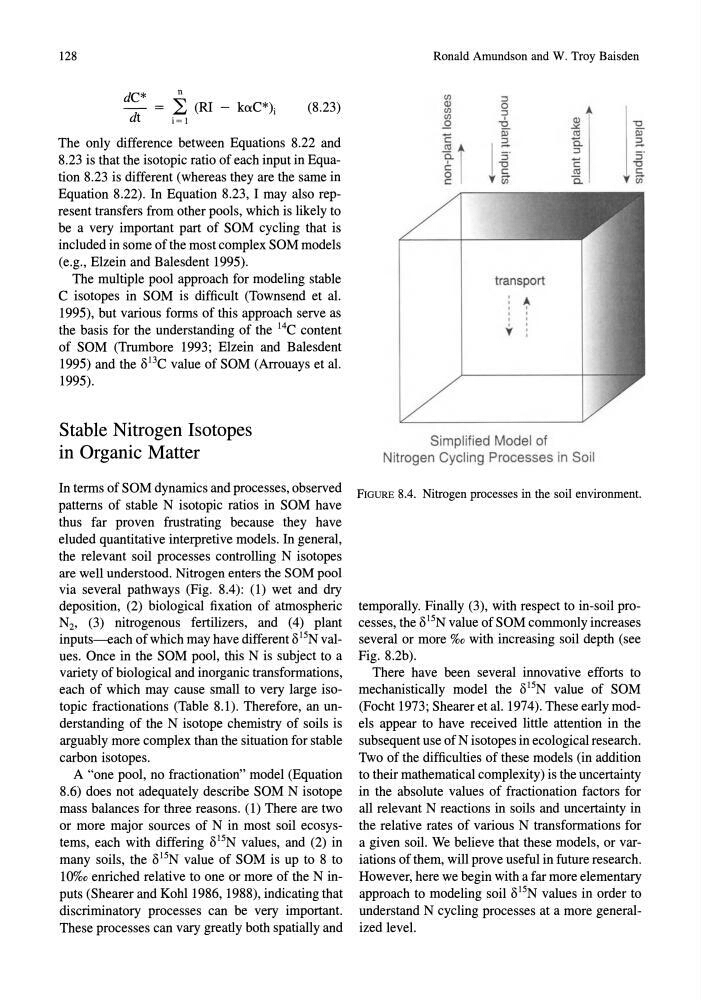
are well understood. Nitrogen enters the SOM pool
via several pathways (Fig. 8.4): (1) wet and dry
deposition, (2) biological fixation of atmospheric
N 2 , (3) nitrogenous fertilizers, and (4) plant
inputs--each of which may have different 0 15 N values. Once in the SOM pool, this N is subject to a
variety of biological and inorganic transformations,
each of which may cause small to very large isotopic fractionations (Table 8.1). Therefore, an understanding of the N isotope chemistry of soils is
arguably more complex than the situation for stable
carbon isotopes.
A "one pool, no fractionation" model (Equation
8.6) does not adequately describe SOM N isotope
mass balances for three reasons. (1) There are two
or more major sources of N in most soil ecosystems, each with differing Ol5N values, and (2) in
many soils, the 0 15 N value of SOM is up to 8 to
10%0 enriched relative to one or more of the N inputs (Shearer and Kohl 1986, 1988), indicating that
discriminatory processes can be very important.
These processes can vary greatly both spatially and
Ronald Amundson and W. Troy Baisden
CI)
Q)
CI)
CI)
..Q
C (I)
0..
C
o c:
transport
~
,
y
Simplified Model of
Nitrogen Cycling Processes in Soil
FIGURE 8.4. Nitrogen processes in the soil environment.
temporally. Finally (3), with respect to in-soil processes, the 015N value of SOM commonly increases
several or more %0 with increasing soil depth (see
Fig. 8.2b).
There have been several innovative efforts to
mechanistically model the 015N value of SOM
(Focht 1973; Shearer et al. 1974). These early models appear to have received little attention in the
subsequent use of N isotopes in ecological research.
Two of the difficulties of these models (in addition
to their mathematical complexity) is the uncertainty
in the absolute values of fractionation factors for
all relevant N reactions in soils and uncertainty in
the relative rates of various N transformations for
a given soil. We believe that these models, or variations of them, will prove useful in future research.
However, here we begin with a far more elementary
approach to modeling soil 0 15 N values in order to
understand N cycling processes at a more generalized level.
dC*
dt
n
L (RI - kaC*)i (8.23)
i= 1
The only difference between Equations 8.22 and
8.23 is that the isotopic ratio of each input in Equation 8.23 is different (whereas they are the same in
Equation 8.22). In Equation 8.23, I may also represent transfers from other pools, which is likely to
be a very important part of SOM cycling that is
included in some of the most complex SOM models
(e.g., Elzein and Balesdent 1995).
The multiple pool approach for modeling stable
C isotopes in SOM is difficult (Townsend et al.
1995), but various forms of this approach serve as
the basis for the understanding of the 14C content
of SOM (Trumbore 1993; Elzein and Balesdent
1995) and the o!3C value of SOM (Arrouays et al.
1995).
Stable Nitrogen Isotopes
in Organic Matter
In terms of SOM dynamics and processes, observed
patterns of stable N isotopic ratios in SOM have
thus far proven frustrating because they have
eluded quantitative interpretive models. In general,
the relevant soil processes controlling N isotopes
are well understood. Nitrogen enters the SOM pool
via several pathways (Fig. 8.4): (1) wet and dry
deposition, (2) biological fixation of atmospheric
N 2 , (3) nitrogenous fertilizers, and (4) plant
inputs--each of which may have different 0 15 N values. Once in the SOM pool, this N is subject to a
variety of biological and inorganic transformations,
each of which may cause small to very large isotopic fractionations (Table 8.1). Therefore, an understanding of the N isotope chemistry of soils is
arguably more complex than the situation for stable
carbon isotopes.
A "one pool, no fractionation" model (Equation
8.6) does not adequately describe SOM N isotope
mass balances for three reasons. (1) There are two
or more major sources of N in most soil ecosystems, each with differing Ol5N values, and (2) in
many soils, the 0 15 N value of SOM is up to 8 to
10%0 enriched relative to one or more of the N inputs (Shearer and Kohl 1986, 1988), indicating that
discriminatory processes can be very important.
These processes can vary greatly both spatially and
Ronald Amundson and W. Troy Baisden
CI)
Q)
CI)
CI)
..Q
C (I)
0..
C
o c:
transport
~
,
y
Simplified Model of
Nitrogen Cycling Processes in Soil
FIGURE 8.4. Nitrogen processes in the soil environment.
temporally. Finally (3), with respect to in-soil processes, the 015N value of SOM commonly increases
several or more %0 with increasing soil depth (see
Fig. 8.2b).
There have been several innovative efforts to
mechanistically model the 015N value of SOM
(Focht 1973; Shearer et al. 1974). These early models appear to have received little attention in the
subsequent use of N isotopes in ecological research.
Two of the difficulties of these models (in addition
to their mathematical complexity) is the uncertainty
in the absolute values of fractionation factors for
all relevant N reactions in soils and uncertainty in
the relative rates of various N transformations for
a given soil. We believe that these models, or variations of them, will prove useful in future research.
However, here we begin with a far more elementary
approach to modeling soil 0 15 N values in order to
understand N cycling processes at a more generalized level.